
I Want to Start a Baby Products Brand: Which Decision Comes First?
The first decision for anyone who wants to start a baby products brand is not the product; it is the buyer. In this category the user and the buyer are not the same person: the baby uses it, the mother decides, and often a pharmacist or shop assistant gives the final nod. Until your brand knows which of the three it will win over first, it can choose neither product nor channel.
The second decision is to start with a single product group: care products, baby textiles or accessories. The third is to document trust; baby cosmetics need a TİTCK (Turkish Medicines and Medical Devices Agency) product notification, while textiles and accessories fall under the Ministry of Trade’s product safety rules. The fourth is the channel: pharmacy, baby store or your own website. This article takes the four decisions in order; seventeen supporting articles open each one up.
Look, I approach this as a brand consultant, not a manufacturer. A manufacturer tells you what to make; I ask who you will sell it to. The sector comparison lives in the baby brand sector guide; here we are on the decision side.
Why is a baby brand a different business from any other brand?
BU BÖLÜMÜN ÖZETİ
- Trust sits in front of the product
- Doubt is damage you cannot undo
- The person who recommends is the channel
Because in this category you sell trust in the product, not the product. A mother does not buy a shampoo for its scent; she buys it because she believes it will not sting her baby’s eyes. So packaging, paperwork and the person recommending it come before the product itself. Elsewhere price and looks win; here a single doubt can finish the brand.
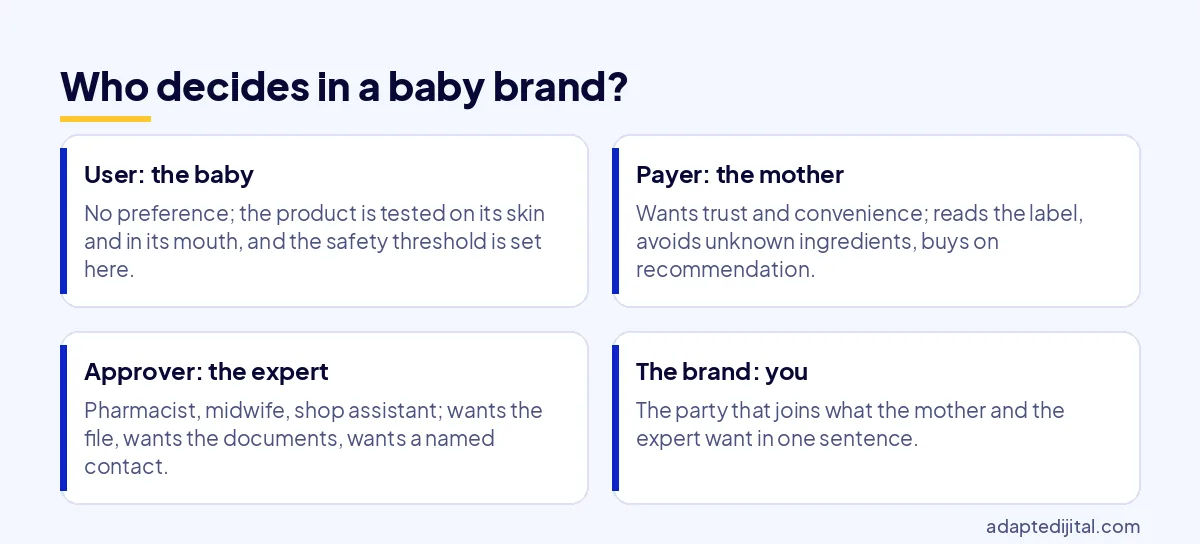
Trust sits in front of the product
Picture two nappy rash creams side by side on a shelf. One is cheaper and smells nicer; the other is the one the pharmacist points to. The mother takes the second, without asking the price. The winner here is not the formula but the chain of trust.
Doubt is damage you cannot undo
In cosmetics a bad review lowers sales; in baby products it closes the brand. One mother writing that her baby came out in a rash is enough. That is why product verification, not product development, sits at the centre.
The person who recommends is the channel
Pharmacist, midwife, paediatrician, the baby store assistant: these are your most expensive advertising space, and money cannot buy them. You show them the paperwork, not the product. Nobody puts their name to a brand without documentation.
What that documentation is, and how it turns into proof, is covered in the article on dermatologically tested and hypoallergenic.
Who buys, and who decides?
Three people determine a baby product: the baby who uses it, the mother who pays and the expert who approves. The brand targets the payer and the approver; the baby has no preference. The mother wants trust and convenience, the expert wants documentation and no trouble. Positioning clicks into place when it joins those two wishes in one sentence.
The persona in one sentence
Now write one sentence: this brand makes the product a pharmacist can recommend with an easy conscience to a mother raising her first baby and reading every label. Once written, the product choice narrows by itself. If you cannot write it yet, you are too early.
Why mothers move from big brands to small ones is told through a case in the article on why parents switch to small baby brands.
Which product group do you start with?
BU BÖLÜMÜN ÖZETİ
- Care products
- Baby textiles
- Accessories
- The single-hero rule
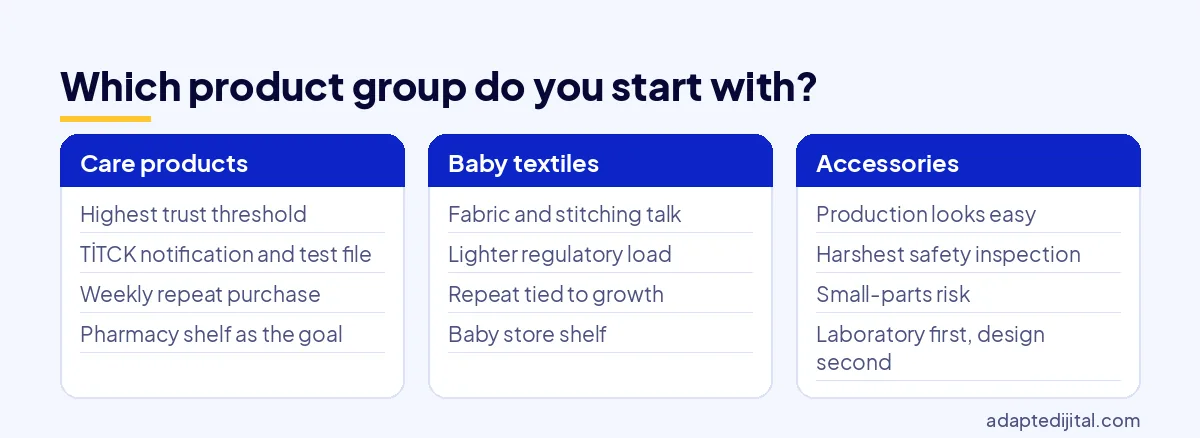
You start with one product group, chosen by the competence you already have. Care products carry the highest trust threshold and the highest repeat purchase; textiles a lighter regulatory load and lower repeat; accessories the easiest production and the highest safety risk. A brand that opens all three at once ends its first year half-finished in all three.
Care products
Shampoo, oil, nappy rash cream, wet wipes. The mother buys weekly, the product can reach the pharmacy shelf, and it needs a TİTCK notification and a test file. For a pharmacist or anyone close to cosmetics manufacturing, this is the natural start.
Baby textiles
Vests, bodysuits, blankets, sleeping bags. Fabric and stitching do the talking, the regulatory load is lighter, but repeat purchase depends on the baby growing. Textile people enter here; pattern consistency matters as much as in underwear.
Accessories
Dummies, bottles, teethers, toys. Production looks easy, yet this group faces the harshest safety inspection; small parts and choking risk are direct grounds for a recall. A brand starting here meets a laboratory before it meets a designer.
The single-hero rule
I did it too: like everyone who enters a business with five products, I left all five half-done in year one. Pick one, let the mother and the pharmacist learn it by heart, and let sales data choose the second.
Samples, contracts and quality control with a contract manufacturer are laid out in the article on choosing a contract manufacturer.
How is trust documented?
BU BÖLÜMÜN ÖZETİ
- Notification and registration
- Testing and analysis
- Market surveillance
Trust is built on three documents: the legal notification, independent testing and a traceable batch record. For baby cosmetics a product notification to TİTCK is mandatory, and dermatological and microbiological tests are the first thing a pharmacist asks for. For textiles and accessories the Ministry of Trade’s market surveillance applies; any product found unsafe is published openly on the GÜBİS system. No documents, no brand.
Notification and registration
A cosmetic product is notified to the Turkish Medicines and Medical Devices Agency before it goes on sale; TİTCK is the official source. The notification is the responsibility of whoever places the brand on the market, not the manufacturer. So even with contract manufacturing, the named contact is you.
Testing and analysis
Dermatological testing, microbiological analysis, stability testing: these are the proof behind every claim on the pack. The report’s date, laboratory and batch number sit in the file. Show that file to a pharmacist and the conversation changes.
Market surveillance
In the first six months of 2026 the Ministry of Trade inspected 4,704 companies and fined unsafe products 8.6 million lira; baby and children’s products were a priority area. We read that picture from a brand owner’s seat in the article on the unsafe product list.
Which channel do you enter through: pharmacy, baby store or your own site?
BU BÖLÜMÜN ÖZETİ
- Pharmacy
- Baby store
- Own site and marketplaces
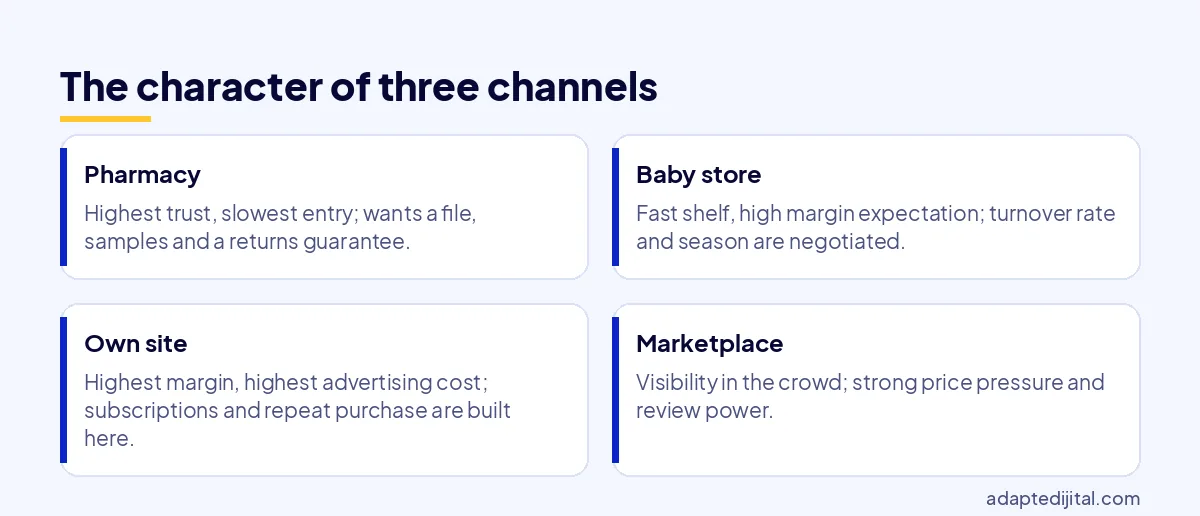
The channel follows the product group and the relationships you already hold. Care products grow through pharmacies, textiles through baby stores, both through your own website. The pharmacy brings the highest trust and the slowest entry; the baby store a fast shelf and thin margins; your own site the highest margin and the highest advertising cost. One main channel in year one, a second in year two.
Pharmacy
The pharmacist wants a file, samples and a returns guarantee. Getting in can take six months, but once you are in, the shelf is not given away. This is the goal for a brand starting with care products.
Baby store
Chain stores and independent baby shops decide quickly, expect a high margin and watch turnover. They are the natural shelf for textiles and accessories; season and sizes are negotiated there.
Own site and marketplaces
Your own site is needed for subscriptions and repeat purchase, marketplaces for being seen in the crowd. We settled this with a table in the comparison of pharmacy, baby store and own site.
The e-commerce side is a separate world on the e-commerce consulting page; here we only take the decision.
In what order is the budget spent?
BU BÖLÜMÜN ÖZETİ
- Documents and samples first
- Then product and packaging
- Promotion last
The budget goes first to documentation, then to product, and last to promotion. Most founders do the opposite: logo and packaging first, then product, documentation left to the end, and the launch slips by two months. In a baby brand the cost of documentation is part of the cost of the product; treating it as a separate expense breaks the budget.
Documents and samples first
Test reports, notification, a sample batch. Without these you cannot even get a pharmacist meeting. The budget is opened line by line in the cost of starting a baby care brand; not figures, but items and their order.
Then product and packaging
A small batch, a single product, plain packaging. In a baby product the pack carries information: child lock, period after opening, ingredient list. Beauty comes second.
Promotion last
A mother buys on recommendation, not because of an advert. The first promotion budget goes to pharmacist and store samples, not social media. Social media grows trust; it does not build it.
For those who want the set-up steps in order, there is the nine-step guide to a baby care brand.
Here is what I see: everyone asks about the manufacturer, nobody asks about the buyer
Everyone who writes to our contract-manufacturing request form about a baby product asks the same first question: who can make it, and at what price? Not one writes who they will sell it to. That observation alone explains why this set exists. Finding a manufacturer is a week’s work and finding a buyer is a year’s work, yet everyone asks about the week.
The sentences that come through the form
The words that appear most often are contract, sample and price. Brand, mother and pharmacy are almost absent. People want to own a product and are leaving brand ownership for later.
The system idea
Go into every meeting in reverse order: buyer first, then channel, then product, manufacturer last. The manufacturer is the easiest piece to find; leaving it until the end costs you nothing.
The three most common mistakes
BU BÖLÜMÜN ÖZETİ
- Natural does not mean safe
- Too many products, scattered stock
- Running to advertising too early
Three mistakes stop most baby brands in their first year: treating the word natural as a document, starting with too many products, and skipping the pharmacist to run straight to advertising. All three share one root: assuming trust is claimed rather than documented.
Natural does not mean safe
Printing natural on the pack replaces no document. The mother may not know that, but the pharmacist does. We corrected the misconceptions one by one in six things people get wrong about baby brands.
Too many products, scattered stock
A brand launching with six products manages six document sets, six packs and six stock lines. A brand launching with one picks its second a year later, with data.
Running to advertising too early
Advertising a product with incomplete documentation only accelerates doubt. Advertising makes sense once the pharmacist and the store have you on the shelf.
The one decision to take today
Today, write down only this: which product group, which buyer, which channel. Three words, three blanks. No manufacturer search, no logo, no packaging. Once the three blanks are filled, everything else falls into line; every step taken before that gets undone.
The articles that follow
Which consultancy to start with is ranked by stage in which consultancy a baby brand needs. The market size is set out with sourced figures in the baby care market in numbers.
If you want help
To fill the three blanks together, write through the consult your expert form. The scope is on the brand consultancy page; we stand beside the brand owner, not the manufacturer.
Frequently Asked Questions
Quick Summary
- The buyer is chosen first: the mother who pays and the expert who approves; the baby does not decide.
- Start with one product group: care, textiles or accessories, chosen by your existing competence.
- Trust is built on three documents: notification, independent testing, batch record; no documents, no brand.
- The channel follows the product group: care to the pharmacy, textiles to the baby store, both to your own site.
- The budget goes to documentation first, then product, and promotion last.
- Today’s one decision: which product, which buyer, which channel.
Short Glossary
- Baby products brand: a business that markets under its own name products the baby uses, the mother buys and the expert approves
- Placing on the market: the party that sells the product under its own brand and carries the legal responsibility; in contract manufacturing this is the brand owner, not the manufacturer
- GÜBİS: the Ministry of Trade’s Unsafe Product Information System, where products found unsafe are published openly
- Single hero product: the one product that carries the brand alone in its first year and that the mother and the expert learn by heart
Next Step
To fill the three blanks, the first step is the consult your expert form; the scope is on the brand consultancy page. To keep reading, next in line is which consultancy should be taken first.
Updated: October 2026
Sık Sorulan Sorular
The mother is awake at four in the morning, phone in hand, twelve brands in front of her. She does not know what she wants, but she knows what she does not want: unfamiliar ingredients, a cluttered label, a brand nobody can reach. She expects a plain answer: is this right for my baby, and why?
The pharmacist asks who stands behind the product. Has the notification been filed, is there a test report, and if something goes wrong, who is the named contact? For the expert your file matters, not your story. A brand with an incomplete file goes into the drawer, not onto the shelf.
Because the search results are held by contract manufacturers, who naturally steer you towards their own question. The manufacturer’s job is to produce; yours is to sell. The two interests do not meet in the same place.
No. Contract manufacturing can make products under your own brand; but responsibility for notification, labelling and safety sits with whoever places the brand on the market, not the manufacturer.
The single product group closest to your competence: pharmacists and people close to cosmetics with care products, textile people with vests and bodysuits, design-led founders with accessories plus laboratory support.
For cosmetics, a TİTCK notification plus dermatological and microbiological test reports; for textiles and accessories, the Ministry of Trade’s product safety rules. Check the official source and an expert for current terms.
Care products in the pharmacy, textiles in the baby store, both on your own site. One main channel in year one; the second opens on sales data.
Once the document file is complete and the product has sold on at least one shelf. Advertising a product with missing documentation grows the doubt.
Sets the buyer, channel and product order independently of the manufacturer; matches documentation and testing with the right experts; fixes the launch calendar and the promotion sequence.