
12-Point Checklist Before a Sock Launch: Is Your Sock Brand Ready to Go Live?
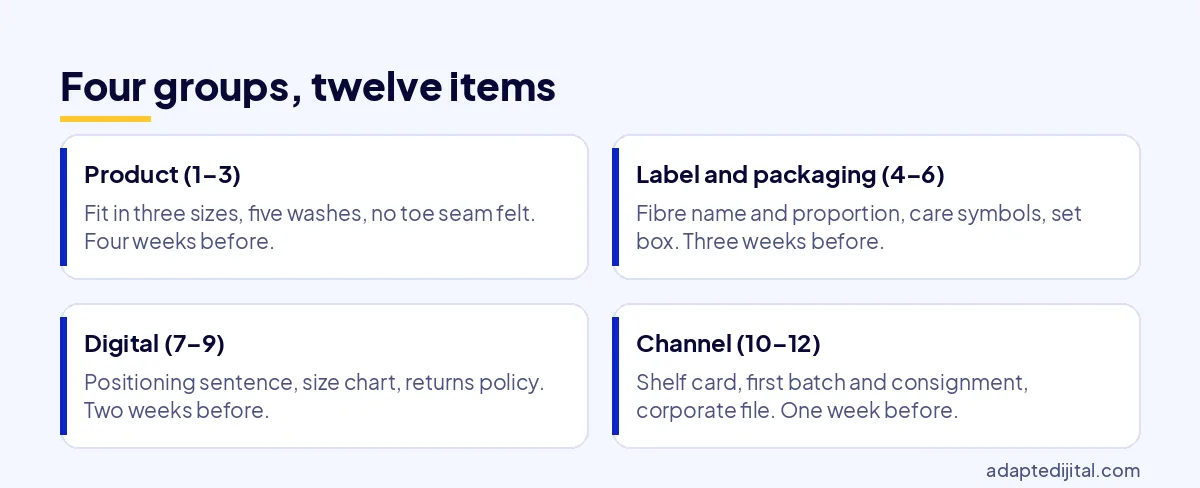
Before a sock brand launches, twelve items get ticked: three for product, three for label and packaging, three digital, three for channel. If even one is missing, the launch is postponed; the date changes, not the product. The list is written for a design sock brand; for basic and sports socks the channel items change, the order does not.
This guide gives every item in one line, says who ticks it and what happens if it is missing. In the middle is a four-week countdown; at the end, the printable list. Launch day is spent with a list, not with nerves.
Group 1: product (three items)
BU BÖLÜMÜN ÖZETİ
- Items 1–2
- Item 3
- Common mistake
The fit test is done on three feet, the wash test passed over five washes, the toe seam cannot be felt. A slipping ankle, a pinching cuff and a toe seam that digs in are invisible to the gift giver, but the wearer never buys again. All three are settled at the sample stage.
Items 1–2
The sample is worn for a day in three shoe sizes; the cuff leaves no mark, the heel stays put. The same sample is washed five times; no colour runs, no length is lost, the pattern holds. Ticked by: brand owner and factory quality control. If missing: no batch approval, new sample.
Item 3
The toe is closed by hand-linking or a seamless method; no thick ridge at the toe tip. In a design sock the toe seam justifies the price; a thick seam wears like a basic sock. Ticked by: brand owner. If missing: discuss the toe machine with the manufacturer; terms in yarn count, knit density and fibre content explained.
Common mistake
Doing the fit test on your own foot. One foot is one size; a sock sells across three sizes and must fit all three. Sample acceptance criteria are in how to choose a sock manufacturer.
Group 2: label and packaging (three items)
BU BÖLÜMÜN ÖZETİ
- Items 4–5
- The claim rule
- Item 6
The fibre label carries percentages and correct fibre names, care symbols and manufacturer details are on it, and the box or band carries the gift logic. The buyer’s hand touches these first; a label that contradicts the regulation gets printed twice, and a box that does not match the set makes a gift look like a single pair.
Items 4–5
The label shows fibre names and proportions; bamboo viscose is not written as bamboo, polyamide and elastane shares are visible, care symbols and manufacturer or importer details sit on the same label. Ticked by: brand owner and label designer. If missing: reprint. Framework in textile labelling rules and unsafe-product inspections.
The claim rule
Every claim on the label is tied to a document: organic means the yarn supplier’s certificate is on file, certified means the manufacturer’s document exists. A claim without a document comes off the label; small true print beats large indefensible print.
Item 6
The box, sleeve or band matches the set logic: a band for singles, a sleeve for three, a box for the gift. Inside the box is a card with the brand’s three words. Ticked by: brand owner. If missing: the product is ready, the gift is not; see how Adapte Dijital positions a sock brand.
Group 3: digital (three items)
BU BÖLÜMÜN ÖZETİ
- Item 7
- Item 8
- Item 9
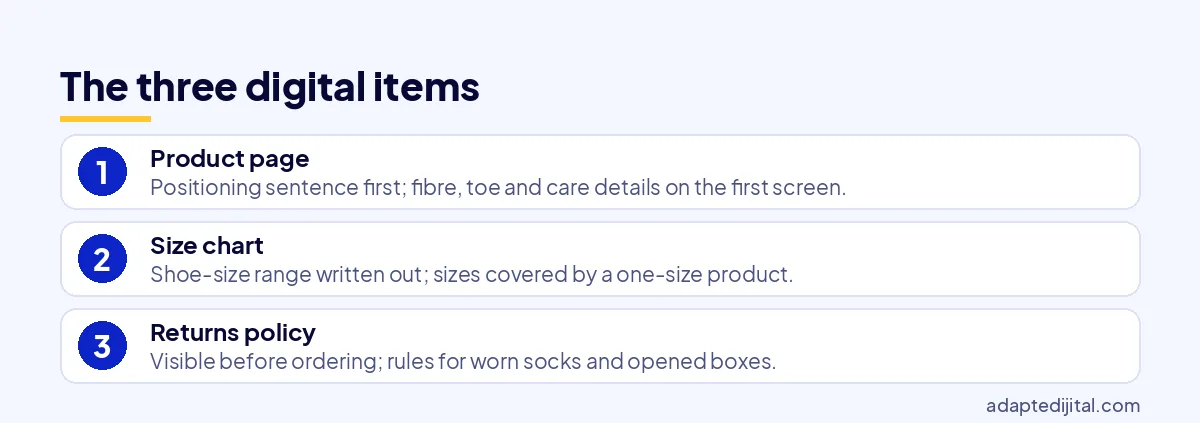
The product page shows fibre and toe details on the first screen, the size chart matches shoe sizes, the returns policy is visible before ordering. These three are what the buyer sees on their phone; a page without a size chart breeds returns, a page without fibre details cannot explain the price.
Item 7
The first sentence of the page is the positioning sentence; fibre, toe seam and care details are on the first screen. Ticked by: brand owner and site manager. If missing: the page does not go live. Building the site is the work of website consulting.
Item 8
The size chart is a shoe-size range; a one-size product states which sizes it covers. Ticked by: brand owner. If missing: size becomes the first reason for returns, and lands in the reviews.
Item 9
The returns and exchange policy is visible on the page and in the basket; the rules for worn socks and opened gift boxes are written down. Ticked by: brand owner. If missing: the first returns dispute becomes a review.
Group 4: channel (three items)
BU BÖLÜMÜN ÖZETİ
- Item 10
- Item 11
- Item 12
The shelf card and single recommendation sentence are ready, the first batch is sized to channel capacity with consignment terms in writing, and the corporate proposal fits on one page. A sock without a shelf card sits unsold, and a brand without a proposal file misses the year-end order.
Item 10
The shelf card carries three words, one sentence for the seller and the brand’s contact details; the concept store seller describes the product with that sentence. Ticked by: brand owner. If missing: the first shelf meeting slips. Channel selection is in own site, marketplace or store for a sock brand.
Item 11
The first batch stays within the three-month sales forecast; the promise to take back unsold stock is in the consignment agreement. Ticked by: brand owner. If missing: stock is locked up or the shelf never opens. Thresholds are in the cost of starting a sock brand.
Item 12
The corporate proposal file is ready: set options, personalisation limit, delivery time, minimum quantity, one page. The year-end gift buyer asks for it and does not wait. Ticked by: brand owner. If missing: the corporate channel slips a season.
Who ticks the list, and when? The four-week countdown
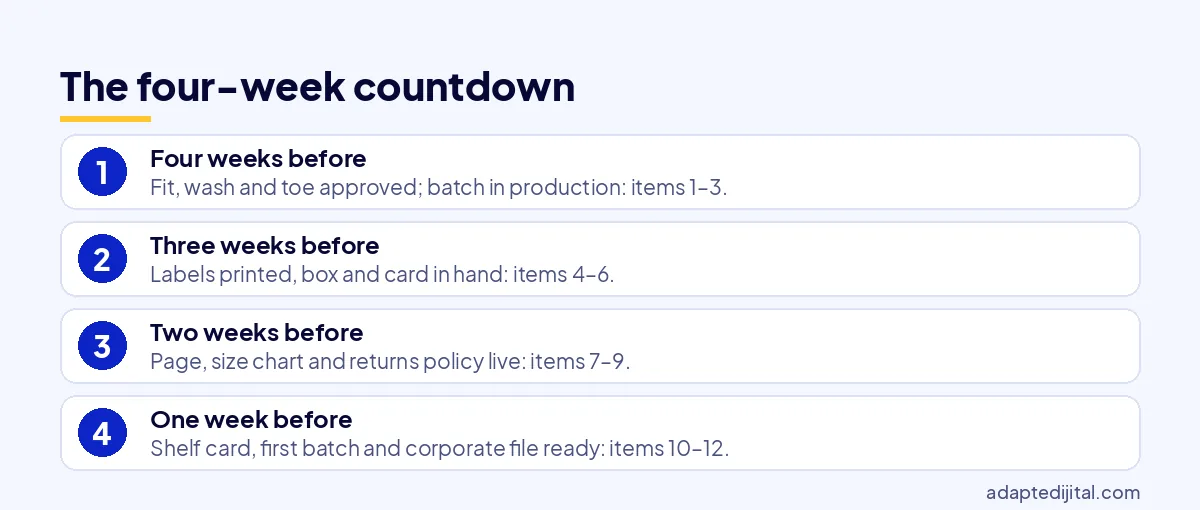
The brand owner ticks it and delegates it to no one; the manufacturer and the site manager keep their own lists, but the twelve items have one owner. Timing: product is finished four weeks before launch, label and packaging three weeks, digital two weeks, channel one week.
Countdown calendar
- Four weeks before: fit, wash and toe approved, batch in production (items 1–3)
- Three weeks before: labels printed, box and card in hand (items 4–6)
- Two weeks before: product page, size chart and returns policy live (items 7–9)
- One week before: shelf card, first batch and corporate proposal ready (items 10–12)
Common mistake
Trying to finish all four groups in the same week. Production and box printing take weeks, the page takes one; a launch that leaves everything to the final week slips a season. Which season to catch is in when should a sock brand launch.
The twelve items as a printable list
Print the list below and write next to each item who ticked it and when. No launch date is announced until all twelve ticks are in; the manufacturer and the store owner learn the date from you, and you learn it from the list.
The list
- Fit test done in three shoe sizes
- Wash test passed over five washes
- Toe seam cannot be felt
- Fibre label with correct names and proportions
- Care symbols and manufacturer details on the label
- Box, sleeve or band matches the set logic
- Positioning sentence, fibre and toe on the first screen
- Size chart matches shoe sizes
- Returns and exchange policy visible before ordering
- Shelf card and single recommendation sentence ready
- First batch within the three-month forecast, consignment in writing
- Corporate proposal file ready on one page
Frequently Asked Questions
Quick Summary
- Twelve items in four groups: product, label and packaging, digital, channel.
- One missing item postpones the launch; the date changes, not the product.
- Product done four weeks before, label three, digital two, channel one.
- Correct fibre names, box matching the set, shelf card with three words.
- The most expensive mistake is the earliest item: a batch cannot be undone.
- One owner: the brand owner.
Short Glossary
- Launch: the dated, planned moment a product first goes on sale
- Shelf card: the card beside the product on a concept store shelf carrying the seller’s recommendation sentence
- Consignment: stock left with a store on condition that unsold items are taken back
- Countdown: the calendar that sets each group’s finishing week counting back from launch
Next Step
To set the twelve items on your own calendar, write to us via the consult your expert form; scope is on the brand consultancy page. Next: starting a sock brand in Istanbul.
Updated: October 2026
Sık Sorulan Sorular
Because batch production cannot be undone. A label can be reprinted, a page rewritten; a batch with a thick toe seam either sells as it is or sits in the warehouse. The most expensive mistake sits in the earliest item.
Building the list and setting it on the calendar is brand consultancy work; the order is in I want to start a sock brand, your stage in which consulting for a sock brand. For labelling and inspections the Ministry of Trade is the official source; verify the current version. To set the list on your own calendar, consult your expert.
Fit in three shoe sizes, wash over five washes, toe seam check; all three are settled at the sample stage and ticked before batch approval.
The launch is postponed; the date changes, not the product. Depending on the item, the delay runs from a week to a season.
The brand owner; the manufacturer and the site manager keep their own lists, but the twelve items have one owner.