
How to Choose a Workshop for a Bag Brand: Three Candidates, Five Clauses, One Sample
Choosing a bag workshop means three candidates, twelve questions, one sample and a five-clause contract. Finding a workshop around Zeytinburnu is easy; picking the right one is not. No decision with fewer than three candidates, no signature unless the pattern belongs to the brand, no approval for a sample that fails the wear test.
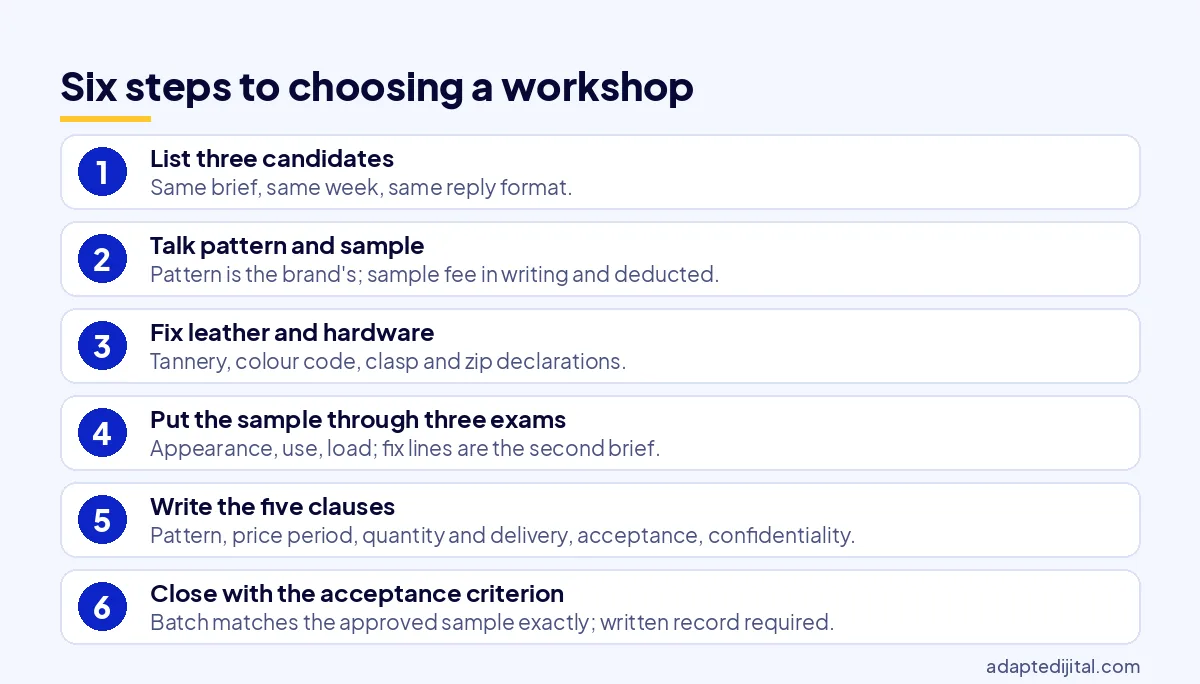
The steps run from workshop versus factory to the acceptance criterion. In the middle sits a twelve-question interview list: read it to three candidates and compare.
Workshop or factory, and why three candidates?
A bag workshop works per piece, accepts a few dozen units of one model and prices pattern and sample separately; a factory wants hundreds per model and puts a small brand at the back of the queue. For a first collection the counterpart is a workshop. Send the same one-page brief to three workshops in the same week; no sample until all three reply.
What the brief contains
Product group, a sketch or reference photo, leather type and colour, hardware, interior layout, a three-month quantity estimate. Learn the terms first in genuine, faux and vegan leather explained.
The most common mistake
Starting a sample with the fastest workshop to reply. A fast reply shows spare capacity, good or bad.
Who owns the pattern, and is the sample charged separately?
The pattern is the cutting template for the bag’s parts and is usually a separate line in the price; the sample is charged separately too, and most workshops deduct it from the first order. The pattern is not negotiable: the right to use pattern and model stays with the brand, and a copy is handed over. Threshold: no written pattern ownership, no sample.
Why pattern ownership is critical
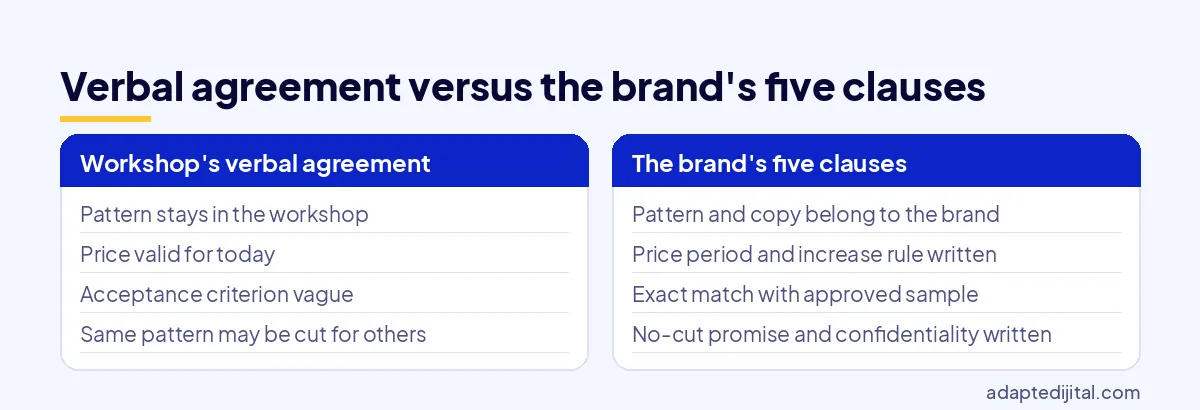
If the pattern stays in the workshop, your model stays there too, and may be cut for another brand. The same principle is in the guide to starting an underwear brand.
The sample fee
Skip the sample and the production price is an estimate that breaks in the first batch. Get the fee and deduction in writing; cost items are in the cost of starting a bag brand.
Who buys the leather, and where does the hardware come from?
BU BÖLÜMÜN ÖZETİ
- The leather decision
- The hardware decision
- The most common mistake
Either the workshop buys leather from its own tannery and folds it into the unit price, or the brand buys it from the Tuzla tannery cluster and delivers it. The first hides quality and price; the second keeps the decision with the brand. Hardware raises the same question: who chooses clasps and zips, who holds the declarations. Threshold: no production until tannery and colour code are on the order form.
The leather decision
Choose the first collection’s leather with the workshop at the tannery; later batches repeat its colour code. Leather Working Group audits tanneries; asking for a certified one is your right.
The hardware decision
Clasps and zips draw the most complaints. Buy from the supplier tested on the sample and ask for nickel and azo dye declarations; see labelling rules and inspections for bag brands.
The most common mistake
Watching only the unit price. The leather turns out to be split, the zip jams in the first month.
How are the sample and the wear test done?
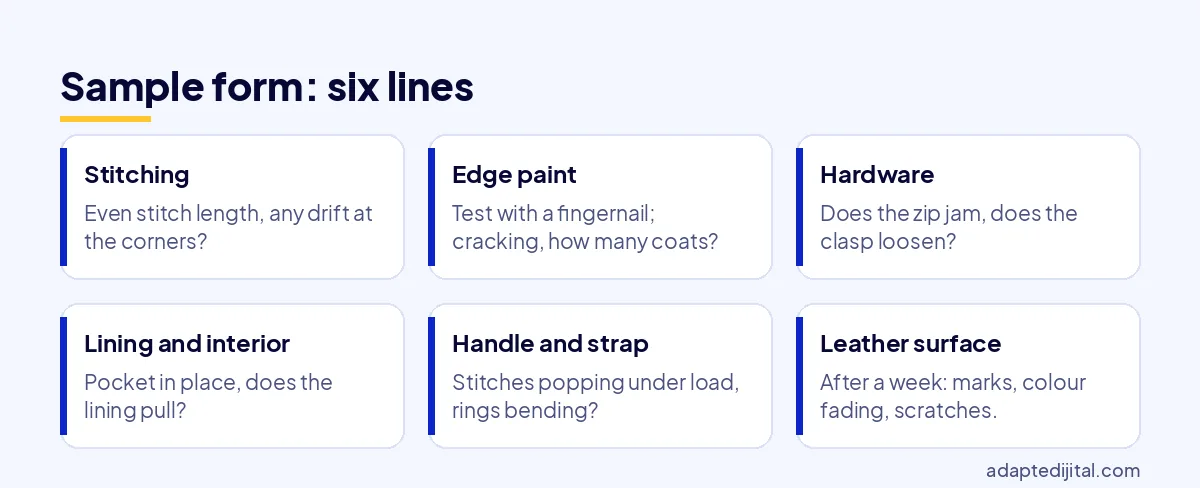
One sample round is enough, but that sample passes three exams: appearance, use and load. Have two people from your target customer profile carry it for a week with their everyday things, then compare stitching, edge paint, hardware and lining with their original state. Threshold: a cracked edge, a popped stitch or a jammed zip means no approval.
The evaluation form
Six lines: stitching, edge paint, hardware, lining, handle and strap, leather surface. Each gets pass, fail or fix; fix lines become the second brief.
The photo exam
Shoot the sample once on white; a stitch that drifts in the photo drifts in the shop window.
Which five clauses go in the contract?
Pattern ownership, price validity period, minimum quantity and delivery time, acceptance criterion and return terms, confidentiality with a promise not to cut the same model for anyone else. Five clauses protect the brand; the workshop’s verbal agreement protects the workshop. Threshold: one clause missing, nothing signed until it is added.
The five clauses
- Pattern and model rights belong to the brand; a copy is handed over
- Price holds for an agreed period; increases need written notice and approval
- Minimum quantity per model and colour; delivery in days
- A batch must match the approved sample, or it is returned or remade
- The pattern is not cut for another brand; files stay confidential
The twelve questions to ask in a workshop interview
Read the same list to three candidates in the same order and write the answers in one table. It covers pattern, leather, hardware, sample, quantity, contract and delivery; a candidate with no clear answer to two questions drops off. The interview takes an hour; the wrong workshop costs a season.
The twelve questions
- Who makes and owns the pattern; is a copy handed over?
- Sample lead time and fee; is it deducted?
- Who buys the leather, from which tannery?
- Who buys clasps and zips; are declarations available?
- How many coats of edge paint; what lining?
- Minimum quantity per model and colour?
- How long does the price hold?
- Will you not cut this pattern for others?
- Do you run a wear test?
- Who attaches label and dust bag?
- Delivery time, and what if it slips?
- Will you write the acceptance criterion?
How to read the answers
A clear number or document scores one; it depends scores zero. Fewest zeros wins. The full order is in the nine-step guide.
How are the acceptance criterion and the decision written?
The acceptance criterion is one sentence: the delivered batch matches the approved sample exactly in leather, stitching, edge, hardware and interior; a batch that does not match is held and inspected in full. A few units are picked at random from every batch, the six-line form is filled in, the batch number goes on record. A workshop cannot accept its own batch.
The decision table
| Criterion | Candidate A | Candidate B | Candidate C | Weight |
|---|---|---|---|---|
| Pattern ownership and confidentiality | Decisive | |||
| Leather and hardware with the brand | Decisive | |||
| Minimum quantity fits estimate | High | |||
| Sample passed three exams | High | |||
| Accepted five clauses | High | |||
| Price and validity | Medium |
Frequently Asked Questions
Quick Summary
- Three workshop candidates, same brief, same week.
- No written pattern ownership, no sample.
- Leather and hardware decisions stay with the brand.
- The sample passes appearance, use and load exams.
- Five clauses: pattern, price validity, quantity and delivery, acceptance, confidentiality.
- Twelve questions; fewest zeros comes out ahead.
Short Glossary
- Pattern: the cutting template for a bag’s parts; owned by the brand
- Deduction: the sample fee taken off the first order
- Price validity period: how long the unit price stays fixed
- Acceptance criterion: the written check of a batch against the approved sample
Next Step
To place your candidates in the decision table, use the consult your expert form; the scope is on the brand consultancy page. Next: own site, marketplace or boutique for a bag brand.
Updated: October 2026
Sık Sorulan Sorular
Trade fairs, tannery recommendations and the manufacturer line on labels of brands you admire; districts are in starting a bag brand in Istanbul.
The owner plus two target customers: for a laptop bag, someone who carries a laptop. The customer’s day is the measure.
Leather moves with exchange rates, so write the period and how an increase is notified. The danger is told in the pillar article on starting a bag brand.
Brand consultancy places the three candidates in this table and carries the five clauses into the contract. For your stage, see the hub article on which consulting a bag brand needs; before the interview, consult your expert.
At least three, with the same brief in the same week; one candidate gives no measure.
The brand. A copy is handed over and a no-cut promise goes in the contract.
Appearance on white, a week of real use by two target customers, then a check of stitching, edges, hardware and lining.