
How to Set Up a Kitchenware Brand in 9 Steps: From Sample to First Set
A kitchenware brand is built in nine steps: choose the product group, decide material and coating, find three manufacturers, test samples for heat, induction and dishwasher, get the declaration of compliance and migration test, prepare packaging and guide, build photos and product page, open the first channel, produce the first batch. Coating comes before manufacturer, documents before production. Because printing a logo is easy, most of the work happens at the desk, not the factory.
Each step gets its output and most common mistake; no prices, as costs vary. A summary table closes the piece.
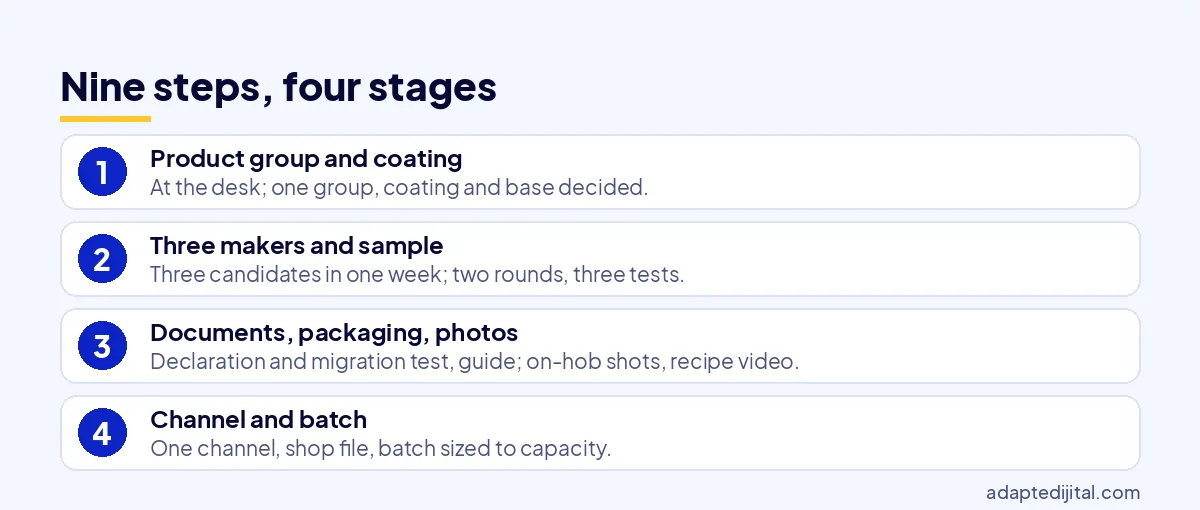
Steps 1–2: product group, material and coating
The first two steps happen at the desk. Choose one product group: pots and pans, knives and boards, storage, serveware or kitchen textiles. Material and coating follow from it. Skip these and manufacturer talks cover the wrong product, and the sample round runs twice.
1. Choose the product group
Output: a one-line product definition and a buyer card: user, payer, approver. Mistake: launching a pot set and a porcelain service together, which doubles manufacturers, documents and channels. See the I want to start a kitchenware brand pillar.
2. Choose material and coating
Output: coating, base, handle and lid on one page. Mistake: taking whatever coating the manufacturer has. Granite-effect, ceramic, stainless steel and cast iron suit different buyers and care; see what granite, ceramic, steel and cast iron mean in cookware.
Step 3: three manufacturer candidates
Once material is set, ask three manufacturers for samples in the same week. For pots and pans, look first at Kayseri and İstanbul’s İkitelli, Hadımköy and Esenyurt belt; for porcelain, Kütahya and Bilecik; for glass, the large producers. Starting with one candidate loses bargaining power and comparison from day one.
3. Compare three candidates in one table
Output: minimum order, mould type, coating supplier, declaration issuer and spare parts for each. Mistake: taking the first one found. See how to choose a manufacturer for kitchen products.
Ask about the coating supplier
Ask who supplies the coating and whether their declaration is shared; supplier changes must be notified by contract.
Step 4: sample and use testing
A sample is tested in a kitchen, not a showroom: two weeks of daily use, high and low heat, flatness on induction, repeated dishwasher cycles, handle heat and lid fit. The first sample is never approved; a second round is mandatory. Keep a written test note and share it with the manufacturer.
4. Put the sample through three tests
Output: a signed-off sample and a test note on heat, induction flatness and dishwasher wear. Mistake: approving a sample by weighing it in your hand.
Steps 5–6: declaration, migration test, packaging and guide
BU BÖLÜMÜN ÖZETİ
- 5. Get the declaration and migration test
- 6. Prepare packaging and use guide
- Breakage allowance
Step five is documents: the declaration of compliance and its migration test report, filed for the brand’s product. Step six is packaging and the use guide: a breakage-proof box, on-box information and a care card. Documents follow the approved sample, and packaging follows the documents, because box claims come from them.
5. Get the declaration and migration test
Output: a declaration for the brand’s product, an accredited migration test report, and a lead and cadmium report for ceramics. Mistake: accepting a report for another product. See our piece on food contact material rules and the Ministry of Agriculture and Forestry website.
6. Prepare packaging and use guide
Output: a shipping-tested box, a care guide, a warranty and spare-parts card. Mistake: skipping the guide, which prevents misuse complaints.
Breakage allowance
Porcelain, glass and ceramics break in transit. Approve the box on your own trial parcel, not the courier’s test.
Steps 7–8: photos, video, product page and first channel
Photos and video come before the first batch, because kitchenware sells on screen by its job: food on the hob, base close-up, handle and lid in hand. The product page carries material, coating, hob compatibility, care, warranty and spare parts. The first channel follows the product group, and only one opens.
7. Build photos, video and product page
Output: on-hob, close-up and in-hand shots, a short recipe video, a page with hob and care details. Mistake: using the catalogue shot. The recipe-led method is in how Adapte Dijital positions a kitchen brand; page setup falls under website consulting.
8. Open the first channel
Output: one channel, with a housewares or trousseau shop file or a marketplace store. Mistake: opening site, marketplace and shop on one day. See own site, marketplace or housewares shop.
Step 9: the first batch
BU BÖLÜMÜN ÖZETİ
- 9. Produce the first batch
- The second batch rule
- Timing
Size the first batch to channel capacity, not a sales forecast. Pots and pans are bulky; storage and shipping grow with quantity. Few products, deep stock: one hero pan and one or two complements. The second batch follows sell-through, and spare lids, knobs and handles are separate items from the start.
9. Produce the first batch
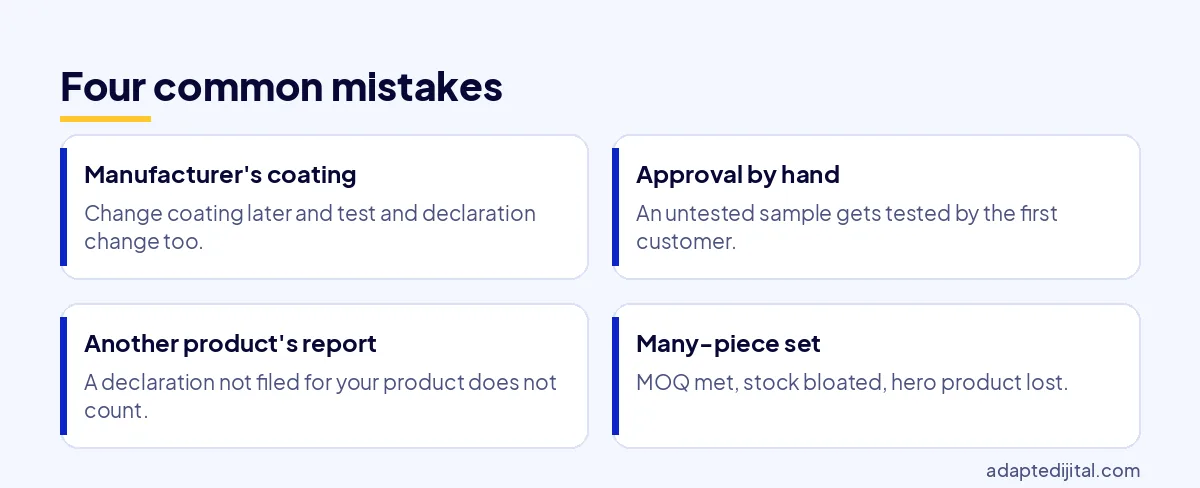
Output: a batch matching the approved sample, guide and warranty card boxed, batch number matched to the declaration, a quality note. Mistake: a many-piece set to hit the minimum order; its result is in the case on why kitchenware brands get lost on marketplaces.
The second batch rule
It grows with sell-through, not forecasts: fast sellers get bigger batches, slow ones stay put. Cost items and three thresholds are in the cost of starting a kitchenware brand.
Timing
Count back from trousseau and holiday seasons; see when a kitchen brand should launch.
The step-output-mistake table
The table shows the output of each of the nine steps and the most common mistake at a glance. No output means the step is not done; a mistake means it repeats. Print it, take it to manufacturer meetings and tick whether you hold each row’s output.
The table
| Step | Output | Common mistake |
|---|---|---|
| 1 Product group | One-line definition, buyer card | Two groups at once |
| 2 Material and coating | Coating, base, handle, lid | Manufacturer’s coating |
| 3 Three manufacturers | Table: MOQ, coating, declaration, parts | First one found |
| 4 Sample and test | Approved sample, test note | Approval by hand weight |
| 5 Declaration and test | Brand declaration, test report | Another product’s report |
| 6 Packaging and guide | Tested box, care and warranty card | Skipping the guide |
| 7 Photos and page | On-hob shots, recipe video | Catalogue shot |
| 8 First channel | One channel, shop file | Three channels in a day |
| 9 First batch | Capacity-sized batch, spare parts | Many-piece set for MOQ |
Document trail
The step-five documents are updated every batch; the European science is on the EFSA food contact materials page.
Nine steps on one page
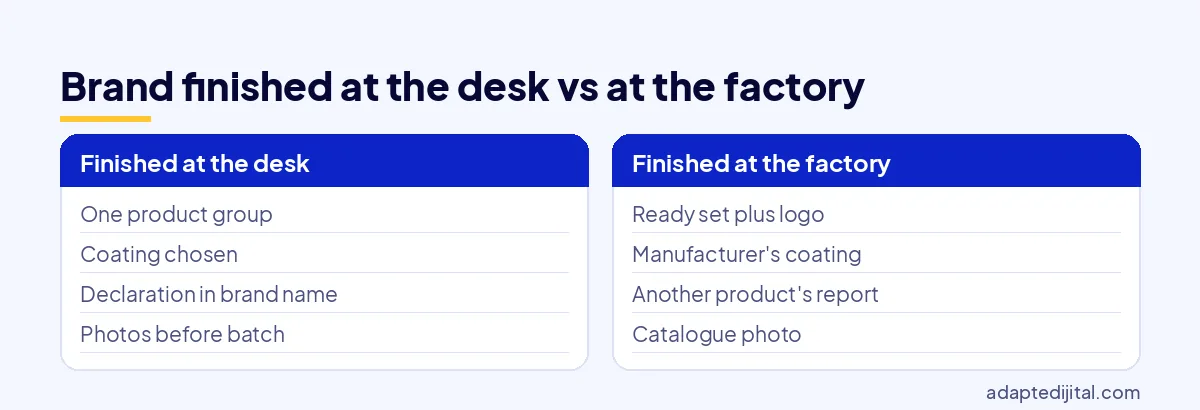
Five steps at the desk, two at the manufacturer, two in the channel: product group, coating, documents, packaging and photos at the desk; sample and batch at the manufacturer; channel and shop file outside. Because a logo is easy to print, the brand’s work finishes at the desk; one finished at the factory becomes one of twenty.
Do this today
Print the nine rows and mark what you hold; the first empty row is today’s job.
Next step
To fit the steps into your calendar, use the consult your expert form; the final check is the twelve-point pre-launch checklist for kitchen products.
Frequently Asked Questions
Quick Summary
- Nine steps from product group to first batch, in a fixed order.
- Coating comes before manufacturer, documents before production.
- Samples get two rounds of heat, induction and dishwasher testing.
- The declaration is filed for the brand’s product; another product’s report does not count.
- First batch sized to channel capacity; spare lids, knobs and handles as separate items.
Short Glossary
- Use test: testing a sample in daily kitchen use for heat, hob and washing
- Induction base: a magnetic base that lets a pot heat on an induction hob
- Minimum order: the lowest quantity a manufacturer accepts
- Sell-through: how quickly a product sells in a channel
Next Step
To fit the nine steps into your calendar, use the consult your expert form; scope is on the brand consultancy page. Next read: how Adapte Dijital positions a kitchen brand.
Updated: October 2026
Sık Sorulan Sorular
Coating determines the manufacturer, since ceramic and PTFE-based coatings often come from different plants. Change it later and everything after changes.
Private label is fast but shared; an own mould is slow but yours. The middle route: a ready body with your own handle, lid or base. See starting a kitchenware brand in İstanbul.
The brand, ideally via a chef or keen home cook. Lab testing is step five; neither replaces the other.
Round two proves the fix holds. Skip it and the second round happens in your first batch.
The brand owner; the manufacturer’s list is not yours. For order and timing, see brand consultancy; for your stage, the hub on which consultancy a kitchenware brand needs.
Nine, in a fixed order: product group, material and coating, manufacturers, sample test, declaration and migration test, packaging, photos and page, first channel, first batch.
In a kitchen, over two rounds: high and low heat, base flatness on induction, repeated dishwasher cycles, handle heat and lid fit, with a written note.
As big as the channel’s capacity: few products, deep stock. The second batch follows sell-through; spare parts are separate items from the start.