
How Adapte Dijital Positions a Kitchenware Brand: A Recipe-Led Method

Adapte Dijital positions a kitchenware brand in seven recipe-led steps: buyer card, positioning line, three words, set architecture, recipe content calendar, warranty and spare-parts promise, and channels tied to measurement. The method is independent of the manufacturer; we set not where the pot is made, but who buys it, with which recipe and through which channel. In the kitchen, position belongs to the food cooked with the product.
Below: each step, its output and what is specific to kitchenware, where the recipe is the product’s user manual. No sales pitch: this is how we work.
Why start with the buyer, not the product?
BU BÖLÜMÜN ÖZETİ
- Three people
- What is different in kitchenware
- Output
Because in kitchenware the product difference is big on the hob and small on screen. A thick base, cool handle and snug lid are obvious when cooking; on screen the same pot shares a frame with twenty brands. So the first task is a buyer card, not a product list; recipes and channels both come from the buyer.
Three people
The user cooks at home daily. The payer may be them, or for trousseau and wedding gifts a mother, relative or the couple. The approver is a food creator, chef, marketplace reviews or the housewares seller.
What is different in kitchenware
The trousseau set is a strong channel specific to Türkiye, where user and payer often differ. The card gives them separate rows.
Output
A one-page buyer card that feeds the next six steps and fills the first gap in the I want to start a kitchenware brand pillar.
How do you fill in the buyer card template?
BU BÖLÜMÜN ÖZETİ
- Template
- Filling rule
- Testing the card
The card has four rows and three columns: each column a person, each row a question. Who, at what moment, deciding on what, wanting to hear which line. The brand owner fills it in with us in a week; any empty cell returns later as a gap.
Template
| Question | User | Payer | Approver |
|---|---|---|---|
| Who? | Home cook; frequency, hob | Self, trousseau or gift buyer | Chef, creator, reviews, shop |
| When? | Old pan sticks, moving | Wedding, holidays, year end | Shooting a recipe, stocking |
| Decides on? | Base, handle, coating | Box, full set, warranty | Hob results, documents, margin |
| Wants to hear? | Nothing sticks, cool handle | Lasts years, parts exist | Easy in recipes, no returns |
Filling rule
One sentence per cell; if two fit, there are two buyers and the card splits. A pot set and a porcelain service need separate cards.
Testing the card
Read it to a shop owner and two buyers; rewrite unclear cells. A lost brand’s empty cells are in the case on why kitchenware brands get lost on marketplaces.
How do you choose the positioning line and three words?
BU BÖLÜMÜN ÖZETİ
- A failed line
- A working line
- The three-word rule
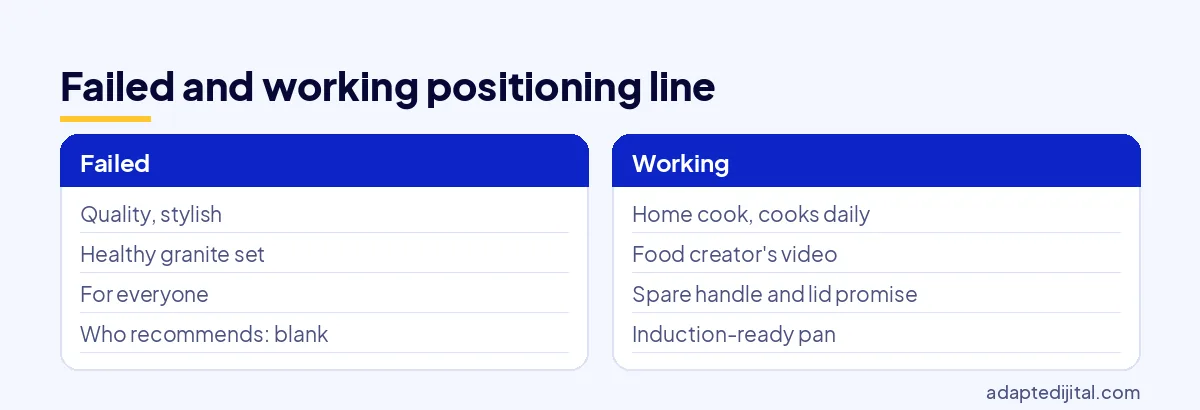
The positioning line has a fixed pattern: this brand makes for [user], that [approver] recommends easily and [payer] pays for with peace of mind. Three words come out of it and repeat in the same order on the product page, box card and recipe videos. Different words in three places look like three brands.
A failed line
Quality, stylish, healthy granite pot sets. Who for, who recommends, why this price: all blank.
A working line
An induction-ready hero pan for the home cook who wants a cool handle every day, easy for a food creator to use on video, paid for with a spare handle and lid promise. User, approver, payer: all filled.
The three-word rule
The words come from the card: cool handle, induction base, spare parts. Beside the price, they shift comparison to use value; see our piece on why buyers switch to a small kitchen brand.
Set architecture: hero pan, complements, trousseau set
A set has three layers: one hero product, two complements and a trousseau set. The hero carries the recipe and story, complements are size or function variants of the same family, and the trousseau set is those pieces in a gift box. Without this, a brand builds a many-piece box where no piece becomes the hero.
Three layers
The hero pan lives on the own site and in recipe videos, complements as options on its page, the trousseau set in trousseau shops. Few pieces, more depth.
The many-piece myth
A many-piece set looks rich in the box and waits in the cupboard; buyers praise two pieces and pay for the rest. See six things people get wrong about kitchen brands.
How do you build a recipe content ecosystem?
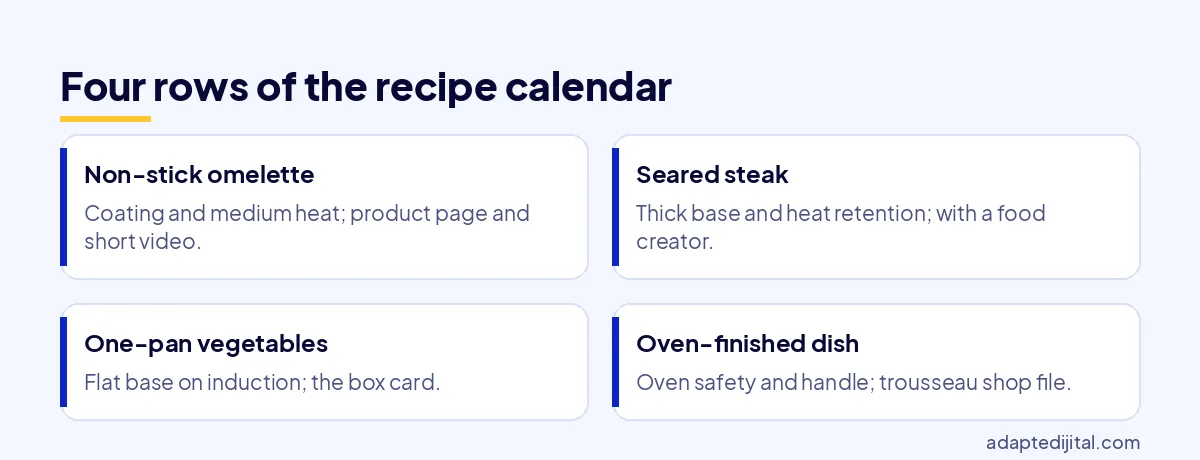
A recipe is a kitchen product’s best user manual. For each hero product we open recipe pages: the recipe, why the product matters at which step, and a product link. The same recipe repeats as a short video, on the product page and on the box card, so people searching for the dish reach the brand too.
Recipe content calendar template
| Week | Recipe | Product’s job | Channel |
|---|---|---|---|
| 1 | Non-stick omelette | Coating, medium heat | Product page, short video |
| 2 | Seared steak | Thick base, heat retention | Recipe page, food creator |
| 3 | One-pan vegetables | Flat base on induction | Short video, box card |
| 4 | Oven-finished dish | Oven safety, handle | Recipe page, trousseau shop |
Filling rule
Each row states the product’s job, or the recipe stays out. The calendar follows the season: guest dishes before Ramadan, trousseau recipes in wedding season.
Why is the warranty and spare-parts promise part of the method?
A pot is used for years, and the first thing to break is a knob, handle or lid, not the pot. A brand with a written warranty period and spare-parts list sells a named contact along with the product. So the promise goes into the positioning line and appears on the box, the page and the trousseau shop file.
Three lines of the promise
Warranty period, spare-parts list and contact channel, on the page, box card and post-order message.
The document side
Coating claims stay within the declaration; the warranty follows consumer law. See our piece on food contact material rules.
How are channel order and measurement linked?
BU BÖLÜMÜN ÖZETİ
- Matching table
- The channel side
- The data ground
The approver on the buyer card names the first channel: a food creator means own site and recipe videos, a housewares seller means the shop file, marketplace reviews mean the marketplace and complements. Each channel has one measure, and the second channel waits until that measure is visible.
Matching table
| Approver | First channel | Second channel | Measure |
|---|---|---|---|
| Food creator or chef | Own site, recipe pages | Trousseau shop | Recipe-to-product clicks, repeats |
| Housewares seller | Housewares, trousseau shops | Own site | Shelf sell-through, hero share |
| Marketplace reviews | Marketplace, complements | Own site | Review tone, return rate |
The channel side
Channels are compared in own site, marketplace or housewares shop; order comes from the approver, not preference. The season link is in when a kitchen brand should launch.
The data ground
Türkiye’s place in housewares exports grounds the method; data is in TİM (Turkish Exporters Assembly) export data, the route in the starting a kitchenware brand industry guide. The method sets position; it does not draw moulds, choose manufacturers or buy coatings.
Seven steps on one page
BU BÖLÜMÜN ÖZETİ
- The seven-week calendar
- What comes next
- To start
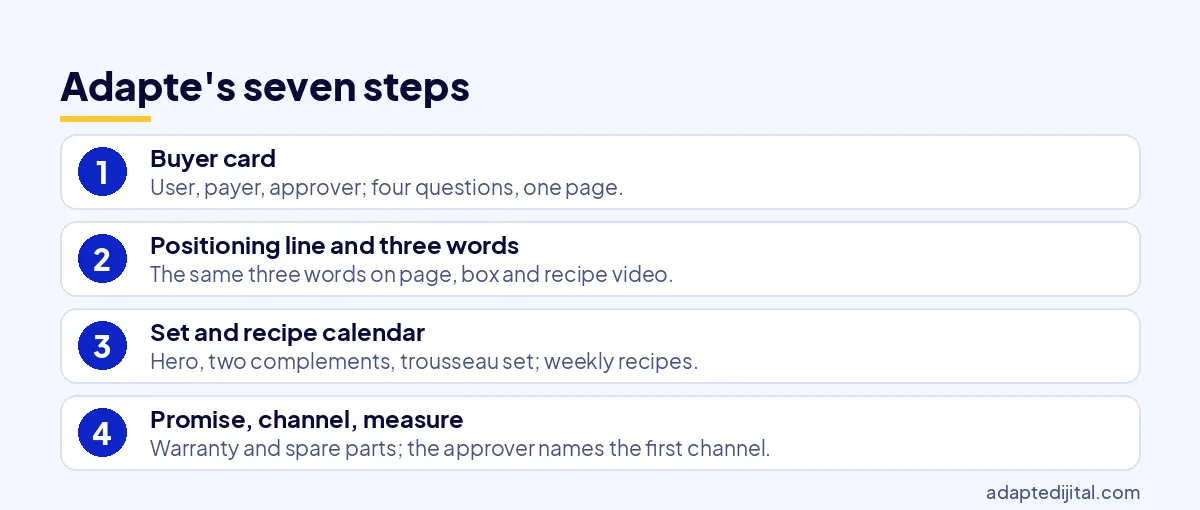
Buyer card, positioning line, three words, set architecture, recipe calendar, warranty promise, channel and measurement: seven outputs, seven weeks. These pages feed the pre-launch checklist and the first batch decision. To apply the method to your brand, start with the buyer card; we fill it in together.
The seven-week calendar
One output a week, each a page the brand owner signs.
What comes next
Then the twelve-point pre-launch checklist for kitchen products takes over; stage order is in the hub on which consultancy a kitchenware brand needs.
To start
To fill in the buyer card together, use the consult your expert form; scope is on the brand consultancy page.
Frequently Asked Questions
Quick Summary
- Seven steps from buyer card to channel measurement.
- Product difference is big on the hob, small on screen; position around the food.
- In trousseau sets, user and payer differ; the card gives them separate rows.
- Three layers: hero, two complements, trousseau set; a many-piece box creates no hero.
- The recipe is the user manual; the card’s approver names the first channel.
Short Glossary
- Buyer card: a one-page sheet of user, payer and approver with purchase moment
- Positioning line: one sentence joining user, approver, payer and product
- Set architecture: hero, complements and trousseau set built with channel and price logic
- Recipe content calendar: a weekly plan of hero-product recipes, product’s job and channel
Next Step
To fill in the buyer card together, use the consult your expert form; scope is on the brand consultancy page. Next read: what granite, ceramic, steel and cast iron mean in cookware.
Updated: October 2026
Sık Sorulan Sorular
The founder, a chef or a food creator; the standard lives in the calendar, not the camera. See from a chef’s kitchen to a cookware brand; distribution falls under producing short video.
It builds the buyer card, positioning line, three words, set architecture, recipe calendar and warranty promise, and ties channels to measurement; it does not choose manufacturers or buy coatings.
Regular recipes made with the hero product, published as pages, short videos and box cards, each saying where the product matters and why.
Three layers: one hero product, two complements and a trousseau set. The hero carries the story; the trousseau set is the same pieces in a gift box.