
From Chef’s Kitchen to Cookware Brand: A Founder’s Story and Three Lessons
A restaurant chef can build his own cookware brand, and this chef is doing it: tired of hot-handled pans, he sketches his own and today runs one hero pan, two companions, his own site and one housewares shop. We give not his name but the sketch, three manufacturers, a warping base, his own declaration and the first recipe video. The defining decision: he sells the pan with the recipe, not alone.
We tell it in the present tense, because the brand is still running. His words are in quotes; the rest is observation. Three lessons close it, for founders who are not chefs.
Hot handles and a chef’s notebook
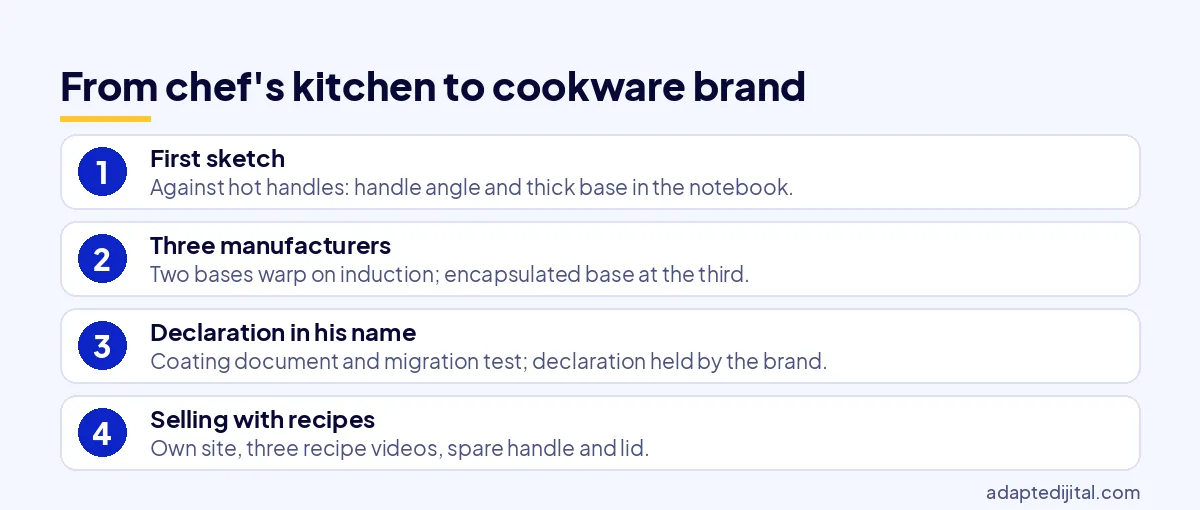
In a busy restaurant kitchen the founder reaches for a cloth to lift the pan, because the handle heats up and its angle strains the wrist. After service he sketches a pan in his notebook: handle angle, the joint to the body, base thickness. That week a cook beside him looks at the sketch and says one thing: “If you get this made, I’ll buy one.” That day the founder writes: a pan is felt in the hand first, then on the plate.
The breaking point
One evening mid-service the cloth slips, the handle burns his hand and he has to drop the pan. He puts it this way: “I want to change the pan for the handle, not the food. The handle is what I hold a hundred times a day.” Why people switch to a small kitchenware brand is covered in the four reasons and a case article.
Three manufacturers, one sample and a base that warps on induction
He takes the sketch to three manufacturers: two in Istanbul’s metalware cluster around İkitelli and Hadımköy, one in Kayseri. All three samples have a good body and coating; the problem is the base. The first two bases warp slightly on induction at high heat and the pan starts to spin on the hob; the third maker proposes a thick encapsulated base. The founder goes with the third.
The founder’s line
He puts it like this: “Every pan is fine on gas. Induction is growing in homes; if I don’t test the base there, the customer will.” What an induction base is, in plain words, is in how to read a coating label.
The clause he writes into the contract
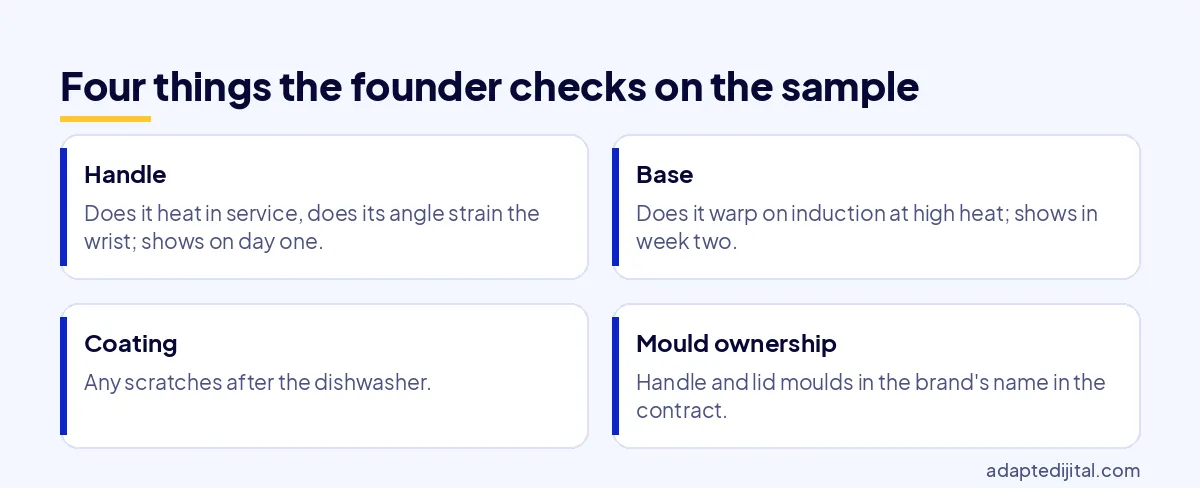
The contract puts handle and lid moulds in his name and commits to spare parts. The founder says: “The recipe is mine, and so is the handle drawing.” Which cost is paid when, line by line, is in the cost article.
He takes the declaration of compliance in his own name
The manufacturer offers to handle the paperwork; the founder stops here. The declaration of compliance for a food contact product is issued in the brand’s name, and inspection questions come to the brand. He requests the content document from the coating supplier and the migration test result from the lab, and takes the declaration in his own name. The founder says: “Just as I know what I put on the plate, I want to know what the pan leaves on it.”
Documents asked for in inspection
The declaration, the migration test report and the coating content document sit in one file. The detail of the three documents is in the food contact material rules article.
Selling the recipe with the product: the first channel is his own videos
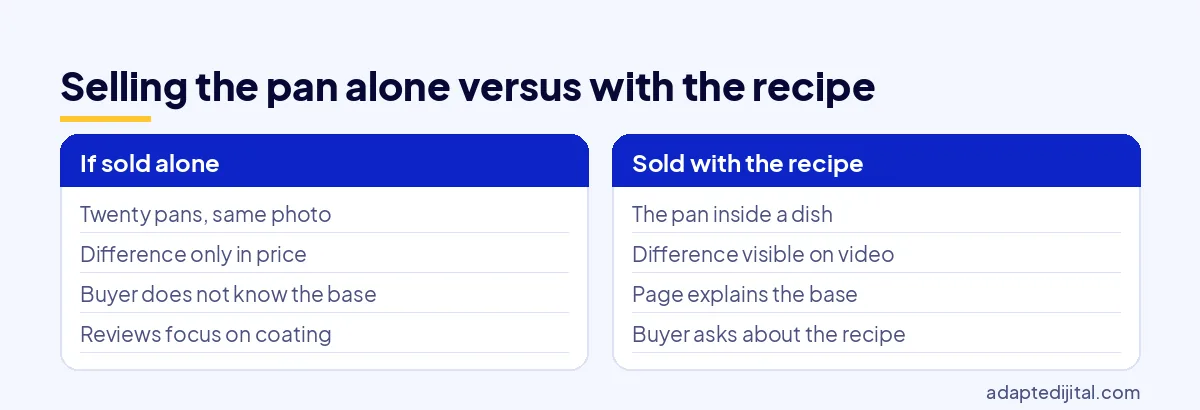
The founder puts the first batch on his own site, not a marketplace, and places videos of three dishes cooked in the pan in the middle of the product page. Recipe and pan pages link to each other. He explains the decision: “On the marketplace my pan stands in the same photo as twenty pans from the same mould. On my site my pan stands inside a dish.”
Recipe calendar
One recipe a week, matched to the season: meat before the holidays, vegetables in summer, soups in winter. The recipe content calendar template is in the recipe-led method article; building the site falls under e-commerce consulting.
The spare handle and lid promise, and the brand today
The founder sells spare handles and lids as separate products on his site and writes the spare-parts promise into the warranty. Today the brand runs on one hero pan and two companions, a deep sauté pan and a lidded pot, with its own site, one housewares shop and one HoReCa proposal. He has not left the restaurant: “The restaurant teaches me the pan, the brand teaches me patience,” he says.
The HoReCa proposal
A restaurant wants pans in bulk; purchasing asks about spares, the chef about weight. The founder says: “Selling a pan to a chef isn’t easy; but I know what a chef asks.” The proposal’s season calendar is in when should a kitchenware brand launch.
Three lessons from the story (for non-chefs)
Lesson one: kitchenware is felt in the hand first, so handle, base and weight are tested in real use. Lesson two: the declaration of compliance, mould ownership and spare-parts promise are settled before sales, in the brand’s name. Lesson three: among same-mould pans, the recipe makes the difference; the pan sells with the dish cooked in it.
Frequently Asked Questions
Quick Summary
- Tired of hot handles, the chef sketches his own pan; a fellow cook is the first buyer.
- Two of three bases warp on induction; the third’s encapsulated base wins.
- He takes the declaration of compliance in his own name; coating document and migration test sit in one file.
- The first channel is his own site; the product page carries videos of three recipes cooked in the pan.
- Spare handles and lids are separate products; today there is a hero pan, two companions, one housewares shop and one HoReCa proposal.
Short Glossary
- Hero pan: the one product that carries the brand’s difference
- Encapsulated base: a multi-layer base plate added under a pot for induction compatibility and even heat
- Declaration of compliance: the document, based on the migration test, stating in the brand’s name that a food contact product meets the rules
- HoReCa: the corporate sales channel covering hotel, restaurant and café buyers
Next Step
To start your own story from the first sample, write via ask an expert; the scope is on the brand consultancy page. To return to the start of the set: I want to start a kitchen products brand.
Updated: October 2026
Sık Sorulan Sorular
The founder says: “For a chef a pan is not a tool, it is an extension of the hand. Thick base, balanced weight, a handle that stays cool; I’ll cook the rest.” Why enter a sector where a logo is easy and standing out is hard is in the pillar article.
He uses the sample in the restaurant for a month, then hands it to two cooks. Handle heat shows on day one, warping in week two, scratches after the dishwasher. Sample and use testing as acceptance criteria are in the manufacturer selection article.
In an inspection, the brand selling the pan is the named contact; why “the manufacturer handles the documents” is wrong is in the six misconceptions article. The rule framework is in EU Regulation 1935/2004 and the Turkish Food Codex regulation.
Coating name, PTFE, heat limit, induction, care and warranty; the same lines on the page. He explains it with a kitchen habit: “What the menu says is what lands on the plate; what the box says is what you get in the pan.”
Same-mould pans sit side by side with the same photo; only price differs. How the same-photo problem loses a brand is in the lost-on-the-marketplace case.
Buyers ask about the recipe before the price: “Can I make this dish with my own pan?” The founder writes the answer on the page: base thickness, heat spread, a handle that stays cool.
The shop owner grips the handle and asks: “What if the handle breaks?” The founder takes a spare handle out of his pocket. How channel order is built by product group is in own site, marketplace or housewares shop.
Do by method what he does by habit: buyer card, use test, document file, recipe calendar, spare-parts page. Bringing these together is brand consultancy work; your stage is in the hub article.
The sector picture is in the kitchen products brand sector guide; the twelve pre-launch items are in the checklist. For your own story, ask an expert.
Yes; this founder solves the base with the third of three manufacturers, takes the declaration in his own name and sells with his own recipe videos.
The declaration is issued in the brand’s name and the brand is the named contact in inspection; the founder collects the coating document and migration test result himself.
Test handle, base and weight in real use, settle the declaration and spare parts before sales, and sell the pan with the recipe.