
Why a Makeup Brand Stalls After Its First Collection: Four Causes
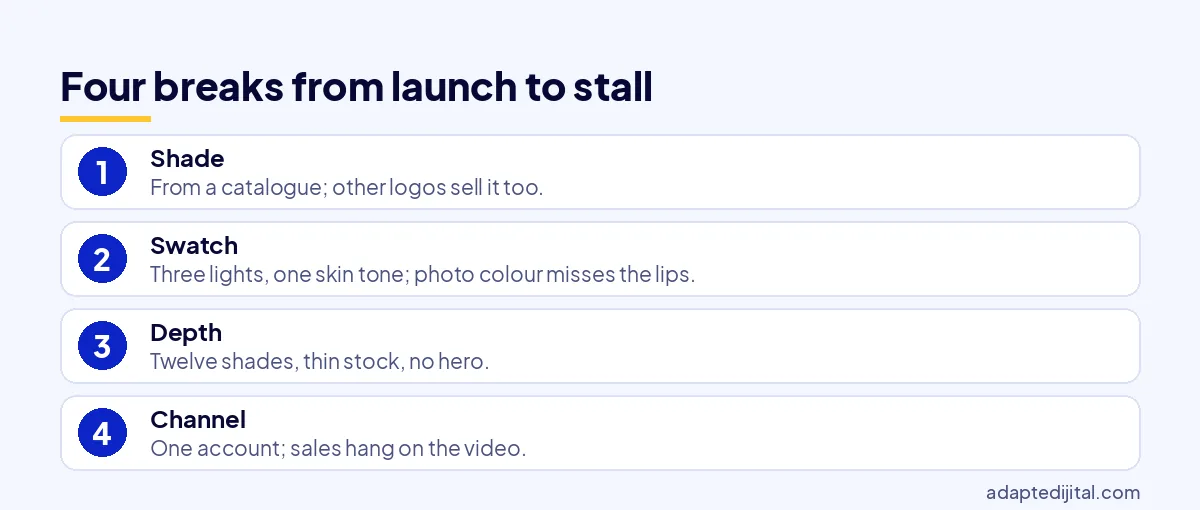
A makeup brand stalls after its first collection not because the lipstick is bad, but because once followers have bought, nobody else has a reason to choose it. The catalogue shade is sold elsewhere, the photo colour never reaches the lips, twelve shades overshadow each other and sales hang on one account. Together, the four keep launch week the best week of the year.
This piece follows a real brand’s first year: no names, only observations. Four causes, what the founder sees and the fix. At the centre sits one observation: the screen-to-skin colour gap.
Say your lipstick collection sells out in week one
Say you are a beauty creator: you pick twelve lipsticks from a contract manufacturer’s shade card, print your logo and launch on your own account. Stock melts in week one and comments are warm. The problem starts after month two, because the follower bond, not the product, is doing the selling.
What the founder sees
Sales slow in month two and stop in month three. New followers watch but do not buy. One sentence keeps landing in the inbox: the colour is not what the photo showed.
The unexpected finding
Reading the return reasons, the founder sees that most complaints are about colour, not formula. Few say the lipstick dries or bleeds; many say the shade differs from the screen. We call this the screen-to-skin colour gap.
Why people switch to small makeup brands is a separate case in why buyers switch to small makeup brands.
Cause one: a catalogue shade with nothing distinctive
Private label is easy in colour cosmetics: picking shades from a ready card and printing a logo takes a few weeks. The price is that other brands sell the same shade. Here all twelve shades come from the catalogue, and a buyer who compares sees a difference only in price.
The founder’s line
The lipstick is good; my face will be the difference. Half true: the founder’s face brings discovery, but the shade brings a buyer back. A non-follower sees colour, texture and wear time, not the founder.
The fix
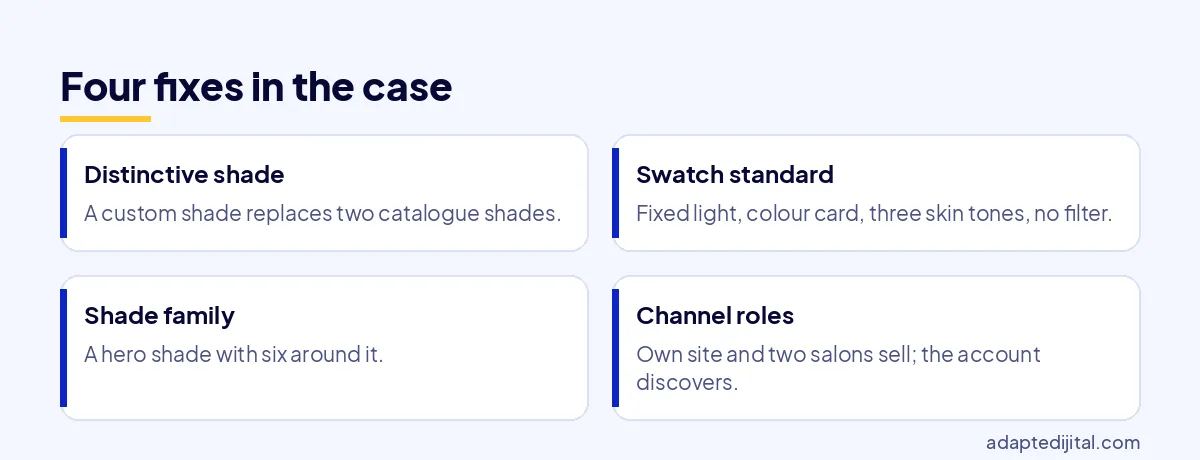
The founder replaces two catalogue shades with her own blends, developed with the manufacturer. The differentiation map is in the I want to start a makeup brand pillar; catalogue versus custom is in how to choose a contract manufacturer for makeup.
Cause two: inconsistent swatches and shade photos
BU BÖLÜMÜN ÖZETİ
- Why swatches matter
- The single skin tone problem
- The fix
The product page photos are shot in three lights: the manufacturer’s catalogue image, the founder’s ring light and daylight. The same shade looks like three colours. The buyer cannot tell which is real, picks the frame she likes and asks for a refund when her lips show another colour.
Why swatches matter
A swatch shows a product’s trace on arm or lips; in colour cosmetics it is the buyer’s only way to touch. A shop has testers, a screen does not. An inconsistent swatch is a shop with broken testers.
The single skin tone problem
Every swatch here is on the founder’s own arm. A shade that reads peach on fair skin almost vanishes on deep skin. Undertone is explained plainly in pigment, shade, undertone and wear time in makeup.
The fix
Every swatch is reshot in the same light, at the same distance, on three skin tones. No filter, no retouching, product in frame.
Cause three: many shades, little depth
Twelve shades make a collection look rich but thin out the stock. The two best sellers run out while six slow shades sit on the shelf. The second batch is again twelve shades, because the founder does not know which shade sells and why. There is no hero; every shade sits in another’s shadow.
The fix
The collection shrinks to one lipstick family: a hero shade with five or six around it. The more-shades myth is covered in six myths about makeup brands.
Cause four: one channel that depends on followers
BU BÖLÜMÜN ÖZETİ
- What the founder sees
- The fix
- Separating discovery from sales
The brand sells only through the founder’s account. Instagram and TikTok are discovery channels; the sale starts there but is not held there. There is no own site, shade finder, email list or makeup artist network. When the algorithm hides the video, sales disappear too.
What the founder sees
Sales come when the video lands and vanish when it does not. Followers and customers look like one list but are not. Repeat buyers are few and no artist recommends the brand.
The fix
The account stays but its job becomes discovery. The hero shade moves to the own site and two beauty salons; a marketplace is planned for year two, with rules read on the Trendyol seller page. The comparison is in own site, marketplace or beauty retailer.
Separating discovery from sales
Discovery needs a content calendar; sales need a product page. How to split them is in our short video guide.
What is the screen-to-skin colour gap?
BU BÖLÜMÜN ÖZETİ
- The observation
- Three things that widen the gap
- How it closes
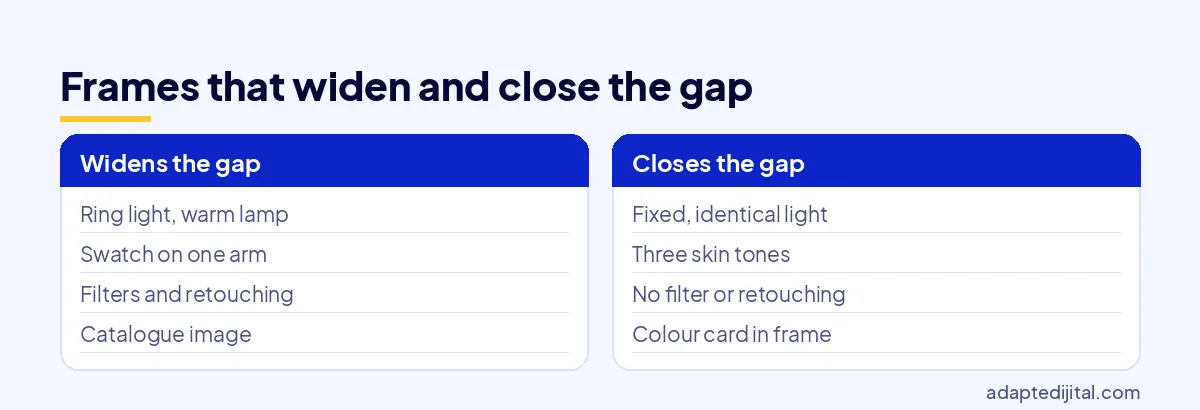
The screen-to-skin colour gap is the difference between the shade in the product photo and the shade on the buyer’s own lips or skin. The wider it is, the more returns and bad reviews; the narrower, the more the buyer trusts the screen. The lesson: in colour cosmetics the photo is part of the product.
The observation
After the new swatches go live, sales do not jump, but colour-related refunds start to fall. Reviews begin to say just like the photo. Buyers now pick the frame closest to their skin tone.
Three things that widen the gap
Light: ring lights and warm lamps shift the shade. One skin tone: a swatch on one arm misleads others. Filters: a pretty frame becomes an untrue one.
How it closes
Fixed light, a colour card, three skin tones and an unfiltered frame. The template is in how Adapte Dijital positions a makeup brand.
Where is the case today?
Today the brand sells one lipstick family: a hero shade with six around it, two of its own development. The own site is the main channel, two salons the second, and the account handles discovery. The formula barely changes; shade choice, swatch standard, depth and channel roles do.
The time cost
The four fixes take most of the first year; done upfront, they fit into a few months before launch. That is why the makeup brand pillar gives a decision order, not a product list.
One observation and what to do today
A makeup brand starts with followers and continues with shade; if the shade is generic and the photo untrue, the first collection stays in its first week. Before adding a shade, check four things: a distinctive shade, consistent swatches, a deep family and a second channel. Miss one and the brand stalls.
Do this today
Open your last thirty return or complaint messages and sort them into colour, formula and delivery. If colour is longest, your gap is open too.
Next step
To find your stage, see which consultancy a makeup brand needs; to choose a distinctive shade together, use the ask an expert form.
Frequently Asked Questions
Quick Summary
- A makeup brand stalls after its first collection because nothing makes buyers choose it once followers have bought.
- The case: twelve catalogue lipsticks, sold out at launch, then stagnation and colour returns.
- Four causes: catalogue shade, inconsistent swatches, many shades with little depth, one channel.
- The screen-to-skin colour gap decides returns.
- Fix order: distinctive shade, swatch standard, shade family, second channel.
Short Glossary
- Swatch: a photo or test showing a makeup product’s trace on arm or lips
- Shade card: a manufacturer’s ready shade selection sold under a brand’s logo
- Shade family: a small group of shades around a hero shade in one texture and finish
- Private label: a manufacturer’s ready product sold with the brand’s logo
Next Step
To find your distinctive shade, write via the ask an expert form; scope is on the brand consultancy page. Next read: cosmetics notification and inspection rules for a makeup brand.
Updated: October 2026
Sık Sorulan Sorular
Followers know the founder and buy to support her. The launch video spreads and the first batch sells out. The founder reorders the same quantity and plans for growth.
Catalogue shades look cheap, so the choice is never narrowed. Yet every shade means its own swatch, photo, stock and return risk. More shades, weaker stories.
The manufacturer makes the formula, the founder picks the shade, a consultant sets the order; here brand consultancy sets differentiation, swatch standard and channel roles independently of the manufacturer.
Often followers carry the launch and the product cannot carry what follows: a generic shade, inconsistent swatches, many shades with little depth and one channel.
The difference between the shade in the photo and on the buyer’s lips or skin. Light, one-skin-tone shoots and filters widen it; fixed light, three skin tones and unfiltered frames close it.
Depth beats number: a hero shade with a family of five or six, each with full swatches and stock.