
Makeup Brand Startup Cost: Items, Three Thresholds and Sizing the First Batch
The cost of starting a makeup brand has ten items: catalogue or custom shade development, samples, the safety assessment, stability and microbiology tests, product notification, packaging, swatch photos and video, the site, marketplace commission and testers with sample giveaways. We give no single total; items vary with product group, manufacturer, number of shades and exchange rates. Three things do not change: the order of payment, the shares inside unit cost and the three thresholds.
This article opens the ten items, says who quotes each, gives the unit cost logic, the item-and-timing table and three thresholds. Tables, no amounts.
What are the ten items, and which one gets forgotten?
Shade and product are what everyone budgets for, the safety report and tests what everyone underestimates, and testers and swatch photos what everyone forgets. The site is a fixed cost in year one; commission and shipping are variable costs on every sale. List the ten items in an empty table and write next to each who will quote it; one quote is not a budget.
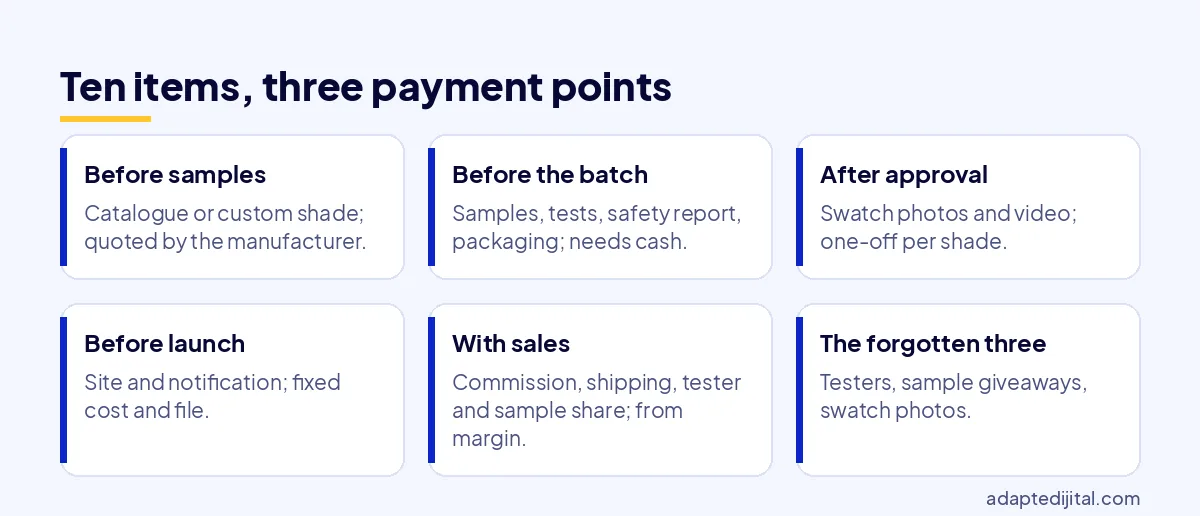
The three forgotten items
Testers, sample giveaways and swatch photos. Makeup is bought after trying, so kits, testers and minis are part of the sale; swatch photos are half the product.
Who gives you a price?
The ten items need quotes from at least six named contacts: the manufacturer for shade, samples and product; a lab for stability and microbiology; a safety assessor for the report; a packaging supplier for bottles and boxes; a photographer for swatches and video; an agency or platform for the site. The channel sets commission, the carrier sets shipping. Threshold: an item without quotes from two contacts goes in the budget as an estimate and is flagged.
The single-contact trap
A manufacturer may offer to handle everything. Convenient, but tests get buried in the unit price and the lab goes unseen. Ask for items separately, then combine.
The link to choosing a manufacturer
Which items stay with the manufacturer and which with the brand becomes clear in the interview. We gave the twelve-question list in the article on choosing a contract manufacturer.
When is each item paid?
Items are paid at three points: before samples, before the first batch and with sales. The order is your cash flow; a brand that pays for product but forgets packaging leaves the batch sitting unfilled in the warehouse. The table lines up the ten items by timing, contact and type; fill the empty column with your own quotes.
Table
| Item | When | Contact | Type |
|---|---|---|---|
| Catalogue or custom shade | Before samples | Manufacturer | One-off, per shade |
| Samples | Before the batch | Manufacturer | One-off, often credited |
| Stability and microbiology | Before the batch | Lab | Per formula and pack |
| Safety assessment | Before the batch | Assessor | Per product, renewed on formula change |
| Notification and file | Before sales | Responsible person | Per product |
| Packaging and box | Ordered before the batch | Packaging supplier | Per unit; custom mould one-off |
| Swatch photos and video | After sample approval | Photographer, video team | One-off, per shade |
| Site | Before launch | Agency or platform | Fixed, monthly or yearly |
| Marketplace commission | With sales | Channel | Per sale, from margin |
| Testers and samples | At launch and ongoing | Brand | Per unit, by channel |
How to read it
Pre-batch items need cash; sales items come from margin. The channel choice sets the commission and tester rows; see own site, marketplace or beauty retailer.
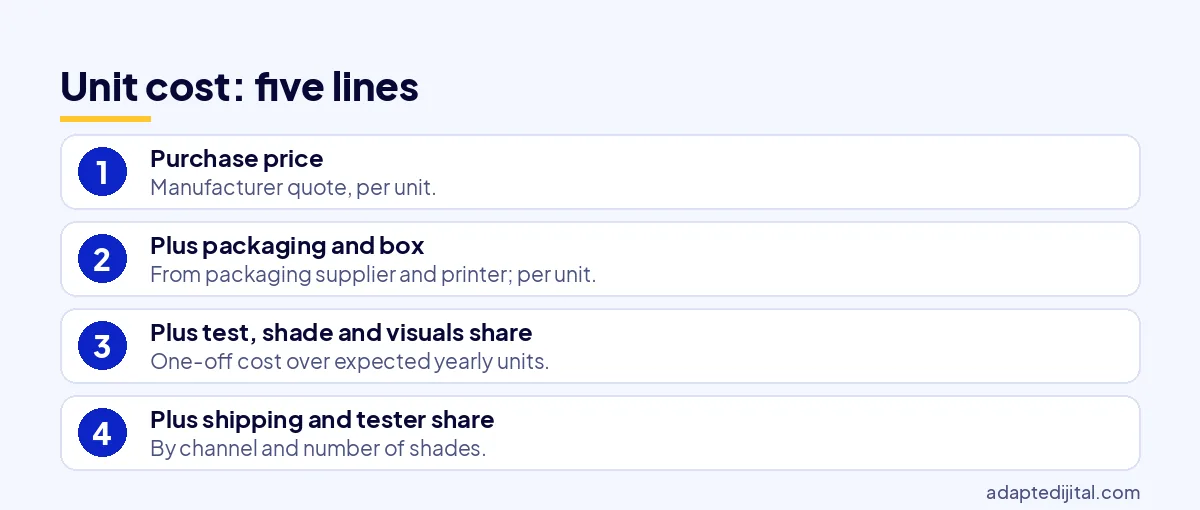
Unit cost logic: what is inside one lipstick?
Unit cost has five parts: purchase price, packaging, test and document share, shade and visuals share, shipping and tester share. Only the first two appear on quotes, yet all five sit inside every unit. Divide one-off costs by the product’s expected yearly units, then add the tester share for each channel.
Formula
| Line | What | Where it comes from |
|---|---|---|
| A | Purchase price | Manufacturer quote, per unit |
| B | Packaging and box | Packaging supplier and printer, per unit |
| C | Test and document share | Test, report and notification cost over expected yearly units |
| D | Shade and visuals share | One-off cost over expected yearly units |
| E | Shipping and tester share | Carrier and the channel’s tester needs |
| Unit cost | A + B + C + D + E | Price is built on top of this |
The too-many-shades mistake
Tests, swatches and shade development fall per shade but spread over units, so a slow-selling shade raises unit cost. That is why a twelve-shade first collection is a budget error; one hero product with five or six shades is a healthier start.
How do testers and samples enter the budget?
In makeup, testers and samples are part of the sale, not a marketing extra. Retailer chains want a tester per shade, artists want kits, and your own site wins the second order with a mini sample in the parcel. Write the tester count per shade for each channel, set it aside from the first batch and add this share to unit cost in relative terms.
Returns of opened products
Most channels limit opened-cosmetic returns, yet brands still exchange. Honest swatches mean fewer exchanges.
Campaigns and support
New entrepreneurs can use KOSGEB (Small and Medium Enterprises Development Organisation) support programmes; scope and terms change by period, so check the official page before applying. Support does not build a budget; it fills a gap.
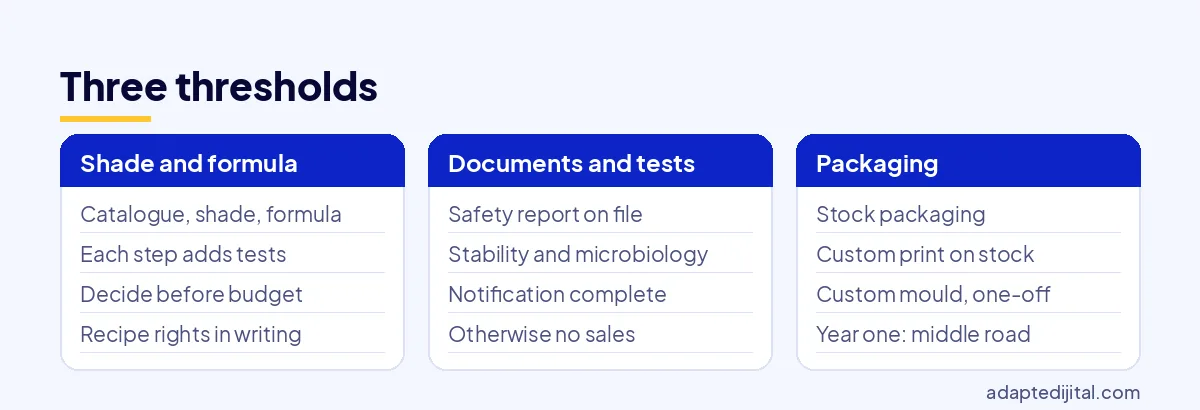
Three thresholds: shade and formula, documents and tests, packaging
Shade and formula threshold: each step from catalogue to custom shade to custom formula adds testing and time, so decide it before the budget. Documents and tests threshold: if the safety report, stability and microbiology results and notification are not on file, the batch does not go on sale. Packaging threshold: stock packaging, custom print on stock packaging and a custom mould are three separate steps; a custom mould is a large one-off item.
How do you size the first batch?
The first batch is no larger than three months of forecast sales, spread on the principle of depth first, variety later. Write down the number of channels, put a weekly forecast on each, multiply by a quarter, spread the result over the hero product’s shades and set the tester share aside. If you are entering the year-end gift season, the batch must be ready before it starts.
Most common mistake
A big batch and many shades to lower the unit price. Cash gets tied up, the best-selling shade runs out, slow shades near their PAO in the warehouse, and nothing is left for the second batch. The pre-launch check is in the twelve-point checklist.
Do this today
Open the ten-row table, write the contacts and note the three thresholds at the top. For the overall order see the pillar article, for your stage the four-doors hub by stage; to fill the table with your own quotes, consult your expert.
Frequently Asked Questions
Quick Summary
- Ten items: shade, samples, tests, safety report, notification, packaging, swatches and video, site, commission, testers.
- The three forgotten items are testers, sample giveaways and swatch photos.
- Items are paid at three points: before samples, before the batch, with sales.
- Unit cost: purchase + packaging + test and document share + shade and visuals share + shipping and tester share.
- Testers are part of the sale; set them aside per shade for each channel.
- Three thresholds: shade and formula, documents and tests, packaging; the first batch stays within a three-month forecast.
Short Glossary
- Safety assessment: a report by a qualified person showing that a cosmetic product is safe for human health
- Stability test: a test of whether colour, texture and pack compatibility hold at different temperatures over time
- Tester share: the cost of unsold units set aside for shops, artists and samples, added to unit cost
- Packaging threshold: the rule that limits the budget impact of choosing stock packaging, custom print or a custom mould
Next Step
To fill the table with your own quotes together, write to us via the consult your expert form; the scope is on the brand consultancy page. Next up: the twelve-point checklist before a makeup product launch.
Updated: October 2026
Sık Sorulan Sorular
They seem to add nothing to sales, yet without a safety report and notification the product cannot reach a shelf, and it is the first document an inspector asks for. Where documents are checked is in the article on product notification and inspection rules.
The pack is the product’s face, and founders get carried away here. A custom mould ties up cash; custom print on stock packaging is the year-one middle road.
The brand sets the thresholds, not the manufacturer; the manufacturer wants a big batch, the brand answers with three thresholds. Brand consultancy sets the scope; the big picture is in the makeup brand industry guide.
There is no single figure; the ten items vary with product group, manufacturer, number of shades and exchange rates. What stays fixed is the order of payment, the shares inside unit cost and the three thresholds.
It is a one-off item per product, divided by expected yearly units and added to unit cost. It is renewed when the formula changes.
One hero product and five or six shades is a healthy start. Each extra shade adds test, swatch and stock share; depth first, variety later.