
Dental clinic advertising ban explained: 9 things you can and cannot say in Turkey
The dental clinic advertising ban is the rule that stops dentists and clinics from advertising their services openly or covertly. In Turkey in 2026, its main basis is the Regulation on Promotion and Information Activities in Health Services, published in Official Gazette no. 33075 and in force since 12 November 2025. The ban does not cover promotion. Address, contact details, opening hours, specialty, title and protective health information are allowed.
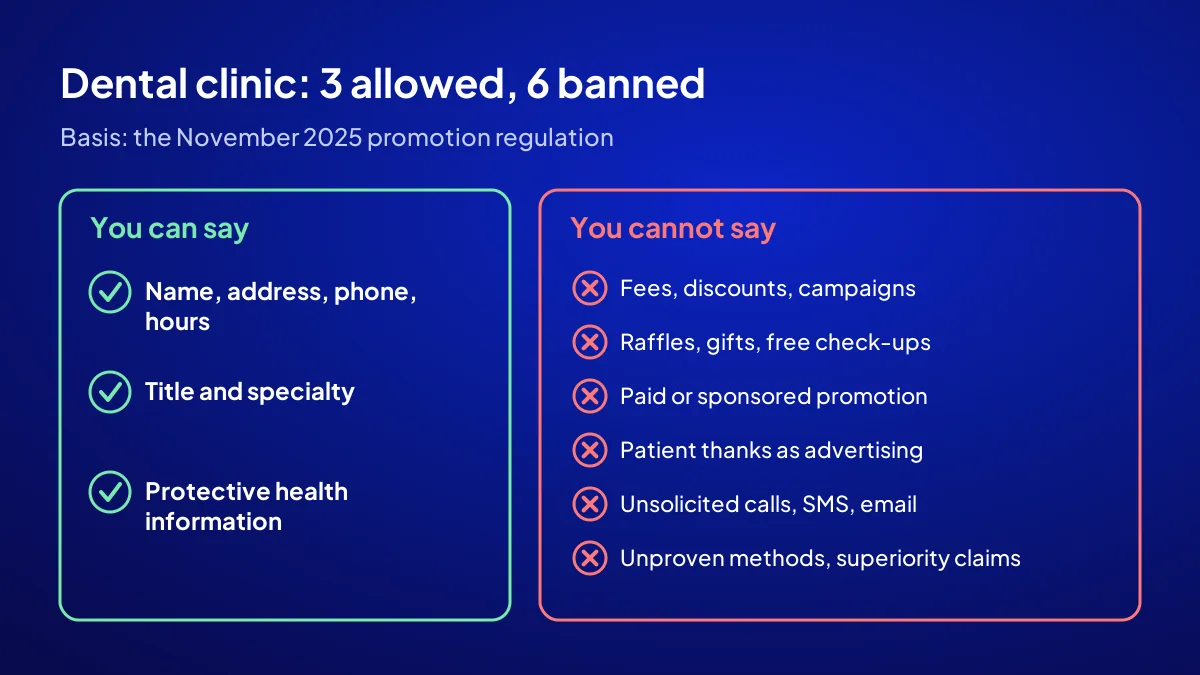
In short, there are three things you can say: who and where you are, which title and specialty you work with, and information that protects oral health. There are six you cannot: prices and campaigns, raffles and gifts, paid promotion, patient thanks as advertising, unsolicited messages and unproven claims.
What does the regulation make your website say?
Most people do not know this: the regulation does not only ban things, it also makes your site carry two lines. The last update date of the information and contact details for the site’s editor must be shown clearly. So a dental clinic website looks a bit like a medicine leaflet with a note at the bottom: “last checked on, ask this person”.
What are the 3 things you can say?
BU BÖLÜMÜN ÖZETİ
- 1. Who and where you are
- 2. Title and specialty
- 3. Information that protects oral health
The allowed area is narrow but not empty. For health facilities, the regulation lists address and contact details, working days and hours, specialties, the dentists’ professional and academic titles, and information that protects and improves health. All three can go on the site, the profile and social media.
1. Who and where you are
The licensed name, full address, phone, working days and hours. At midnight with toothache, “are they open now?” is answered here.
2. Title and specialty
Main and sub-specialty, academic title, patient days and location. You write only the titles you really hold. Wording that hints at a specialty you are not authorised in counts as misleading.
3. Information that protects oral health
“How often should you change your toothbrush?” or “when should a child have a first check-up?” are allowed. It must come from an authorised professional, be scientifically accepted and carry the dentist’s approval.
Which 3 bans are about money and rewards?
BU BÖLÜMÜN ÖZETİ
- 4. Fees, discounts and campaigns
- 5. Raffles, gifts and free check-ups
- 6. Paid and sponsored promotion
The first three bans shut down the sales language shopkeepers use most: price, gifts and paying to be seen. A neighbourhood shop can hang “20% off this week” on its door. A dental clinic cannot write that on the door, the site or Instagram.
4. Fees, discounts and campaigns
A price list, an “opening discount on implants”, instalment offers or “whitening this month” are not promotion. How to answer the price question is covered, through other sectors, in why they only ask about price.
5. Raffles, gifts and free check-ups
Health services cannot be the subject of incentives, raffles or gifts. “A toothbrush set for the first 50 patients” or “free check-ups in opening week” fall here.
6. Paid and sponsored promotion
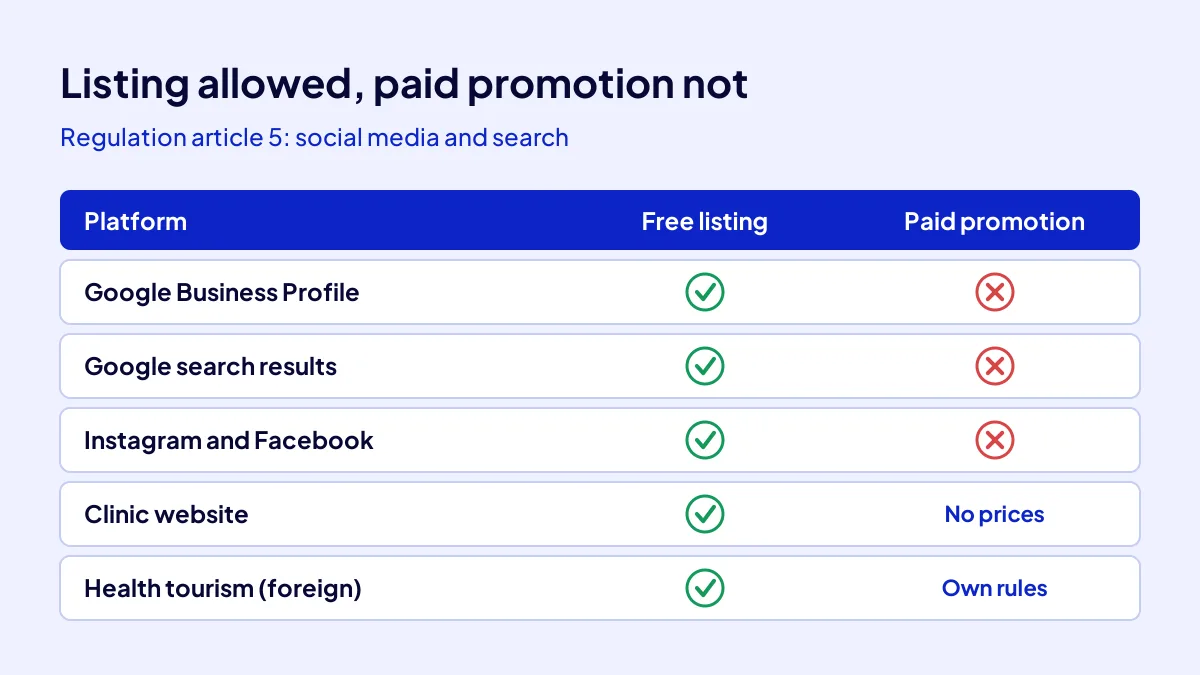
Clinics and dentists may register on social media and search engines, provided the listing is not paid, sponsored or aimed at boosting. Domestic search ads and sponsored posts therefore fall outside the rules; keywords must also follow the principles.
Which 3 bans are about patients and claims?
BU BÖLÜMÜN ÖZETİ
- 7. Patient thanks as advertising
- 8. Unsolicited calls and messages
- 9. Unproven methods and misleading superiority
The last three bans protect the patient: do not turn their words into ads, do not contact them without consent, do not mislead them. Even when a delighted patient thanks you, putting that thanks in the shop window is banned.
7. Patient thanks as advertising
You cannot share patient satisfaction or thanks for advertising. Turning Google reviews into a scrolling banner on the site, or posting a screenshot of a message on Instagram, falls here.
8. Unsolicited calls and messages
Reaching people who have not consented by phone, SMS, email or social media message is banned.
9. Unproven methods and misleading superiority
You cannot promote methods that lack scientific acceptance. Claims like “the best clinic in the area” or “guaranteed painless”, and comparisons that run down colleagues, count as misleading.
How are before-and-after photos and social media treated?
Before-and-after images are tied to strict conditions. Written explicit consent is required, no retouching or effects, and no treatment moments. Likes and comments are switched off and a note says results vary from person to person. Our advice to new clinics is simple: stay out of this area and promote with information.
Instagram and Facebook accounts
A free account is allowed. No sponsored posts, prices or patient thanks.
Google Business Profile
The profile is a free listing and sits right in the allowed area. How to set it up with the right category and fields is in the right Google category for a dental clinic.
With so many bans, where can a new clinic be seen?
In information. The dentist’s plain answer to a patient’s question is the one growing area the regulation clearly leaves open. The full map is in new dental clinic promotion, and the order of the first 90 days in the new dentist practice plan.
One way to build the information area
Adapte’s AI SEO Campaign lists clinics among its audience. It includes 108 articles in 6 question groups, entity setup and structured data; the price is TRY 36,000 + VAT fixed, with delivery in 30 days. Twelve businesses are taken per period; mention the 10% coupon code when you apply. No recommendation is guaranteed; readability is built and measured. See the AI SEO Campaign page.
What happens to a clinic that breaks the rules?
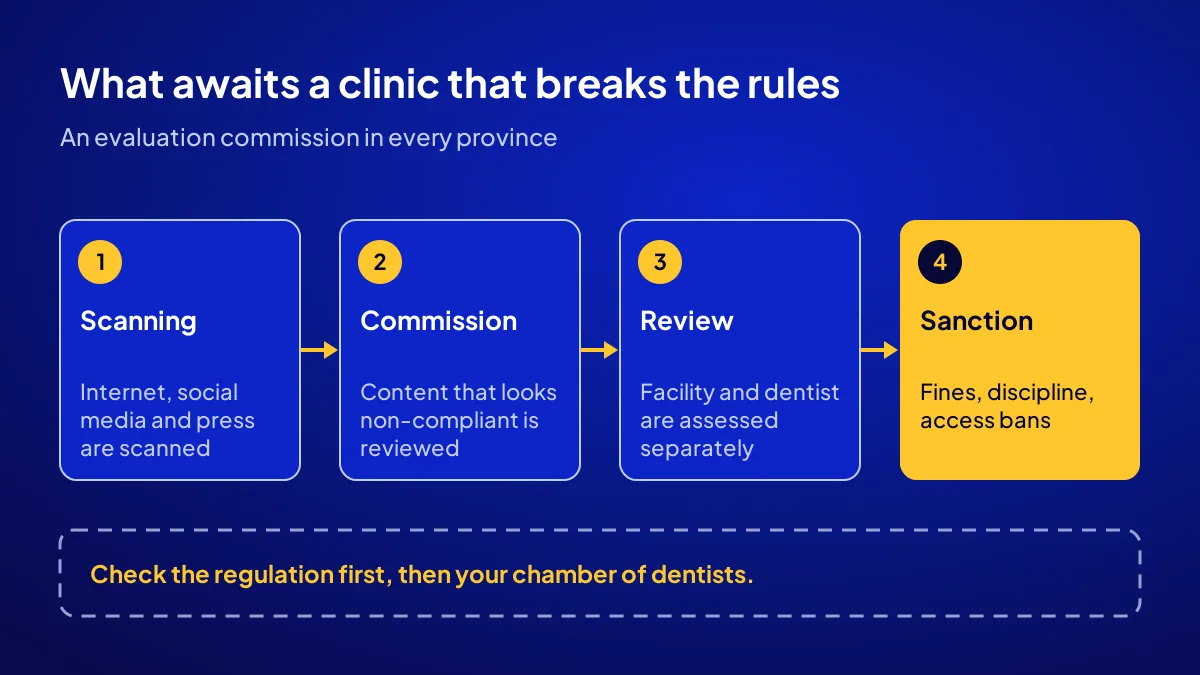
A provincial evaluation commission for health promotion activities, set up in every province, scans the internet, social media and the press. Breaches can bring administrative fines for private health facilities and disciplinary action for professionals.
The health tourism exception
The regulation opens a separate door for international health tourism: in languages other than Turkish, on a separate platform aimed abroad, without targeting domestic audiences. It does not apply to local patients.
Now you know: a dental clinic can say who it is and what it knows, but it cannot sell itself; for a new clinic, the safest growth is being seen through information.
Quick Summary
- Open or covert health advertising is banned; the basis is the November 2025 regulation.
- Allowed: identity and address, title and specialty, protective health information.
- Banned: prices, gifts, paid promotion, patient thanks, unsolicited messages, misleading claims.
- Websites must show the last update date and editor contact.
- Before-and-after images face strict conditions; our advice is not to use them.
- Provincial evaluation commissions enforce the rules.
Short Glossary
Covert advertising: Covert advertising is the form of advertising used to push a service forward under the look of information, without openly praising it.
Explicit consent: Explicit consent is the legal concept used when a patient approves the use of their image or data for a specific purpose, informed and of their own free will.
Evaluation commission: The evaluation commission is the provincial board used to scan health promotion activities and examine breaches.
Next Step
If you want your clinic to be visible within the rules, through information, apply to the AI SEO Campaign; we start with a diagnosis card and build a dentist-approved question-and-answer base together.
Frequently Asked Questions
Sık Sorulan Sorular
Law no. 1219 on the practice of medicine and its branches, the Turkish Dental Association’s professional rules and the 2025 regulation are read together. When opening a clinic, check the regulation first, then your chamber of dentists’ announcements.
The regulation defines advertising as any activity that puts a service, person or institution forward and goes beyond promotion and information. Promotion is like the plate on your door: it says who you are and when you are open. When it says “lovely inside, come now”, it becomes advertising.
The 2023 version was replaced in 2025, and the rules may change again. We track what the latest change means for dental clinics in health advertising rules: the latest.
No. Under the regulation, promotion and information may not include fees, discounts, campaigns or promotions. This applies to the site, social media and the profile.
Registering on search engines is allowed, provided it is not paid, sponsored or aimed at boosting. Paid search ads aimed at domestic patients conflict with that condition.
Sharing patient satisfaction for advertising is banned. Do not turn reviews into a showcase on the site; reply to Google profile reviews with a short thank-you and no treatment details.
The campaign lists clinics among its audience and works with question-and-answer articles that contain no prices or discounts. No recommendation is guaranteed; readability and recognisability are built and measured.
Yes, 12 businesses are taken per period. The price is TRY 36,000 + VAT fixed, delivery takes 30 days, and you mention the 10% coupon code when you apply or during the call.
The provincial evaluation commission reviews it. Private health facilities can face administrative fines and professionals disciplinary action; harmful content can also lead to access bans.
Updated: October 2026