
Where does a virtual office company appear on the map, Organization or LocalBusiness?
A company set up with a virtual office address should appear on the map in the area it serves, not at its registered address; in structured data, it should in most cases use the Organization schema, not LocalBusiness. The status of a virtual office as a registered address (tebligat adresi) is among the open legal questions in Vircon Legal’s article of 18 June 2026. The Ministry of Industry and Technology’s definition of the digital company (dijital şirket) had not been published as of October 2026, when this article was updated.
What this means for you: the address question is a visibility question, not a bookkeeping one. If your website, structured data and map listing do not name the same area, neither Google nor AI places your company where it belongs. Our digital company page follows this issue alongside the others.
Does a virtual office company appear on the map, and why are the registered address and the service area separate?
It does, but not at the door of the virtual office. The registered address is where the trade registry and the tax office find the company. The service area is where the customer looks for you. For most virtual-office companies they are not in the same district. The map listing and the structured data are built around the second.
The registered address is the registry’s question, the service area is the customer’s
The registry needs an address for official notices; a virtual office meets that need. The customer searches for “who is near me”. If a company serving Beylikdüzü is registered at a virtual office in Şişli, the map shows only Şişli. Virtual office and e-ledger rules are covered in our article on virtual offices and automated accounting.
The legal status of the virtual office is still an open question
Vircon Legal’s assessment of 18 June 2026 counts the virtual office’s status as a registered address among the unanswered questions. In Minister Kacır’s announcement of 27 April 2026, the virtual office was named as part of the digital company package. With no secondary legislation published, the existing registry rules apply today.
Organization or LocalBusiness in structured data, which should a virtual office company choose?
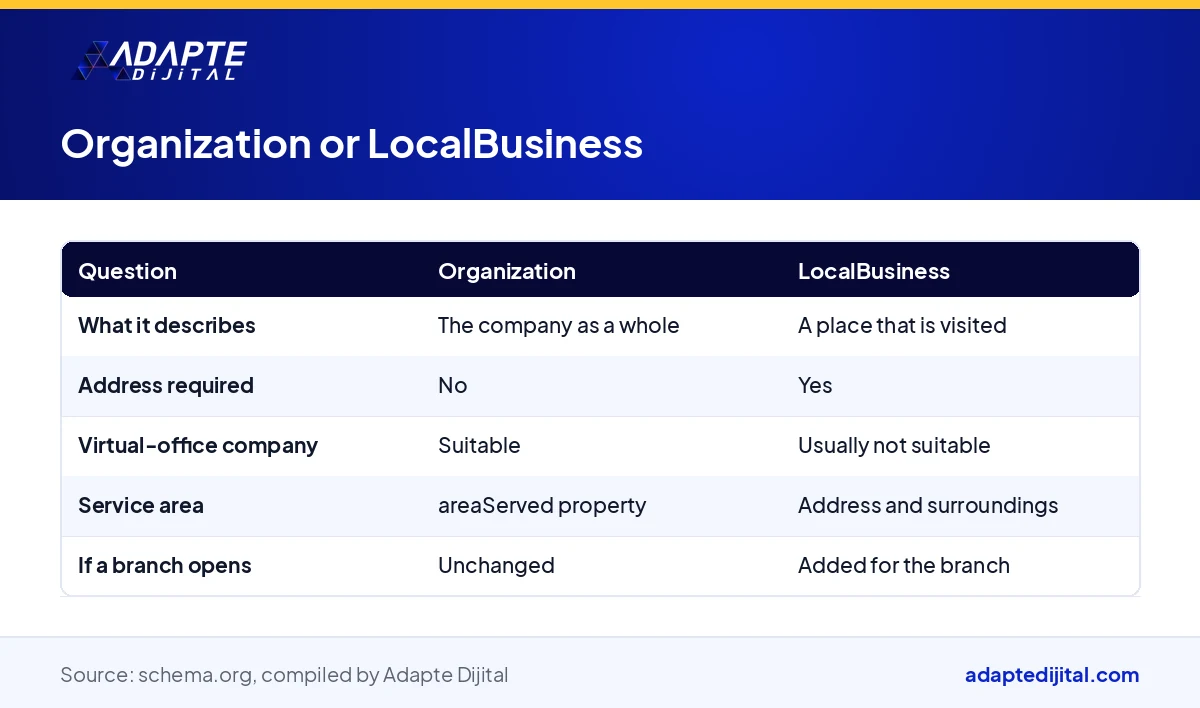
In most cases, Organization. LocalBusiness describes a place the customer physically visits: a shop, a workshop, a clinic. A virtual-office company does not receive customers at its address. So the company’s identity is described with the Organization schema and its service area with the areaServed property.
The Organization schema defines the company without forcing an address
The Organization schema carries the company’s name, trade name, domain, logo, contact details and service area. The address field is not required. If the virtual office address is included, it is written so that it is clear no customer visits take place there. The registry trade name, the domain and the website name are linked here as one entity.
What is a service-area business in Google Business Profile, and does the virtual office address go on the profile?
A service-area business serves customers where they are, not at its own address. For this type, the profile hides the address and shows the districts and provinces served. For a virtual-office company, this is usually the right type.
A service-area business shows an area instead of an address
In consulting, software, installation or cleaning, the customer does not come to the business. The profile marks a service area instead of an address, and the map shows the company in searches for that area. The virtual office address can be used for verification, but it is not the visible address.
How are the address and the service area written on the website, and how do the contact page and structured data match?
BU BÖLÜMÜN ÖZETİ
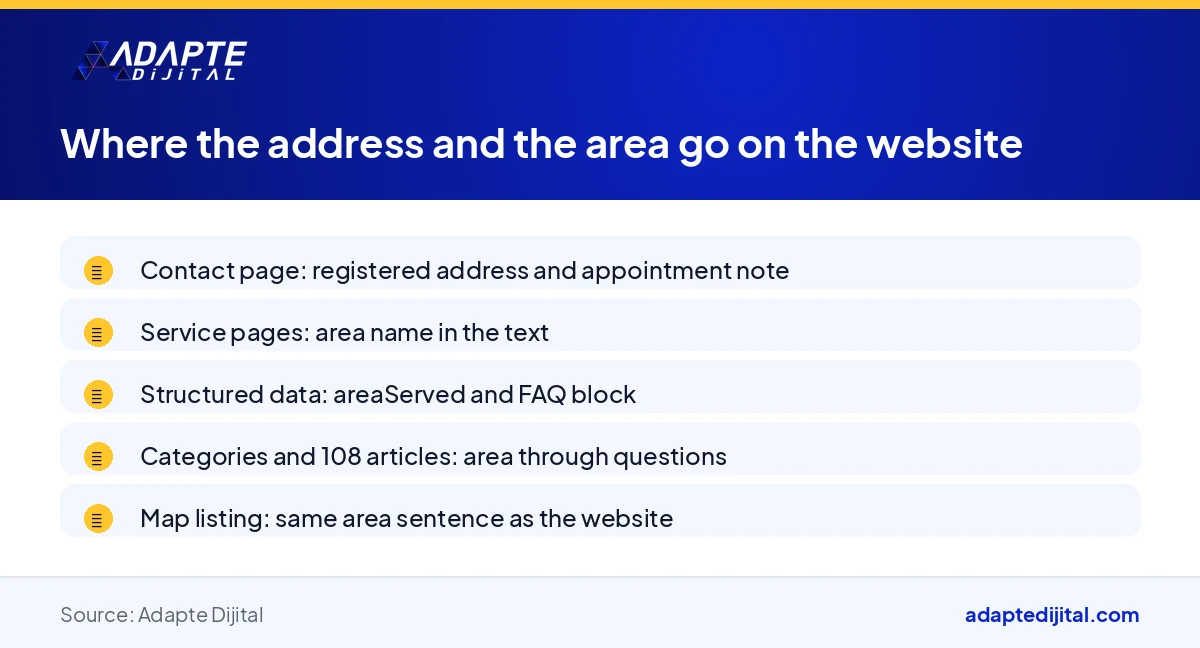
- Contact page: registered address and an appointment note
- Service pages: the area name in the text, not in the headings
- Structured data and visible text must agree
Two pieces of information live in two places. The registered address goes in the legal notice and on the contact page; the service area goes on the service pages and in the structured data. A structure of 6 top-level pages, 12 sub-pages and 6 categories carries this information consistently at every layer.
Contact page: registered address and an appointment note
The contact page lists the registered address, with a note that meetings are held online or by appointment. The note tells the customer not to come to the door and tells AI that this is not a visiting address. Phone, company e-mail and WhatsApp Business sit on the same page.
Service pages: the area name in the text, not in the headings
Each top-level page describes one service, and the service area appears naturally in its text. Stacking the area name into every heading tires the reader and the AI. The area is written with the same words as the areaServed property.
Structured data and visible text must agree
The area in the structured data must match the visible text on the page. A claim the page does not make is disregarded. An FAQ block is added to the Organization schema, and “where do you provide service” gets a clear answer there. This match is checked before delivery.
How do AI and search answer the “where” question, and what does Search Console show?
AI answers and search results build the “where” answer from three sources: structured data, the text on the website and the map listing. If all three agree, the company appears in the right area. If one differs, the answer blurs. AI SEO builds this consistency; Search Console shows the result.
Entity consistency: name, domain and area in the same words
The registry trade name, the domain, the name on the website, in the structured data and on the map listing must all match. The area must be written in the same words too. If one place says “European Side” and another “West Istanbul”, AI struggles to merge them into one entity.
Which steps should a founder setting up with a virtual office address take this week?
BU BÖLÜMÜN ÖZETİ
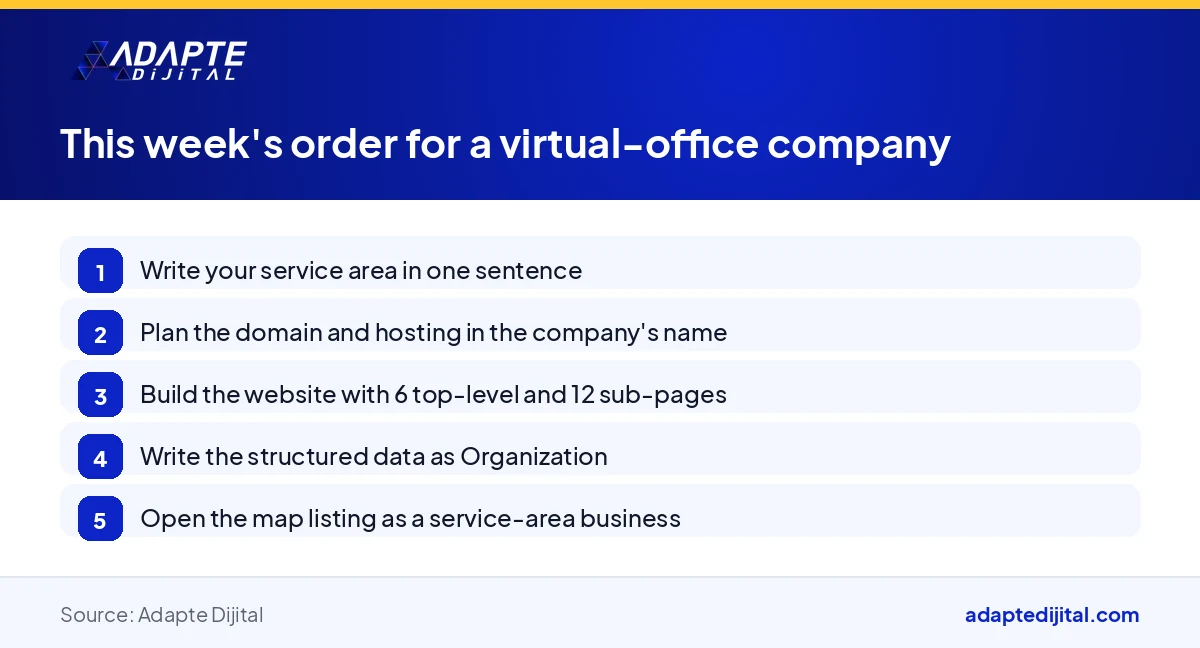
- Write your service area in one sentence
- Set up the domain, the website and the structured data from one hand
- Leave the map listing until last
Three tasks: define your service area in writing, plan the domain and website in the company’s name, and note the structured data decision as Organization. The map listing comes after.
Write your service area in one sentence
Write the sentence “we serve this type of customer in these provinces and districts”. It goes into the contact page, the service pages, the structured data and the map listing in the same words.
Set up the domain, the website and the structured data from one hand
The domain and hosting are registered in the company’s name; the website is planned with 6 top-level pages, 12 sub-pages and 6 categories; the structured data is written with the Organization and FAQ schemas. Our My Digital Company (Dijital Şirketim Olsun) package delivers these three with the map listing at a single price of TL 36,000 + VAT. A live website is adapted to the definition quickly.
Leave the map listing until last
The Google Business Profile is opened after the website and structured data go live. The type is set to service-area business, the area is written with the website’s sentence, and the website link is added. After delivery, the AI-SEO Diagnostic Card measures this consistency.
Quick Summary
- On 18 June 2026, Vircon Legal listed the virtual office’s status as a registered address among the open legal questions.
- On 27 April 2026, Minister Kacır named the virtual office as part of the digital company package.
- In structured data, a virtual-office company is in most cases defined with Organization, not LocalBusiness.
- On the map listing, the right type is the service-area business, which shows an area instead of an address.
- The Ministry’s definition had not been published as of October 2026; the registry side may change, the visibility rule stays.
Short Glossary
- Registered address
- Registered address is the address recorded in the trade registry so that official notices reach the company, known in Turkish as tebligat adresi.
- areaServed
- areaServed is the structured data property used to state the area a company serves.
- Service-area business
- Service-area business is the business type used on a map listing to show a service area instead of an address.
Frequently Asked Questions
Next Step
If you want your service area, Organization schema and map listing set up together with your website from one hand, book a discovery call on our digital company page.
The definition and conditions of the digital company scheme are not final yet; support amounts and conditions may change. Check the latest information with the Ministry of Industry and Technology, KOSGEB and the Official Gazette before deciding. This is not legal or financial advice.
Sources: Vircon Legal, Is the digital company coming to Türkiye (18 June 2026) · Dünya/AA, Minister Kacır’s announcement (27 April 2026) · schema.org, Organization (accessed October 2026) · schema.org, LocalBusiness (accessed October 2026)
Updated: October 2026
Sık Sorulan Sorular
Dozens of companies sharing one door number look alike on the map. None of them receives customers there. The answer is not to hide the address but to define the company by the area it serves.
If the customer walks through the door, LocalBusiness is right. If a virtual-office company later opens a store or workshop, a LocalBusiness entry is added for that location. Organization describes the whole company; LocalBusiness describes the branch. The two can coexist. A LocalBusiness chosen wrongly at the start presents the virtual office as a shop.
A website that marks a virtual office address as LocalBusiness promises the customer a place to go. Google and AI carry that promise into local results; the customer arrives and finds nobody. The contradiction lowers trust.
Showing an address where no customers are received as a storefront conflicts with platform rules and customer expectations. More importantly, the customer sees a company in the wrong district and keeps searching. The area on the profile should match the website.
The map listing comes after the website and structured data. First the domain and website are set up in the company’s name and the structured data is written as Organization; then the Google Business Profile is linked to that source. In this order, the profile repeats what the website says; in reverse, it stands alone.
The 108 articles under 6 categories describe the service area through questions: which problem in which district, which customer looking for what. This content lets AI associate the company with the area. We build this structure in our website consulting service.
Search Console shows which queries reach which page and from which country. GA4 gives visits at city level. Side by side, visits from your service area become visible. The four search gateways are explained in our article on where customers search for a digital company.
If the Ministry’s definition makes the virtual office the natural address of a digital company, the registry side gets easier. On the map and structured data side, the rule stays: the company appears where the customer is. The concept is covered in our article what is a digital company in Türkiye; the decision to wait or incorporate is discussed in wait or incorporate now.
It can, but it should not be shown as an address where customers are received. The right type for a virtual-office company is the service-area business, which shows an area instead of an address. The platform’s current rules apply.
If customers do not come to the address, Organization. LocalBusiness is used for a place that is physically visited. If a store or workshop opens later, a LocalBusiness entry is added for that location, and Organization continues to describe the company as a whole.
Unknown; the Ministry’s definition had not been published as of October 2026. Even if the definition eases the registry side, the map and structured data rule stays the same: the company appears in the area where the customer is.