
Bag Brand Labelling Rules and Inspections: What Leather and Textile Bags Must Show
Turkey’s Ministry of Trade publishes unsafe product findings periodically; for a bag brand that makes the leather declaration, the fibre label and the manufacturer details part of the product. Faux leather is not sold as leather, fibre content is regulated, hardware and dyes are tested for nickel and azo. In an inspection nobody reads the bag, only the label and the paperwork.
News first, then the rule, then five precautions. Sources: the Ministry’s announcement and the legislation in force. In the middle, one box: the three documents asked for in an inspection.
What happened: the Ministry’s unsafe product announcement
BU BÖLÜMÜN ÖZETİ
- The official source
- The grounds for bags
- The calendar
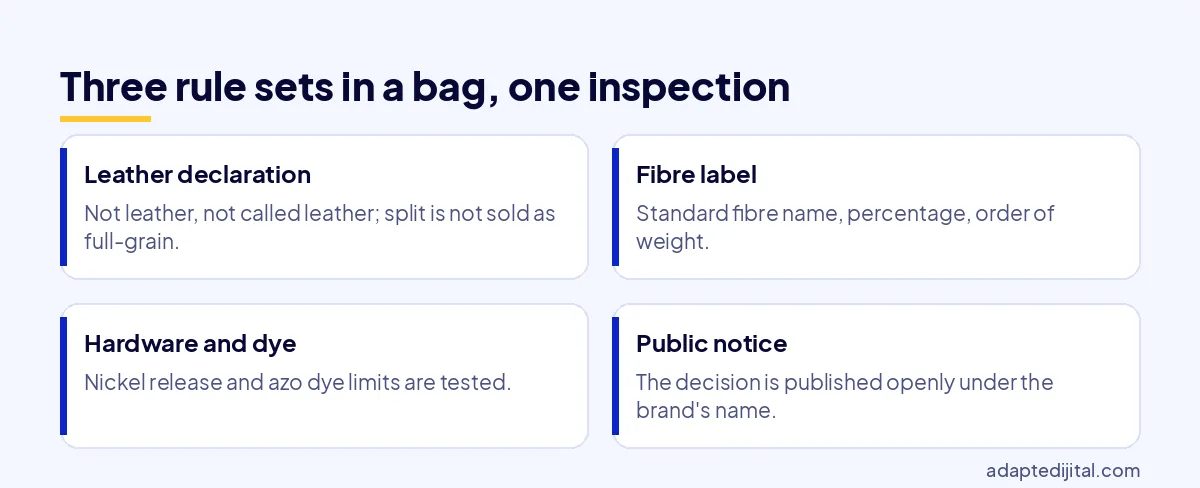
The Ministry of Trade has published first-half market surveillance results: sales bans, recalls and public notices for unsafe products, grounds published openly. Leather goods, textiles and hardware look like separate groups, but a bag combines all three and answers to three rule sets at once.
The official source
Full announcement: the Ministry of Trade’s unsafe products statement; the figures are there, and this article explains the rule, not the numbers.
The grounds for bags
Three grounds stand out: a material declaration that does not match the contents, missing label and manufacturer details, chemicals over the limit in hardware. All three meet in one bag.
The calendar
Announcements come in cycles; seasonal products are inspected before the season, so a year-end gift collection means checking the label before print. Season calendar: when should a bag brand launch.
When does a genuine leather claim become misleading advertising?
BU BÖLÜMÜN ÖZETİ
- The framework
- The leather type is a declaration too
- Page and social media count as labels
If the product is not real leather, the word and the symbol cannot appear on the label, the page or in advertising; that misleads the consumer. Leather-look and vegan leather are judged the same way if they leave the impression of leather. The rule reads what the buyer understands.
The framework
The regulation on commercial advertising and unfair commercial practices bans deceptive claims; leather is a frequent example. Legislation: the Ministry of Trade website; no fine amounts here.
The leather type is a declaration too
Full-grain, corrected-grain and split leather are different materials; selling split as full-grain is also a declaration error. Types: genuine, faux and vegan leather explained.
Page and social media count as labels
The declaration is read on the product page, in social media posts and in the boutique file, not only on the label. A correct label under a page that says leather is still misleading.
What does the fibre label on a textile bag say?
On a canvas tote, cotton bag or textile backpack, fibre content is written as percentages using standard fibre names; a trade name does not replace them. Turkey’s Textile Fibre Names Regulation and the EU textile fibre regulation set the rule and are aligned. Cotton, polyester and polyamide are listed by weight.
Turkey and EU alignment
Because the two regulations are aligned, a brand sending small batches to European online boutiques repeats the same declaration in the target language. Text: the EU textile fibre regulation.
Mixed products
Leather body, textile lining, canvas strap: most bags are mixed. Body under the leather declaration, textile part under the fibre declaration, lining and strap by share of weight. One material for a mixed product is an error.
Hardware, origin and manufacturer: three quiet rules
BU BÖLÜMÜN ÖZETİ
- One question for the hardware supplier
- One question for the tannery
- The manufacturer line
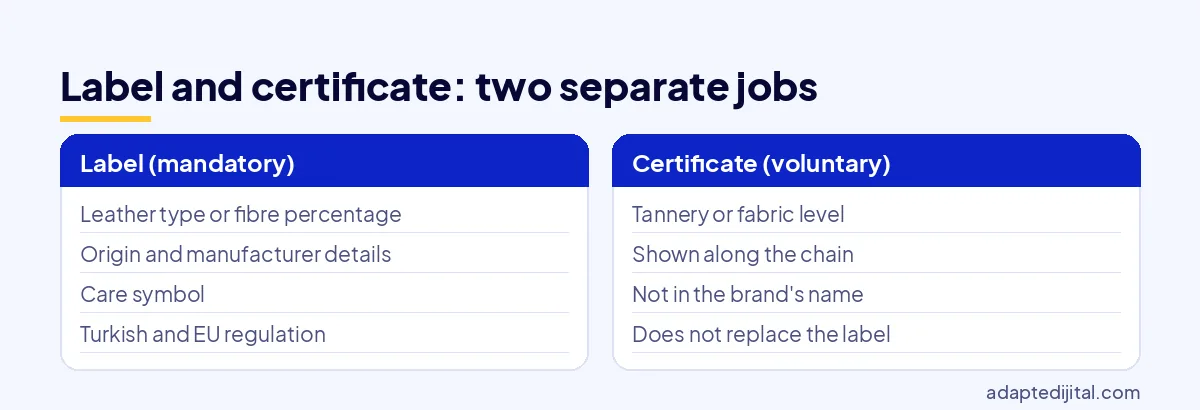
Market surveillance checks metal hardware such as clasps, zips and chains for nickel release, and leather and textile dyes for azo colourants. The label carries origin and manufacturer or importer details. The rules are quiet because the brand buys hardware in Tahtakale and leather in Tuzla and asks for no document.
One question for the hardware supplier
One question when buying clasps and zips: is there a nickel release test report? Hardware without one is cheap and makes the whole bag unsafe. Supplier choice: choosing a workshop for bags.
One question for the tannery
Ask the tannery for an azo dye and chemical limit declaration; voluntary certificates are part of the trail. A Leather Working Group certificate carries the tannery’s name, not the brand’s.
The manufacturer line
Whoever places the product on the market under their own name writes their registered name and contact on the label; the workshop’s name does not replace it. Origin follows the main body.
The three documents an inspection asks for
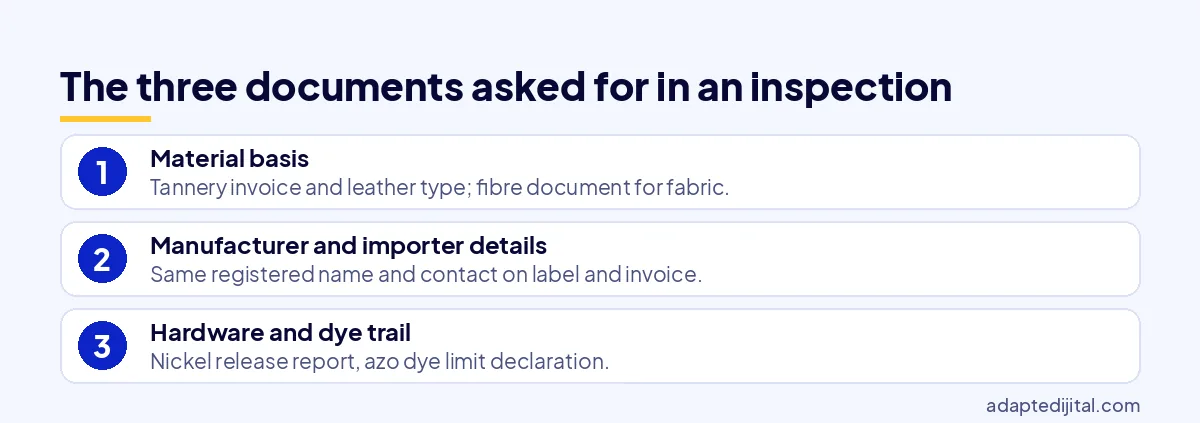
The inspector asks for three things: a document confirming the leather or fibre declaration, the manufacturer or importer details, and the test trail for hardware and dye safety. All three must be in the brand’s hands; the workshop or tannery holding them is not enough. Print this box.
The three-document box
Three documents on the table:
- Material basis: tannery invoice and leather type; for textile, the fabric supplier’s fibre document
- Manufacturer and importer details: registered name and contact of whoever places the product on the market, same on label and invoice
- Hardware and dye trail: nickel release report for clasps and zips; azo dye limit declaration or certificate chain
A document left at the supplier does not exist for the brand; responsibility lies with whoever places the product on the market.
The workshop contract line
Issuing the three documents in the brand’s name, or handing over copies, goes into the workshop contract, or nothing turns up on inspection day. With pattern ownership and price validity, it is one of five clauses.
The bag brand’s five precautions
BU BÖLÜMÜN ÖZETİ
- The five precautions
- The pre-launch check
- The industry picture
Five precautions before production: confirm the material declaration with tannery and fabric documents, check the label draft against the regulation, request the nickel report in writing, separate manufacturer and brand lines, claim a certificate only for the component it covers. All five are decisions, none made at the sales stage.
The five precautions
- Leather type on the tannery invoice, fibre percentage on the fabric document, not the workshop’s word
- Label draft beside the regulation clause: symbol or fibre name, order, percentage
- Nickel release report for clasps and zips, in writing, before ordering
- Manufacturer details and brand contact on separate lines; the brand is the named contact
- Certificate claim only for the component it covers; a tannery certificate is not the whole bag
The pre-launch check
These five form the label and packaging group of the 12-point pre-launch checklist; tick it before printing.
The industry picture
Route: the industry guide to starting a bag brand; decision order: the pillar article on starting a bag brand.
What does an inspection mean for a bag brand?
The loss is not the fine but the channel: the notice carries the brand’s name, concept stores and corporate buyers check the list, search results show the brand beside it. A small brand cannot absorb that. A correct label makes an inspection a day; a wrong one, a year.
The boutique and export side
A concept store wants the document in the consignment file, a European boutique before ordering; gaps mean rejection. Vegan leather reading PU: six things people get wrong about bag brands.
The consultant’s role
The consultant issues no documents; the consultant sets their order, their place in the contract and their counterpart on the label. Scope: brand consultancy; stage: which consulting a bag brand needs.
Summary and what to do today
The label is part of the product, a leather claim is read by what the buyer understands, and the documents stay with the brand. Today: compare five lines of your label draft against the regulation: material declaration, leather symbol or fibre percentage, origin, manufacturer details, care symbol. One doubtful line stops printing, not sales.
One check
Turn the bag over and put the three documents on the table: material basis, manufacturer details, hardware and dye trail. Three minutes; if one is missing, write to the supplier today.
The next article
The build from start to finish: the guide to starting a bag brand in nine steps; the label alongside your own product: the consult your expert form.
Frequently Asked Questions
Quick Summary
- The Ministry publishes unsafe product findings; a bag answers to three rule sets at once.
- A leather claim is read by what the buyer understands; faux leather is not leather, split is not full-grain.
- Textile bags need a fibre label; mixed products are declared part by part.
- Three documents in an inspection: material basis, manufacturer details, hardware and dye trail.
- Five precautions before production; the loss is not the fine but the channel.
Short Glossary
- Material declaration: the leather type, or the textile part’s fibre content, stated on label and page
- Nickel release: nickel given off by hardware on skin contact, tested against a limit
- Azo colourants: a dye group, certain types banned in leather and textiles and tested for
- Placing on the market: selling under one’s own brand and carrying the legal responsibility
Next Step
To read your label draft with the three documents, the consult your expert form; scope on the brand consultancy page. Next: how to start a bag brand in nine steps.
Updated: October 2026
Sık Sorulan Sorular
No; without real leather the word and the symbol cannot be used. Leather-look or vegan leather are also misleading if they leave the impression of leather.
Fibre content with standard names and percentages by weight; origin and manufacturer or importer details. A marketing name does not replace the fibre name.
A nickel release test report for clasps, zips and chains; an azo dye limit declaration for dyes, obtained in writing before ordering and kept by the brand.