
Accountants and the digital company: will exemptions grow, what do technoparks gain?
An assessment published in 2026 by a sworn-in certified public accountant’s office (yeminli mali müşavir, YMM) predicts that the exemptions, exceptions and conveniences granted to the digital company (dijital şirket) will continue and grow. According to the note, technoparks and technology-based startups will gain additional financial advantages. This is a professional opinion, based on the wording of the 2027-2029 Medium-Term Programme and the exemption provision added to Law No. 5746 on 4 June 2026. As of October 2026, when this article was last updated, the Ministry of Industry and Technology had not published its digital company definition.
What this means for you: if you ask your accountant about the digital company today, you will not get a definite answer, but you can hear three concrete things.
What do accountants expect from the digital company, and what is the opinion based on?
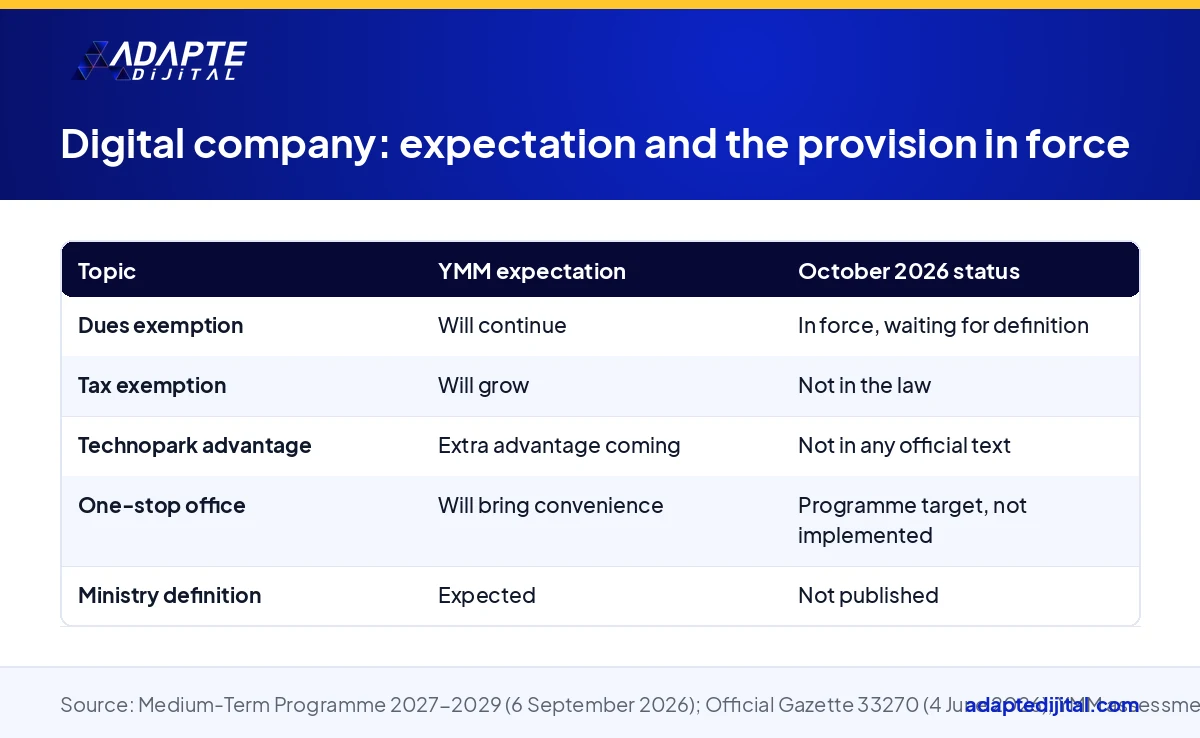
The expectation fits into three sentences: exemptions will continue and grow, technoparks will come to the fore, and technology-based startups will gain extra advantages. All three are opinions; none is written this clearly in an official text.
The difference between an opinion and a provision
The accountant’s expectation rests on the programme wording; the provision in force is only the dues exemption. Telling a client that a tax exemption is coming has no basis today; saying that the programme targets exemptions is correct. For the concept as a whole, see our guide to what a digital company is.
What is in force today, and what does the 4 June 2026 addition say?
The only provision in force is the exemption added to Law No. 5746 by Article 11 of Law No. 7582. Its scope is TOBB (Union of Chambers and Commodity Exchanges of Türkiye), chamber and exchange fees and dues; its duration is up to three years from incorporation. Dues, not tax.
Will exemptions grow, and is the basis of the expectation enough?
BU BÖLÜMÜN ÖZETİ
- The programme shows a direction, not a rate
- The target in the Ministry’s report was missed
- The status or entity type uncertainty
The basis has three parts: the programme wording, the Minister’s statement and the addition to the law. All three point the same way, but only the last is in force. An expectation of growth is reasonable; there is no date and no rate.
The programme shows a direction, not a rate
The programme wording shows a direction of convenience and exemption; it does not answer which tax, up to what scale, or for how many years. For an accountant, that is not enough to write a figure into a client’s plan.
The target in the Ministry’s report was missed
The Ministry’s 2025 Institutional Financial Status and Expectations Report targeted the digital company scheme for the end of 2025. The target was missed; no new date was given. The delay does not disprove the expectation of growth, but it makes the timetable uncertain.
The status or entity type uncertainty
The first question Vircon Legal asked is still open: is the digital company a status or a company type? How the exemption applies to limited liability and joint stock companies depends on it. No new company type has been created. Details are in our guide to whether the digital company is a new entity type.
Does a technopark startup gain extra advantages from the digital company?
BU BÖLÜMÜN ÖZETİ
- The incubator condition points to the technopark
- The existing withholding incentive and the 2028 threshold
- The extra advantage expectation stays at opinion level
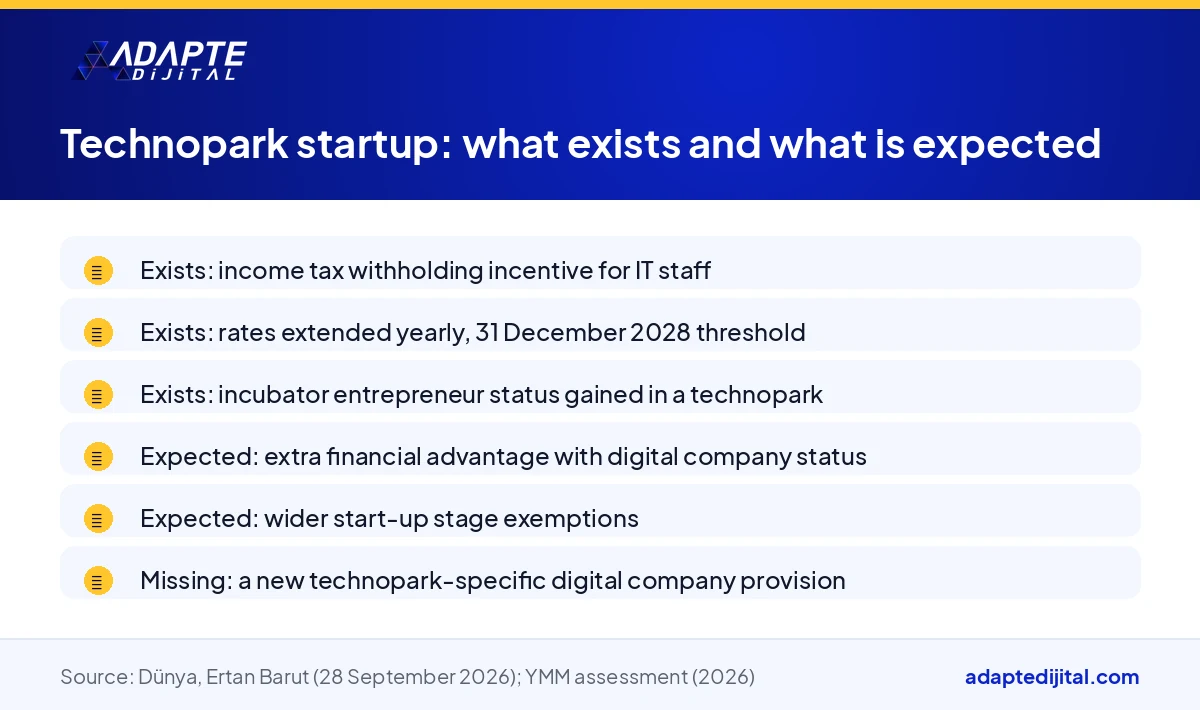
The YMM opinion brings technoparks and technology-based startups to the fore. Its basis is two things: the incubator condition in the exemption provision and the existing incentives of technoparks.
The incubator condition points to the technopark
The exemption provision requires incubator entrepreneur status, acquired through a technopark, an incubation centre or a TEKMER (technology development centre). So the first beneficiary will be the technology-based startup.
The existing withholding incentive and the 2028 threshold
An income tax withholding incentive for IT staff in technoparks and R&D centres exists today; the rates are extended yearly, and 31 December 2028 is the critical threshold. The relationship between digital company status and this incentive has not been defined. We covered it separately in our article on whether the technopark withholding incentive ends on 31 December 2028.
The extra advantage expectation stays at opinion level
The YMM note expects technoparks to gain additional financial advantages; it does not say which. No official text contains a new technopark-specific digital company advantage. An accountant can pass this on to a client as possible, not certain.
How does the digital company question land on an accountant’s desk?
The typical scene: the founder of a software company about to be incorporated says, let’s set it up as a digital company. The accountant has no type, no status and no definition to work with. The example below is a composite; it does not describe a particular office or person.
Division of labour: the accountant and the digital side
The accountant runs registration, tax and the books; the domain name, website, AI-SEO-ready content and accounts are not on that desk. Our guide to the accountant incorporated the company, who builds the digital side explains this division of labour and the first 30 days after incorporation.
Which three things can an accountant tell a client today?
BU BÖLÜMÜN ÖZETİ
- Choose the registration date deliberately
- Build the incubator link now
- Plan the digital record together with incorporation
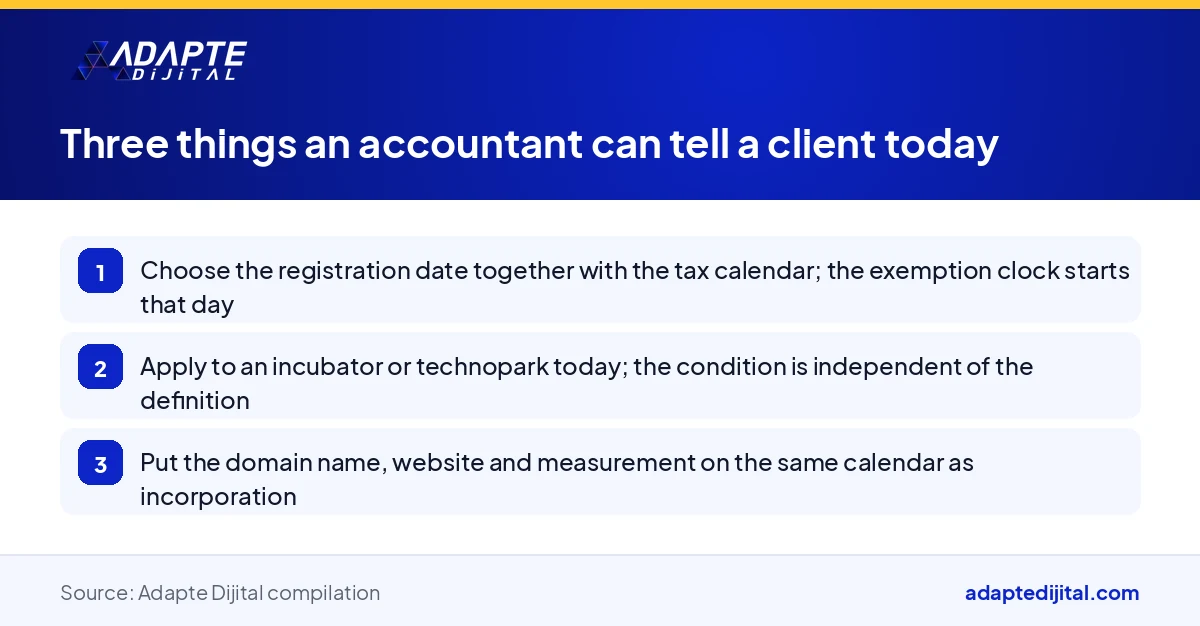
Three things are certain: the exemption depends on the incorporation date, the incubator link is a condition, and the digital record is independent of the definition. All three hold whether or not the definition arrives.
Choose the registration date deliberately
The exemption runs for up to three years from incorporation; the registration day starts the clock. The KOSGEB Business Setup Support period also begins at incorporation. The accountant should plan the registration day with the tax calendar. Since the definition is not out, the date cannot be tied to it.
Build the incubator link now
Incubator entrepreneur status is the second condition of the exemption, and it should be ready when the definition arrives. An application to a technopark, an incubation centre or a TEKMER can be made today, and the accountant can direct a technology-based client to it now. Half of the condition is then ready.
Plan the digital record together with incorporation
The domain name, website, 108 articles, accounts and measurement are independent of the definition. We build this plan, which runs alongside the accountant, in our adaptive business model and digital transformation management service. We update developments on our digital company page, where we collect every question on the topic.
Quick Summary
- A YMM assessment (2026) expects digital company exemptions and conveniences to continue and grow; this is an opinion.
- The only provision in force is the exemption from chamber and exchange dues for up to three years, added to Law No. 5746 on 4 June 2026.
- The Medium-Term Programme set the digital company scheme as a target on 6 September 2026; it gave no rate or duration.
- Minister Kacır spoke of a scale-based tax exemption on 27 April 2026; it did not enter the law.
- The Ministry’s digital company definition had not been published as of October 2026.
Short Glossary
- Sworn-in certified public accountant
- Sworn-in certified public accountant (yeminli mali müşavir) is the professional authorised to certify financial statements and give opinions on tax matters.
- Exception
- Exception (istisna) is the term used when taxable income is left outside taxation under specific conditions.
- Secondary legislation
- Secondary legislation is the set of regulations and communiqués issued to determine how a law is applied.
Frequently Asked Questions
Next Step
If you want to plan your company’s digital side together with incorporation, book a discovery call on our digital company page and review the My Digital Company (Dijital Şirketim Olsun) delivery list; we stay your friendly adviser throughout your digitalisation journey.
The definition and conditions of the digital company scheme are not final yet; support amounts and conditions may change. Check the latest information with the Ministry of Industry and Technology, KOSGEB and the Official Gazette before deciding. This is not legal or financial advice.
Sources: AA, Medium-Term Programme report (10 September 2026) · Official Gazette, Issue No. 33270, Law No. 7582 (4 June 2026) · Vircon Legal, Is the digital company coming to Türkiye (18 June 2026) · Dünya/AA, Minister Kacır’s statement (27 April 2026) · Sworn-in certified public accountant’s office assessment (2026, undated)
Updated: October 2026
Sık Sorulan Sorular
The note reports that the digital company appears in the Medium-Term Programme under the heading of innovative processes that ease incorporation and provide start-up stage exemptions. From there it expects exemptions and conveniences to grow. The note is undated; it was published during 2026.
The 2027-2029 Medium-Term Programme was published on 6 September 2026 in repeated Official Gazette issue No. 33362. According to the Anadolu Agency (AA) report of 10 September 2026, the programme sets the digital company scheme and the one-stop office as targets. The type, rate and duration of any exemption are not in it. A programme sets targets; implementation comes through secondary legislation.
It covers companies that fit the Ministry’s definition and are founded by persons with incubator entrepreneur status under Law No. 4691. Because the definition has not been published, the first cannot be met today. The provision is explained item by item in our guide to the exemption from TOBB dues for up to three years.
The chamber registration fee and annual dues are among a new company’s fixed costs. An exemption of up to three years zeroes this item; the amount varies by chamber and capital. An accountant can put it into the expense plan with the note “if the definition arrives”.
On 27 April 2026 Minister Kacır spoke of a tax exemption up to a certain scale; the wording did not enter the law. On 18 June 2026 Vircon Legal wrote that how the threshold would be defined, and how abuse would be prevented, remained open questions. Our guide to whether digital companies will get a tax exemption separates what is certain today from what is not.
The answer is no: there is no digital company option in MERSİS (Türkiye’s Central Registry System); a company is incorporated as a limited liability or a joint stock company. Whether an existing company will count as compliant when the definition arrives is also unclear. Postponing incorporation is a separate decision.
The exemption runs from the date of incorporation, so timing incorporation to the definition is a calendar decision for some founders. But a company that waits also puts its sales, KOSGEB application and digital record on hold. The accountant weighs this balance with the client.
No. The only provision in force is the dues exemption of 4 June 2026. A tax exemption was mentioned in the Minister’s statement of 27 April 2026 but did not enter the law; its threshold and scope are undefined.
Not today. There is no digital company option in MERSİS; a company is incorporated as a limited liability or a joint stock company. Because the Ministry’s definition had not been published as of October 2026, no compliance check can be made either.
There is no such advantage in any official text. The YMM opinion expects it, because the exemption provision requires the incubator condition and technoparks meet that condition. The expectation is possible, not certain.