
When the digital company definition is published, what should change on your website?
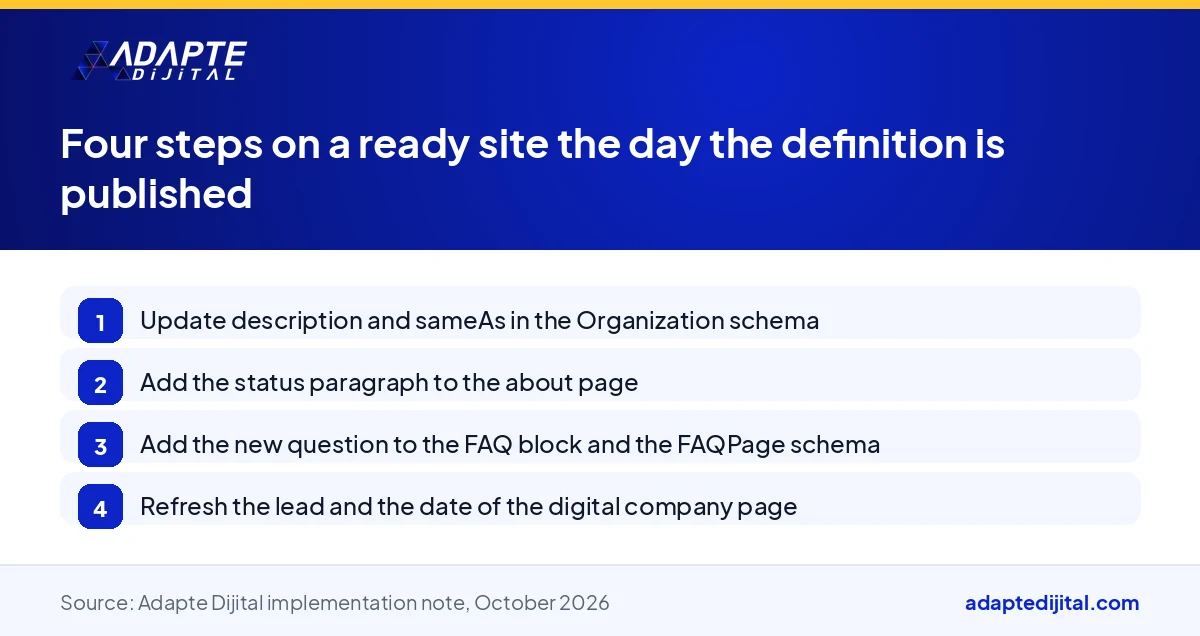
The day the digital company (dijital şirket) definition is published, four places on your website change: the Organization schema, the about page, the FAQ block and the digital company page. As of October 2026 the Ministry of Industry and Technology had not published the definition (KOSGEB announcement, 12 October 2026). The only provision in force is the dues exemption in Law No. 7582 of 4 June 2026, and it too depends on the definition.
What this means for you: the definition will arrive one day, and a company with a ready website will update a few sentences. A company without a website has nothing to update. This article explains what changes on a ready site on definition day and what stays put.
What changes first on a website when the digital company definition is published?
The sentences in which the company describes itself change first. The form of the definition is not clear: Vircon Legal’s assessment of 18 June 2026 leaves open whether it will be a company type or a status. Either way, what enters the site is short: that the company fits the definition, from which date, and on what basis.
What does not change: domain, page plan and articles
The domain, 6 main pages, 12 sub-pages, 6 categories and 108 articles stay in place. They are built around the customer’s question, not around legislation. The backbone of an AI-ready, user-friendly site is planned independently of the definition, which only adds a layer on top.
How is the Organization schema updated for the digital company definition?
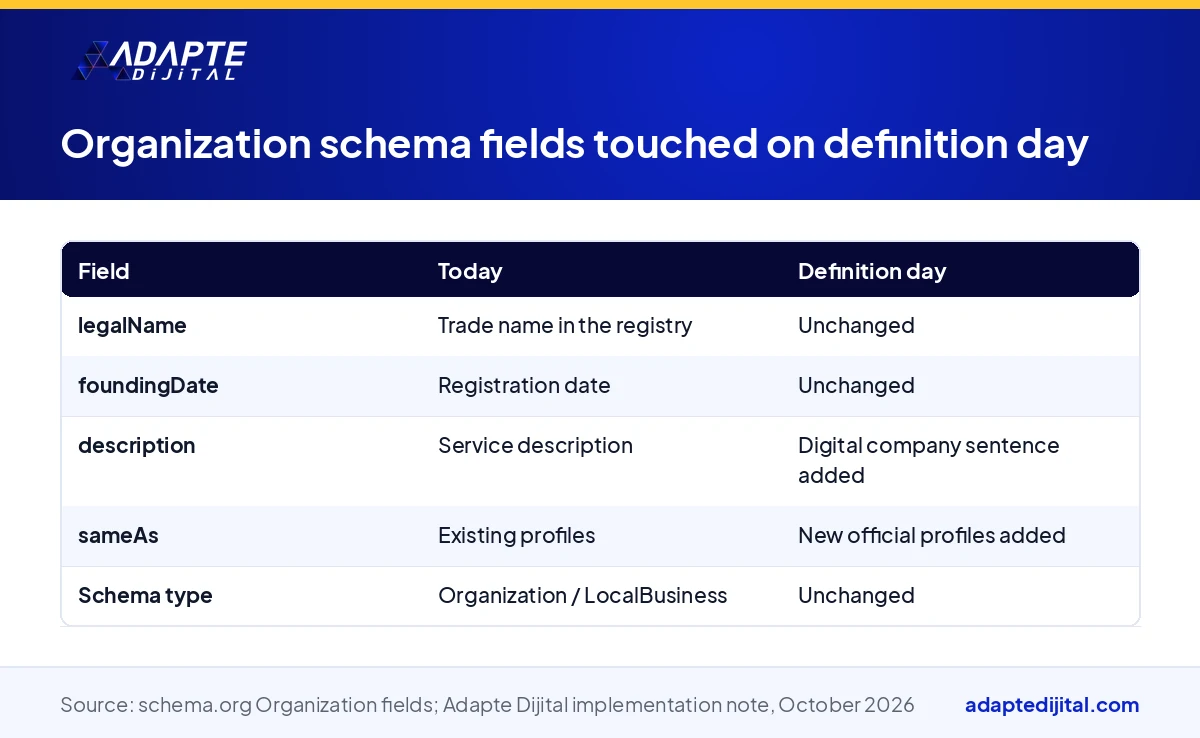
The Organization schema is the structured data block in which your site tells search engines and AI models who the company is. On definition day a few fields are added or corrected. A delivered site already has this block; the update is an edit, not a rebuild.
How should the about page be written for the digital company definition?
The about page is where most sentences change on definition day. Today it explains what the company does, for whom and from where. When the definition arrives, a short status paragraph is inserted; the rest of the page stays as written for the customer.
Trade name, registration date and the status sentence
Three facts sit in one paragraph: the registered trade name, the registration date and the sentence on fitting the definition. The match between trade name and domain shows here; without it, an AI model may see two separate companies. How to build that match is in our article on domain name and trade name alignment.
What not to write: incentives that are not final
The tax exemption, remote incorporation and Terminal Istanbul perks were announced on 27 April 2026, but their secondary legislation has not been published. They do not go on the about page as benefits the company enjoys. If they do, customers and banks will try to verify them and fail. The site describes what the company has today, not what it is waiting for.
Why open the digital company page and FAQ before the definition?
Because search engines and AI models use a page not on the day it is published but after they have read and come to trust it. A page opened on definition day is invisible that day. A page opened today is only updated, and the update is picked up quickly.
Once the definition is out, what does the site show on KOSGEB, accounts and measurement?
According to KOSGEB’s announcement of 12 October 2026, a Platform Costs Support for digital companies was added to Business Setup Support; the amount was not announced and the scope depends on the definition. On the site this appears as information only, not as a support received.
Google Business Profile and social account descriptions
The 3 social media accounts and the Google Business Profile opened with the site carry the same description sentence. The sentence that changes on definition day is carried over to these accounts too. Five different descriptions in five places mean five separate companies to an AI model. Because the accounts are in the company’s name, you make this update from one place.
What does a company without a website lose when the digital company definition is published?
It loses the day, because it has nothing to adapt. On that day founders, accountants and customers look for answers, and companies with ready sites give them. The difference is made in time, not in code.
Nothing to adapt, everything to build
A company that starts its site on definition day needs a domain, then hosting, then a page plan, then content; each step depends on the one before. On a ready site this chain was built long ago; the job is a few paragraphs and one schema field.
AI reading time cannot be skipped
Search engines and AI models take time to recognise a site and use it in answers. This time cannot be bought, only gained by starting early. Being ready on definition day means having been read before that day.
Quick Summary
- The Ministry’s digital company definition had not been published as of October 2026.
- On definition day four places on the site change: Organization schema, about page, FAQ, digital company page.
- The domain, 6 main pages, 12 sub-pages, 6 categories and 108 articles stay independent of the definition.
- The dues exemption of Law No. 7582 (4 June 2026) is written on the site only if both conditions are met.
- KOSGEB Platform Costs Support was announced on 12 October 2026; its amount and scope depend on the definition.
Short Glossary
- Organization schema
- Organization schema is the structured data block used to tell search engines and AI models a company’s name, founding date and official profiles.
- FAQPage
- FAQPage is the schema type used to mark up a page’s questions and answers so that a search engine can read them directly.
- legalName
- legalName is the field used to state a company’s full registered trade name within structured data.
Frequently Asked Questions
Next Step
If you want a website that will be updated on definition day, book a discovery call on our digital company page; we build your company’s digital side from domain name to measurement.
The definition and conditions of the digital company scheme are not final yet; support amounts and conditions may change. Check the latest information with the Ministry of Industry and Technology, KOSGEB and the Official Gazette before deciding. This is not legal or financial advice.
Sources: Official Gazette, Issue No. 33270, Law No. 7582 (4 June 2026) · Vircon Legal, Is a digital company coming to Türkiye? (18 June 2026) · KOSGEB, Entrepreneur Support Programme renewed (12 October 2026) · Dünya/AA, Minister Kacır’s announcement (27 April 2026)
Updated: October 2026
Sık Sorulan Sorular
Only the part that concerns your company, not the whole text. For example: “Our company was incorporated in line with the Ministry’s digital company definition.” Add the date and the official basis. The concept is explained in our guide to what a digital company is, and your site stays focused on its own service.
Nothing is lost. Your site today describes a company that runs its business digitally. If the definition turns out narrow and your company falls outside it, the “digital company” page stays an information page and no status claim is added. We post every development on our digital company page.
Four fields stand out: legalName (registered trade name), foundingDate (registration date), description (short description of the company) and sameAs (official profile addresses). When the definition is out, the digital company sentence goes into description. Because the exemption runs from the date of incorporation, foundingDate must match the registry exactly.
No. The schema type follows how the company serves its customers: a business that receives customers at a fixed address uses LocalBusiness, a company serving remotely or across a region uses Organization. For virtual office addresses, see our article on where a virtual office company appears on maps.
On definition day a new question is added: “Is your company a digital company?” The answer is the same sentence as on the about page. The question goes into both the visible FAQ block and the FAQPage schema. When both carry exactly the same text, an AI model takes the answer without hesitation; if the two differ, trust drops.
Only if it is in force and applies to you. Article 11 of Law No. 7582 grants up to three years of exemption from TOBB, chamber and exchange dues to companies that fit the definition and whose founders hold incubator entrepreneur status. If you meet both conditions, state it in one sentence. Details are in our article on the TOBB and chamber dues exemption.
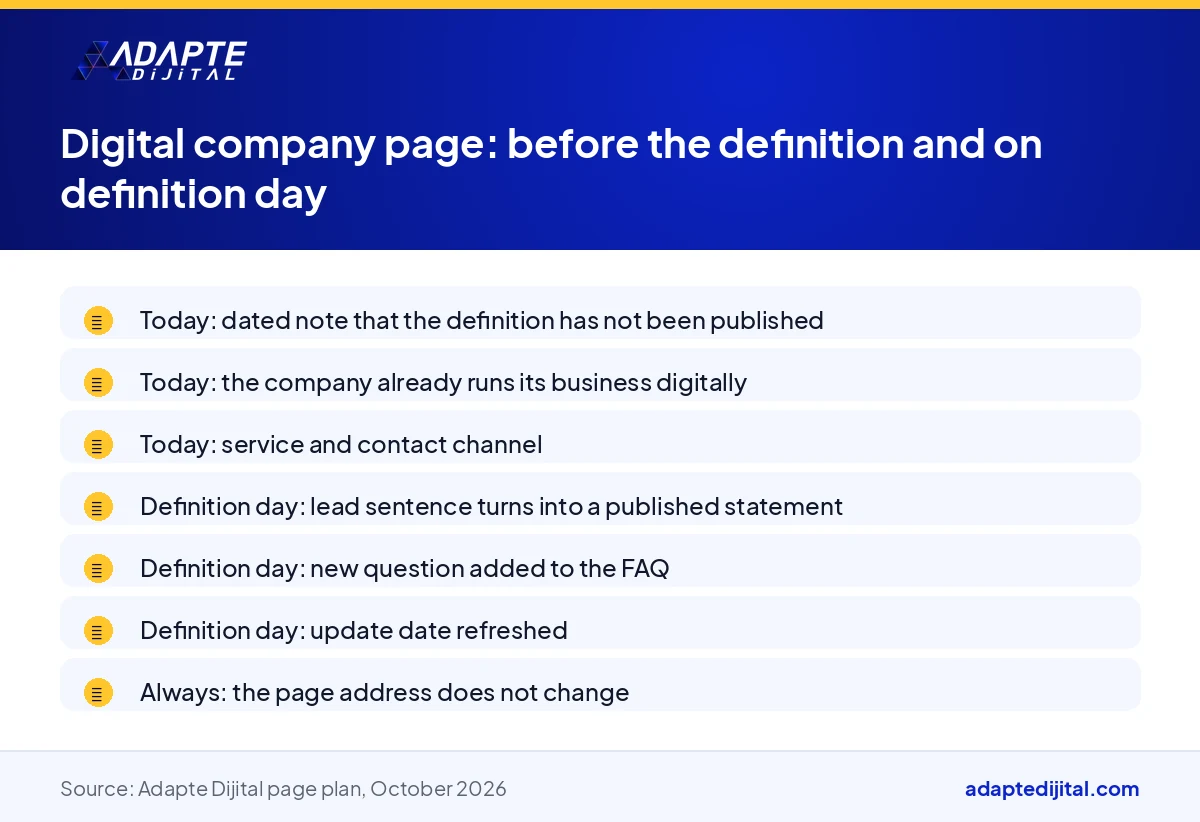
Three things: that the Ministry’s definition is not yet published, that the company already runs its business digitally, and how a customer can reach it. The page is not a legal article; it links to sources on the legislation and returns to its own service.
The lead paragraph changes, the “not yet published” sentence becomes a dated “published” sentence, a new question joins the FAQ and the update date is refreshed. The page address does not change; if it did, the accumulated trust would reset to zero. These four operations fit into one working day because the skeleton is ready.
The 108 AI-SEO articles are spread across 6 keyword groups. One group can be reserved for the company’s incorporation and status questions. The cluster marks in advance the articles to update on definition day. An AI model that sees several consistent pages from one site takes the company as a source; a single page cannot build that consistency.
If your company actually receives a KOSGEB support, yes; if you have only applied, no. The programme page of KOSGEB Business Development Support (İş Geliştirme Desteği) lists software and service purchases among the supported items; KOSGEB decides which expenses are accepted. Who the Platform Costs Support will cover is in our article on the platform fee support.
In Search Console, queries containing “digital company” and impressions of the digital company page are watched. If these queries rise on definition day, the page’s readiness pays off. How to read measurement after delivery is in our article on the first 90 days of measurement.
The site delivered in Adapte Dijital’s My Digital Company (Dijital Şirketim Olsun) campaign comes with an Organization schema, an FAQ block and a digital company page; the places to update are known. Because the domain and hosting are in the company’s name, you make the update or we do it for you. The website plan is explained on our website consulting page.
No. The domain, page plan and articles stay in place. What changes is a few fields in the Organization schema, the status paragraph on the about page, the new question in the FAQ and the lead text of the digital company page.
Not as a status, because the Ministry’s definition had not been published as of October 2026. You can say that you are a company that runs its business digitally; the status claim is added once the definition is out and your company falls within it.
Mostly the description field; legalName and foundingDate should already match the registry. New official profile addresses are added to sameAs. The schema type, Organization or LocalBusiness, does not change with the definition.