
“Let’s Register You With ChatGPT”: How to Tell an AI SEO Charlatan From a Real Expert

The phone rings: “Good afternoon — we’ve entered the age of artificial intelligence, and your brand still hasn’t completed its ChatGPT registration. Your competitors are in the queue, and our quota for this month is almost full.” In ten minutes you hear three technical terms, two fear-inducing sentences and one discount. When you hang up, a single question remains: “What if it’s true?”
It isn’t. But these calls work not because you are naïve but because the field is new: the topic is fresh, information is scarce, fear is recent — the charlatan’s three favourite things at the same table. Real experts are in the crowd too; their voices are just quieter and their promises more modest, which makes them harder to hear.
This article is a set of filters: the charlatan’s phrasebook, the real expert’s behavioural signature, the grey zone in between and a ten-minute meeting filter. By the end, those calls will not make you sweat again.
Why Are There So Many Charlatans in This Field?
First, let us understand the enemy — not the person, but the conditions. Charlatanism flourishes in every new market, and this one has four fertilisers at once.
How the four conditions work:
The Charlatan’s Phrasebook: When You Hear These, Stand Up
Now the phrasebook. These lines come alone or in chorus; even one is a reason to leave the table.

Inside each family:
The Real Expert’s Behavioural Signature
The mirror side of the phrasebook: how do you recognise a real expert? Again, not by sentences but by four behaviours.
The signature has four strokes:
The Grey Zone: Not Charlatans, but Not Enough
An honest filter separates grey from black. The market also has two well-meaning but incomplete types; treating them as charlatans is unfair, treating them as experts is wasteful.
Two types, four questions:
The Ten-Minute Meeting Filter
Let us reduce it all to a pocket-sized set: four questions for the first ten minutes of the first meeting, and how to score them.
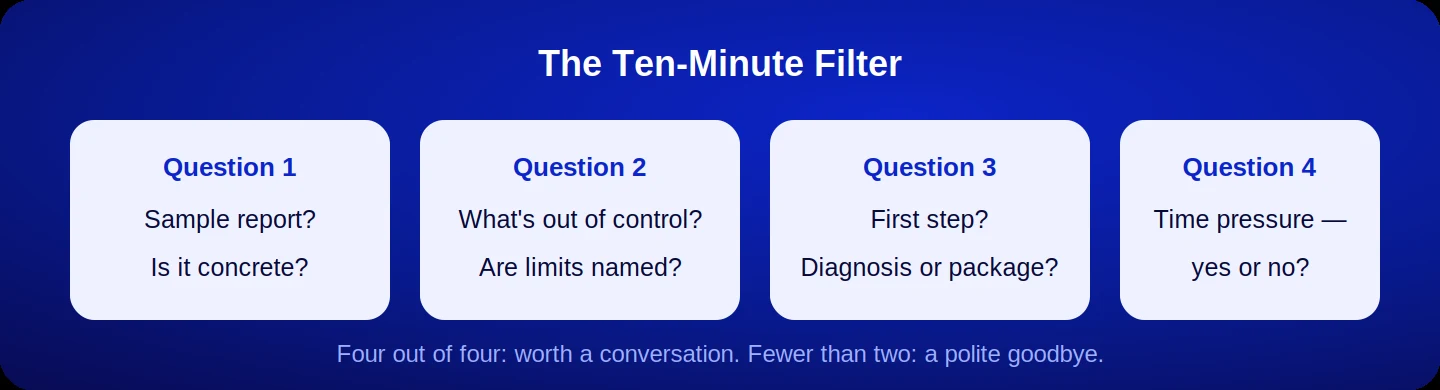
Using the filter:
If You Were Fooled: Damage Assessment and a Clean Exit
The last section is the one nobody wants to write but the field needs most: what if you already said yes to that phone call?
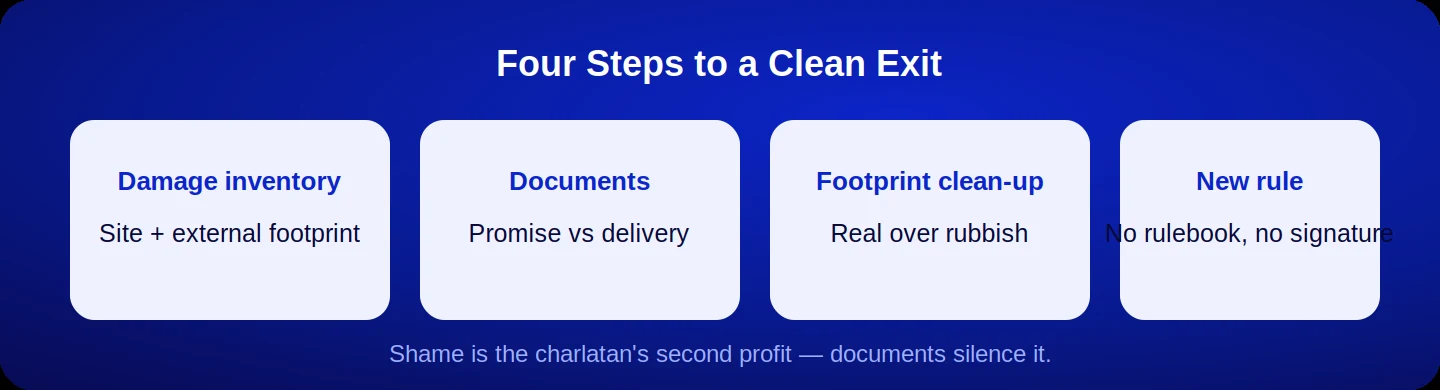
The four-step exit:
Field Notes
· The most creative answer we have heard to “show me the address of the registration desk”: “that information is confidential.” Selling registration at a secret desk — the sentence refutes itself.
· The most common place to fail the second filter question: answering the limits question with “we handle everything.” Those who handle everything usually turn out to measure nothing.
· The shared sentence of brands that were fooled: “we didn’t tell anyone.” Those who do tell gain two things: a documented chance of recovery and a circle of peers who won’t fall for the same number.
Mini Glossary
Four families of phrases: The charlatan’s signature — registration, guarantees, algorithm loopholes, false urgency.
Behavioural signature: The expert’s marks — diagnosis first, rulebook transparency, statement of limits, attitude to time.
Ten-minute filter: A four-question quick screen: sample report, what’s out of control, first step, time pressure.
Quick Summary
· Charlatans are caught by behaviour, not promises: a non-existent process, an unkeepable guarantee, an unknowable loophole, false urgency — any one is a reason to leave.
· The real expert’s signature: starts with diagnosis, shows the rulebook up front, names limits, leaves you time; the grey zone is separated by tests.
· The filter fits into two questions: “Sample report?” + “What can’t you control?” If you were fooled: damage inventory, documents, footprint clean-up, no signature without a rulebook.
Your Next Step
Save the four questions in your phone’s notes; open them the next time an “AI opportunity” call comes and ask them. If you are curious about the answers — or want to discuss the damage of a past signature — a preliminary assessment takes five minutes. Neighbouring doors: the guarantee fairy tale and the pricing logic.
Frequently Asked Questions
Can a big, well-known agency be a charlatan, or is this a small-player problem?
Size does not whitewash behaviour: the four families of phrases can come from a small office or a glass tower — in the tower the packaging is nicer, the sentence is the same. The reverse is true too: a young two-person team can pass all four filter questions with flying colours. That is why the filter looks at behaviour, not logos. Assuming “a big agency wouldn’t do that” means switching the filter off — and a switched-off filter is exactly what charlatans love most.
Should I expose the charlatan to the industry?
Separate two channels. A documented complaint — to consumer and trade authorities or professional bodies — both pursues your rights and protects the next person; do that. Public shaming — naming names in a social media campaign — cuts both ways: even with a documented claim you may face legal counter-moves. The practical middle path: go to official channels with documents, and tell your circle in the language of experience (“if you hear these promises, be careful”). The goal is not revenge but a market that gains a ruler.
Do firms selling proven software tools fall under this filter too?
Distinguish tool sellers from service sellers. A firm selling a measurement or analysis tool makes a testable claim when it says “our tool measures this” — you verify it with a trial, and the filter runs quickly. Charlatanism can come dressed as a tool too, though: a product that claims “our software registers your brand with AI” is the first phrase family put in a box. The rule stays the same: if the claim is measurable, listen; if it is an unmeasurable promise — even packaged as software — say goodbye.
Sık Sorulan Sorular
The field is so new that buyers have no comparison ruler: there is no settled answer yet to “what is a normal price, a normal timeline, a normal promise?” In a market without rulers, the loudest claim sounds like knowledge. This whole series — from the guide to this article — exists to put that ruler in your hands.
Because it has a real core: the shop window really is moving, and not being mentioned really does cost something. The charlatan takes that real core and wraps it in false urgency: “this month”, “limited places”, “last chance.” The real loss unfolds over months, and its unexaggerated version is written up separately; weekly panic selling is an abuse of that core.
The charlatan. Because mention measurement is not yet a common habit, the sentence “we’re working on it” can live unchecked for months; invoices are issued and no one asks for reports. The client who asks for measurement is the charlatan’s least favourite client — a brand that asks for the rulebook in the measurement article has hired its own guard in this market.
AEO, GEO, LLMO, AIO — the acronyms are legitimate concepts, but they can also be used as smoke: a ten-term presentation can fill half an hour without committing to a single concrete output. A simple rule: when the terms are many, count the outputs. If there are no counted outputs, the acronyms are a curtain — and behind the curtain there is usually an old package.
Because it is the most convincing: it sounds like an official procedure — like tax registration or trademark filing. But there is no desk where brands are registered with assistants; mentions come from footprint, as explained in the recommendation map. Its cousins in the same family: “adding you to the AI database”, “sending your brand file”, “listing in the AI directory.” One question answers them all: “Show me the address of the registration desk.”
The raw version is “guaranteed number one”; the made-up versions are “money back if you don’t appear”, “100% mention rate”, “we’ll put it in the contract.” The make-up inspires trust, but the physics does not change: no agency controls an assistant’s answer — a guarantee on something uncontrolled cannot be sold. The full dissection of this family is in the guarantee article, including the trap inside refund promises.
“We’ve found a loophole in the algorithm that nobody knows about” is one of two things: a lie or a danger. If it is a lie, you lose your money; if it is true — if shortcuts aimed at tricking the system are really being tried — your brand’s footprint gets contaminated, and cleaning up costs more than building. The damage map of shortcut promises is in the risk article; a single sentence from this family should send you to both articles.
Because its job is to prevent thinking: if the first three families lose to your logic, the fourth gives logic no time — “decide today.” The real expert’s calendar is the opposite: it asks for a diagnosis, leaves room to think and is glad when you compare. The only seller who makes you watch the clock is the seller to walk away from. For the general framework of your rights against misleading commercial practices, the Ministry of Trade is a useful reference to keep at hand.
In the first meeting you hear questions, not a sales pitch: what do your customers ask, on which fronts do you want to be mentioned, who are your competitors? And the first offer is a measurement: the mention snapshot described in the guide. Where the package comes first, the diagnosis never comes; where the diagnosis comes first, the package arrives with its reasons.
Before the contract, three things are on the table: a sample report, the tracking rhythm and the list of outputs — with numbers. The expert does not wait for you to ask; they bring them, because being measured works in their favour: good work shows on the scoreboard. A relationship where you have to wrestle the rulebook out of the agency is tired before the signature.
“Here is what we can’t control: changes in assistant behaviour, competitors’ moves, answers varying from person to person” — whoever says this unprompted has given you the most valuable thing: a sample of their honesty. Whoever claims to control everything turns to excuses in the first bad month; whoever knows their limits turns to analysis.
A real expert does not create time pressure, but does not avoid a timeline either: “think it over, compare; if we start, here is what the first quarter looks like” — the honest frame in the timing article. They sell neither urgency nor inertia: they state the genuine advantage of starting early without exaggerating it. The difference is subtle, and that subtlety is the mark of the craft.
An agency that has done SEO for years, added “AI” to its package name but not changed its contents: no bad intent, no new muscle either. The way to recognise it is the four competence tests — especially the measurement and off-site tests. A path with a relabeller is possible too: give them the old work until they pass the tests, the new work once they do.
The field is new; everyone started somewhere. Three conditions make a beginner acceptable: they say they are a beginner, they price accordingly, and they put measurement in place from day one. With all three, they can be a highly motivated travelling companion. If they sell inexperience as expertise, they have left the grey zone and entered the first page of the phrasebook.
Not “we’ve worked with hundreds of brands”, but a single concrete case: which brand, on which questions, what movement — ideally confirmed by that brand. Because the field is new, nobody has a long case list; that is normal. What is abnormal is filling the natural gap of newness with a fake crowd: brand logos used without permission are the classic décor of this market — one phone call exposes them.
Neither, on its own: there are expensive charlatans and reasonably priced real experts. But the extremes carry information: far below the market usually means inexperience or careless automated production; far above it, if it cannot be justified with the budget items, means label inflation. Price is not the filter; its justification is.
“Can I see a sample report?” and “What can’t you control?” — one measures muscle, the other character, and a charlatan cannot pass both: if they fake a report they stumble on limits, if they have memorised limits they cannot produce a report. The pair breaks the one-question memorised defence, which is why they are asked back to back, in that order.
“If we started working with you, what would the first step be?” — it looks like an innocent opener; it is really a reflex test. Opening with a diagnosis shows craft; opening with a package and a price shows a printing press. If the answer comes back ornate but empty — “we’ll prepare a bespoke strategy” — the follow-up is ready: “What is that strategy’s first concrete output, and in how many days?”
Simply: pass or fail for each question. Four out of four is an invitation to a deeper meeting; three out of three plus one hesitation is settled in a second meeting; fewer than two is a polite goodbye — however sweet the timeline, however tempting the price. The filter score is not traded against beautiful references: décor is cheap, behaviour is expensive.
The prepared: a brand owner who arrives with five examples of customer questions, a screenshot where a competitor is mentioned and these four questions keeps control of the meeting’s direction. The unprepared get carried along by the presentation. The long version of the ten-minute filter — the full pre-contract question set — is waiting in the first-meeting article.
Three questions: what was lost besides money? If you gave access to your site, what changed — added pages, outgoing links, altered settings? What was produced in your name elsewhere — spam content, fake profiles, irrelevant listings? If a technical eye is needed for the assessment, website consulting comes in; without a damage inventory there is no repair plan.
Gather the paperwork: contract, correspondence, records of what was promised, invoices. If the gap between promise and delivery is documented, the conversation about refunds and termination grows stronger; if the dispute escalates, official channels for commercial rights are open. Tie the emotional side to paper as well: shame is the charlatan’s second profit — once documents speak, shame falls silent.
The rubbish produced in your name — spam listings, inflated profiles, low-quality content — is identified and removed where possible, and whatever cannot be removed is covered with real footprint: in the right sources, in the right language, patiently. The clean-up plan uses the same muscles as normal footprint-building; a bad experience does not change the curriculum of good work, it only adds a repair chapter at the start.
No signature without a rulebook: from now on every proposal — whoever it comes from — passes through the sieve of four items, counted outputs, a sample report and a statement of limits. If you want a travelling companion who runs that sieve on your behalf, our AI SEO service page explains how we work; the preliminary assessment door is open, and we will listen without judgement. We start with a diagnosis — as always.