
Can a Small Brand Get Recommended by ChatGPT? Does AI Visibility Work for Small Businesses?

We know the sentence going through your head: “This is a game for the big players. ChatGPT recommends famous brands; who is going to count my three-person business?” The sentence sounds so reasonable that most small business owners leave the game without trying — and that very exit turns the sentence into a self-fulfilling prophecy: whoever does not play is, of course, never mentioned.
Yet on the assistant’s scales, “size” is not what you think. It does not ask about turnover, headcount or a photograph of your office tower. What it looks at is footprint — and footprint, on the right front, is something a small brand can thicken too.
This article dismantles the size myth, honestly weighs the real advantages and real disadvantages of being small, and then gives a roadmap that starts from a narrow front. Being small is not an excuse; it is a strategic variable — and an advantage for those who use it well.
The Size Myth: Where Did It Come From, and Why Is It Wrong?
First, let us understand the myth at its roots — because a myth that is not uprooted comes back to the strategy meeting.
The four roots of the myth:
What Does “Size” Mean on the Assistant’s Scales?
Now let us look at the scales themselves: when an assistant weighs a brand, what does it call “big”?

Four lessons from the language of the scales:
Three Natural Advantages of the Small
Let us draw strategy from the scales: a small brand sits at this table with three natural cards.
The cards:
The Honest Side: The Small Brand’s Real Disadvantages
Let us not tell fairy tales while giving courage; three disadvantages are real, and each has a remedy — not a free one.
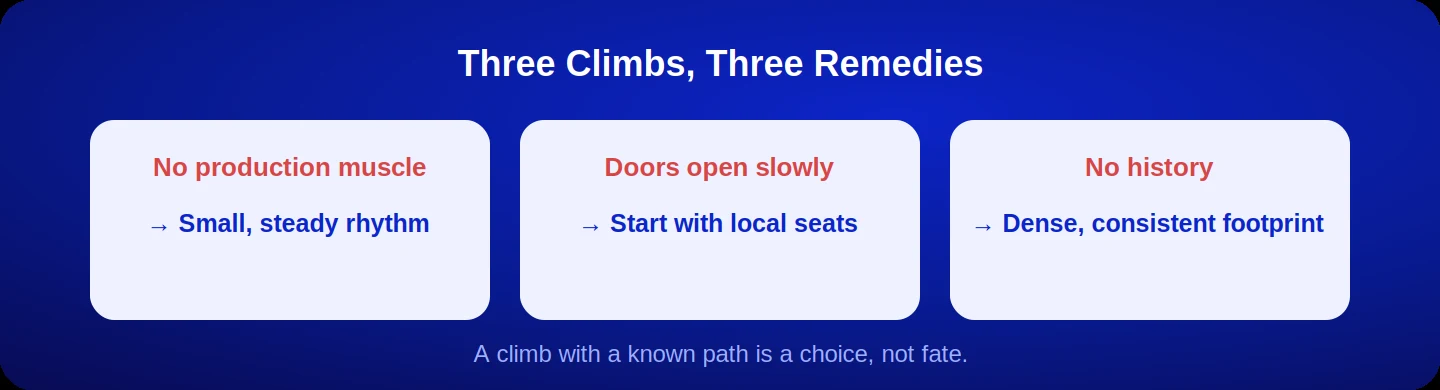
Three climbs, three remedies:
A Small Brand’s Roadmap: Narrow-Front Victory in Four Steps
Let us tie everything into one plan: four steps for a small brand starting from zero or with a thin footprint.

Inside the steps:
Meeting Test and Front X-Ray
BU BÖLÜMÜN ÖZETİ
- To the agency: “What have you done with brands of our size?”
- “Our budget is tight; what does the plan cut first?”
- To yourself: “On which slice could I be ‘the best answer’?”
- “What do we get if we start small?”
Closing rulebook. Four questions:
What good answers sound like:
To the agency: “What have you done with brands of our size?”
A good answer respects your scale: it describes a narrow-front strategy, gives an example built on a small budget and says “this slice first.” A bad answer puts the corporate template in front of you without shrinking it: broad-front targets, a big package, a plan that doesn’t touch your reality. Whoever doesn’t understand your scale cannot choose your front.
“Our budget is tight; what does the plan cut first?”
A good answer knows the priorities: diagnosis and measurement stay, production rhythm shrinks, the front narrows — the backbone is kept, the fat is trimmed. A bad answer cuts measurement: “let’s do the work first, measure later” — an offer of school without a report card; the most dangerous spending of a small budget is unmeasured spending.
To yourself: “On which slice could I be ‘the best answer’?”
A good answer is concrete and narrow: one region, one service, one customer type — and a claim of unrivalled depth on that slice. “We’re good at everything” means no front has been chosen; whoever is everywhere is thick nowhere on the scales. A clear answer to this question is half the strategy.
“What do we get if we start small?”
A front X-ray: your current snapshot across your market’s question layers, an analysis of the winnable slice (demand–gap–right intersection) and a four-step first-quarter plan — built for small scale, fixed fee. Write the work you do best and your region in one sentence and send it for a preliminary assessment; the scope is on our AI SEO service page. Neighbouring doors: the pricing article and the dependency question.
Field Notes
· The classic moment of first diagnoses with small brands: absent on the broad question, unrivalled on the district question. Joy and “we should have asked this sooner” arrive in the same sentence.
· The fastest results on narrow fronts come from businesses whose content is written in the founder’s own voice: the craftsperson who moves their phone answers onto the page beats agency copy every time.
· The assumption “the big players are everywhere anyway” often collapses in the field: big brands’ district and niche pages are frequently empty or copy-pasted — the first authentic voice to fill the slice takes the seat.
Mini Glossary
Narrow front: A question slice narrowed by region, niche or customer type — the small brand’s winning ground.
Demand–gap–right intersection: The three criteria for choosing a front: is it asked, is the competitors’ footprint thin, are you genuinely good?
Local seat: Your place in the local or niche sources the assistant uses for a narrow front’s questions.
Quick Summary
· The assistant weighs footprint, not turnover or fame: a small brand competes not on the broad front but on the narrow one — and can win there.
· Three cards of the small: narrow-front choice, speed of decision, authenticity; three climbs: production muscle, source doors, no history — each with a known path.
· The path has four steps: choose a winnable slice, fill its questions with the deepest answers, furnish local seats, expand to the next slice when the scoreboard shows saturation.
Your Next Step
A five-minute experiment tonight: ask the assistants three questions the way your customer would — including district, budget and need. Bring the resulting picture (who is there, where you are) to a preliminary assessment; we will mark your winnable slice together and put the four steps on a calendar.
Frequently Asked Questions
I run a neighbourhood shop; does this make sense for me, or is it only for companies?
It makes perfect sense for you — because questions are becoming more local: people ask assistants “near me”, “in this neighbourhood”, “open this evening”, and answers are built from local footprint. A neighbourhood business’s front is narrow from birth: a slice of a few dozen questions that, filled correctly, becomes yours quickly. What it takes is not big either: correct and consistent business details, authentic answers to service questions, clean listings on local directories and platforms, real customer reviews. As scale shrinks, the game does not get harder; it becomes winnable.
If I squeeze myself onto a narrow front, am I giving up on growth?
No — you are accepting an order: the narrow front is not the goal but the ramp. A small brand that goes straight to the broad front stays invisible; one that enters through a narrow front first becomes the name mentioned on one slice, and those mentions produce new seats and new customer stories that open the doors of neighbouring slices. The dream of growth stays; its route is simply realistic: slice by slice, on scoreboard signals. The real surrender is the other path: trying to be everywhere and becoming thick nowhere.
My budget covers only one thing: should I produce content or go after external sources?
The ordering question is right; the answer lies in your front’s current state. Ask the assistants your front’s questions: if the answers don’t know you at all, start with content (a seat is useless without something to recognise); if they know you but don’t recommend you, or you are absent from source lists, start with seats. For most small brands the realistic mix is content-heavy, something like eighty to twenty — but the ratio is personalised by diagnosis. The worst use of a single-item budget is touching both halfway: finish one front, then move to the other.
Sık Sorulan Sorular
When business owners first test the assistant, they always ask the broadest question: “Who is the best X in the country?” They see the giants in the answer and close the file. But their customers do not ask that way: they ask “X in my district, for someone with this budget and this need” — and the picture on that question is completely different. An experiment with the wrong question is the mother of the wrong decision; the right experiment is done with the layered set in the measurement article.
In advertising, visibility scales with money: the bigger budget is seen more — small brands have learned that lesson by heart. On the assistant side the gear is different: visibility is built not with spending but with footprint, and footprint thickens as much with brains and patience as with money. Budget inequality does not vanish entirely here, but the four pans of the scale cannot be bought with money — they are produced.
True on broad fronts: on “best” questions the assistant leans on known names whose footprint is thick everywhere. Half true on narrow fronts: on district and niche questions the pool of fame shrinks and often empties — the big brand has produced no content for that slice and holds no seat in local sources. The first to swim in an empty pool owns the pool; a small brand that takes the half-truth for the whole truth never enters the pool it could own.
The myth’s sneakiest trick is building a loop: the small brand says “it won’t mention me” and leaves no footprint; without footprint it isn’t mentioned; not being mentioned, it says “told you so.” The loop is not evidence; it is a self-feeding prophecy — and it is broken with a single move: leaving the first real footprint on a narrow front. The rest of this article is the handbook for that move.
Because the assistant does not read balance sheets; it reads text: your site, your content, the mentions of you, your place in lists. A ten-person firm’s forty in-depth pieces on a niche front are a thicker footprint than a thousand-person firm’s two generic pages on the same front. Turnover makes production easier — staff, budget — but what goes on the scales is produced footprint, not turnover.
Because of its closeness to customers: in a small business the person answering the phone is often the owner — the customer’s real sentences are in their ear. Moving those sentences into content does not pass through layers of corporate approval; a question heard today is answered this week. In a large brand the same path takes months through committees and agency briefs. Agility is the small brand’s natural weight on the second pan of the scale.
There is one story to tell: one or two services, one region, a clear identity — saying the same sentence everywhere is easy. A large brand’s story of a hundred services in ten cities is prone to scatter; the assistant reads a scattered story with low confidence. The small brand’s tidy story is a quiet advantage on the consistency pan — as long as the site, profiles and external mentions all say the same sentence.
Let us be honest: the fourth pan — a place in external sources — is the steepest climb for the small; national press and big lists do not open easily. But as the front narrows, the seats become local: district directories, niche industry publications, local chambers, regional news. Networks like Türkiye’s chambers of commerce — the curious can look at the TOBB umbrella — are still under-used examples of institutional visibility layers a small business can reach.
By choosing: you compete not across the whole market but in the slice you can win — not “X in the city” but “X in this district” or “X for this niche need.” A narrow front has few questions, and writing deep answers to all of them takes months, not years. The full map of fronts is in the guide; the rule here is one sentence: the front is chosen by your chance of winning, not by the competitor’s strength.
The decision chain is short: a question gap noticed today becomes content tomorrow; an objection heard from a customer enters the FAQ before the week is out. Assistant behaviour is changeable too, and the first to adapt is often the small one — the big ship turns with a meeting, the small boat with the rudder.
An authenticity footprint: real customer stories, experiences named with the place, a brand that speaks with its owners’ faces — the “real business” signals assistants increasingly weigh are naturally present in the small; the big try to imitate them through agencies. Your everyday reality is their content strategy — and reality is cheaper to produce than imitation.
This: a slice filled on a narrow front (card 1), quickly (card 2), with authentic footprint (card 3) — a slice the big brand cannot be bothered to enter and moves clumsily in if it does. This hand can make a brand that could never win on the broad front the first name mentioned in its own slice. If a competitor is already there, the recipe does not change, only the order: the gap-closing article is the handbook for that scenario.
The most common climb: no staff to produce content, no time. The remedy is prioritisation: list the narrow front’s questions and set up a small but regular monthly production rhythm — little but steady beats a lot but intermittent. If you bring in outside support, use the item logic of the budget article: diagnosis and plan from outside, the portable part of production inside.
Start local and niche: district directories, local news sites, small but respected industry publications, chamber and association visibility — national doors join the queue once the local seats are filled. There is a multiplier too: on a narrow front one good seat does more than ten seats on a broad front; because few sources exist for that front’s question, your voice echoes in a small crowd.
With density, not time: in place of past years, a dense and consistent footprint is laid down quickly — the founding story, the team’s faces, first customer experiences, the founder’s expertise content. The assistant does not ask “how many years old?”; it weighs “what do I know about it?” Multiplying what can be known is faster than ageing — and a clear identity built with brand consultancy is the backbone of that dense footprint.
When a climb with a known remedy is not climbed: saying “I have no staff” and setting up no rhythm, saying “the press won’t cover us” and not even entering a local directory, saying “we’re new” and not writing the story. The climbs are real; but each has a known path. For those who do not take the path, the disadvantage is not fate but a choice — and the competitor feeds on that choice.
At the intersection of three: what customers really ask (there is demand), where competitors’ footprint is thin (there is a gap) and where you are genuinely good (you have a right to win). The triple intersection is usually narrower than you expect — and that is good news: a narrow slice fills fast. The data for the choice comes from the customer log and layered question tests; a feeling is not enough.
Not deep enough to say “we wrote it”, but deep enough to be the best answer to that question: price range, process, common mistakes, real examples, local detail — depth that covers every sub-question customers ask on the phone. Because a narrow front has few questions, this depth is sustainable; care that is impossible on a broad front is possible on a narrow one — that is the small brand’s luxury.
With an inventory: ask the assistants your front’s questions and look at which sources appear in the answers — those sources are your seat list. Then one by one: directory entries with correct details, story pitches to local publications, chamber and association visibility. Even two seats a month furnish a narrow front within a year.
It comes from measurement: if the narrow front’s share on the mention rulebook has settled — regular, high, correctly framed — move to the adjacent slice: a neighbouring district, a related service, a higher question layer. Expansion is made on a scoreboard signal, not in the rush of victory; whoever expands too early thins out on both fronts. Keep the timing article at hand for expectations.