
I Want to Start a Sock Brand: Manufacturing Is Easy, Standing Out Is Hard
The first thing anyone who wants to start a sock brand should know: in Turkey, getting socks made is easy and standing out is hard. Production clusters in Istanbul’s industrial estates and in Thrace; a contract knitter turns up within a week. The hard part is explaining why your sock should be chosen among the hundred brands coming off the same machine. That answer lives not in the machine but in the pattern, the yarn, the toe seam, the packaging, the story and the channel.
This article gives the founder a decision sequence: why socks, the same-machine problem, where differentiation happens, product group, first product and set, manufacturer and labels, channel order, first-year calendar and when to bring in a consultant. The industry side sits in the industry guide to starting a sock brand; here we stay on the decision side.
I look at this business as a brand consultant, not a manufacturer. A manufacturer tells you about the machine; I ask you about your buyer. The founder who grasps that difference early wins the first year.
Why is a sock brand worth building?
Socks are a gift product where the wearer and the payer are usually different people, and Turkey is a production base for that product. Being a gift product makes the box and the set part of the product; being a production base gives easy access to samples, yarn and machines. Together they open a door for a small founder. An open door lets everyone in; staying inside is another job.
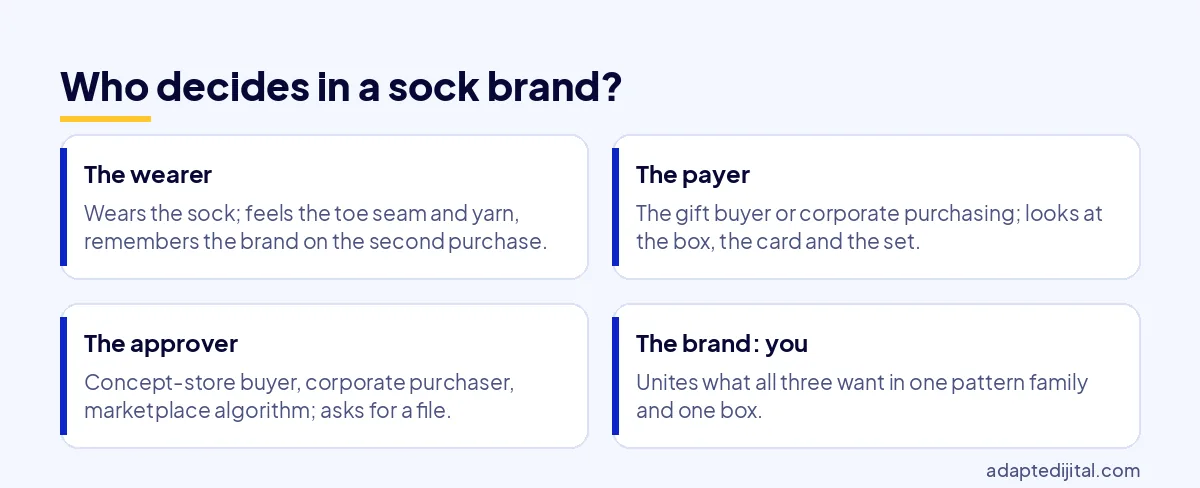
The three-person buyer chain
In design socks the wearer is one person, the payer is the gift buyer, and the approver is the concept-store buyer or the corporate purchaser. Your brand cannot choose a product until it knows which of the three to convince first.
Why people pay for design socks is told through a real case in why people pay for design sock brands.
If a hundred brands come off the same machine, where is the problem?
The problem is that the manufacturer does nothing special for you. The same machine, the same yarn stock and the same toe seam are sold to a hundred other brands. The founder prints a logo and then cannot tell their own sock from a rival’s on the shelf. Contract manufacturing is an advantage; on its own it builds no part of the brand.
Do this before you go
Before meeting a manufacturer, write this sentence: my sock differs from its rivals in these three ways. If it cannot be written, it is too early to visit the factory.
The questions to ask a manufacturer are listed in how to choose a sock manufacturer.
Where does a sock brand differentiate: pattern, yarn, toe, packaging, story, channel
Differentiation happens at six points, and only some depend on the machine. Pattern and design are in the founder’s hands; yarn quality is chosen with the manufacturer; the toe seam depends on the machine; packaging, story and channel belong entirely to the brand. The map below spreads the six points across those three axes and shows the founder where to spend their energy.
The differentiation map
Six points, three axes; the points hardest for a rival to copy sit in the right-hand column.
| Differentiation point | Who decides | Axis | How easily copied |
|---|---|---|---|
| Pattern and design | Founder | Design | Hard, if the pattern files stay with you |
| Yarn quality | Founder and manufacturer | Machine and design | Medium; everyone can reach the same spinner |
| Toe seam | Manufacturer | Machine | Easy; everyone rents the same machine |
| Packaging and set | Founder | Channel | Hard; the box and set logic belong to the brand |
| Story | Founder | Channel | Hardest; nobody else can tell your story |
| Channel | Founder | Channel | Medium; a store relationship is not easily dropped |
Differentiating in the wrong place
Most new brands try to differentiate in the machine row: thicker yarn, denser knit. These make a good product, not a brand. We correct such misconceptions in 6 things people get wrong about sock brands.
Which product group do you start with: design, basic, sports or specialist?
BU BÖLÜMÜN ÖZETİ
- Design socks
- Basic socks
- Sports and specialist
- The single-hero rule
You start with one product group, chosen according to the founder’s existing skills. Design socks demand gift and set logic; basic socks demand volume and price discipline; sports socks demand technical yarn and testing; specialist products such as compression socks demand certificates and experts. A brand that opens all four at once ends its first year half-finished in all four.
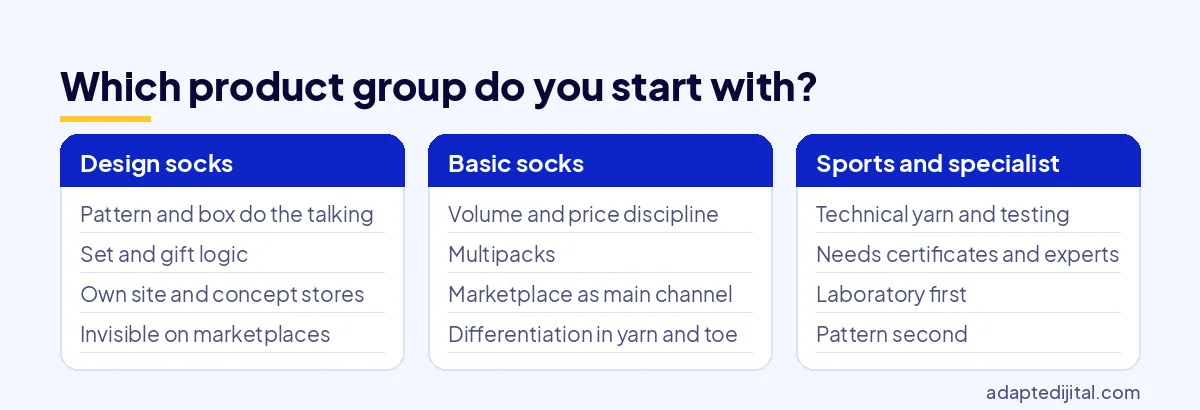
Design socks
Patterned, giftable, boxed. The natural door for a founder with a graphic or design background. Margin is protected through packaging and sets; on a marketplace the pattern disappears.
Basic socks
Plain colours, multipacks, daily wear. Suited to a founder with a textile background who knows volume. Competition is on price, so the marketplace is the main channel and differentiation is limited to yarn and toe seam.
Sports and specialist
Sports socks demand technical yarn plus sweat and friction testing; compression socks make a claim and demand certificates. Meet the laboratory and the expert first, the pattern second.
The single-hero rule
Pick one group and let a single product from it carry the brand’s name. Let the first group’s sales data choose the second, not your enthusiasm.
The cost items and thresholds are opened as a structure, without figures, in the cost of starting a sock brand.
How do you design the first product and the set?
The first product is not a sock; it is a set. A single sock gets compared on price with basic socks on the product page and loses; a three-pack or a gift box moves into another category. The set is designed together with the pattern family, the box and the card. The founder who thinks about packaging alongside the product, or before it, escapes this trap.
Set architecture
Single, three-pack, gift box. All three come from the same pattern family, and the box is designed alongside the pattern. Leave a logo area on the box for the corporate buyer; it brings in the year-end order.
Packaging before the product
The box, the card and the label are part of the sock, not accessories added later. How this decision changes a founder is in from graphic designer to sock brand: a founder’s story.
Manufacturer and labels: when, and what do you ask for?
BU BÖLÜMÜN ÖZETİ
- Three candidates, one sample
- The labelling rule
- What a certificate is and is not
The manufacturer is sought after the buyer and set decisions; you talk to three candidates and decide on one sample. The label is not a negotiation but a rule: fibre content labelling is mandatory on textile products, with care symbols and manufacturer details added. The Ministry of Trade’s market surveillance inspects textiles too and announces unsafe products. An unlabelled sock is not a brand; it is a risk.
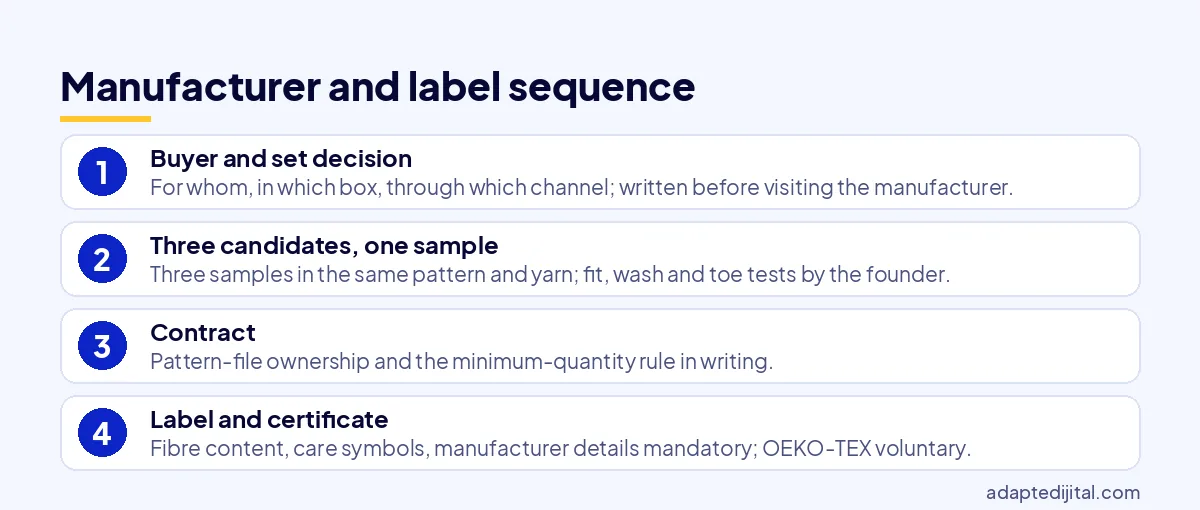
Three candidates, one sample
Ask three manufacturers for a sample in the same pattern and yarn. Run the fit, wash and toe-seam tests yourself. Put pattern-file ownership and the minimum-quantity rule into the contract, or you will see your pattern on another brand a year later.
The labelling rule
Fibre content labelling is governed by regulation in Turkey and by the textile labelling regulation in the European Union. Blend ratio, care symbols and manufacturer details sit on the label.
What a certificate is and is not
OEKO-TEX and GOTS are voluntary certificates obtained through the yarn or the manufacturer; none is issued in the brand’s name. Ask for the document before printing it on your packaging. Details are in textile labelling rules and unsafe-product inspections.
How to read a label and what yarn count means is explained in yarn count, knit density and fibre content explained.
How do you order the channels: own site, stores, marketplace, corporate?
BU BÖLÜMÜN ÖZETİ
- Your own site
- Concept stores and independent boutiques
- Marketplace and corporate
Channels are ordered by product group, and the first year runs on a single main channel. Design socks start with your own site and concept stores; basic socks with the marketplace; corporate gifting with a direct proposal file. The marketplace makes design socks invisible, while concept stores give no volume.
Your own site
The main channel for gift and set sales; the box, the card and personalisation are explained here. The site side is a separate world covered by website consulting; here we only make the decision.
Concept stores and independent boutiques
Consignment, small volume, high visibility. Stores in Karaköy, Cihangir, Moda and Nişantaşı are the first shop window for design socks. The neighbourhood map is in starting a sock brand in Istanbul.
Marketplace and corporate
The marketplace means volume in basic socks and low margin in design socks. Corporate gifting can close a season with a single year-end order. The three channels are compared on six criteria in own site, marketplace or store for a sock brand.
What does the first-year calendar look like?
BU BÖLÜMÜN ÖZETİ
- The production calendar
- The season calendar
- The corporate calendar
- Pre-launch check
The first year is the intersection of three calendars: production, the gift season and the corporate purchasing period. The year-end gift season must be locked down by autumn, and corporate buyers want the proposal file before the season. The founder who lays the three calendars on top of each other picks a launch date from the intersection, not at random.
The production calendar
Pattern, sample, correction, batch. A toe problem in the sample pushes the batch back a month. So count backwards from the launch date, not forwards.
The season calendar
The year-end gift period, Valentine’s Day, Mother’s Day and Father’s Day, back to school and winter socks. Which product group enters which season is tabulated in when should a sock brand launch.
The corporate calendar
Companies discuss year-end gifts in early autumn. If your proposal file, sample box and logo area are not ready that month, the corporate order slips by a year.
Pre-launch check
Product, labels, digital and channel; twelve items in four groups. The list, with a countdown calendar, is in the 12-point checklist before a sock launch.
For a step-by-step build, see how to start a sock brand in 9 steps.
When does a sock brand need a consultant?
BU BÖLÜMÜN ÖZETİ
- The next articles
- Our method
- If you want help
A consultant is needed before you find the manufacturer, not after. A brand consultant sets the buyer, the differentiation points, the set and the channel order independently of the manufacturer. The only decision today: which product group, which buyer, which channel.
The next articles
Which consulting to seek at which stage is explained through four doors in which consulting for a sock brand. Where to read the sector’s numbers is in Turkey’s sock industry in numbers.
Our method
The gift-led positioning and the buyer card are in how Adapte Dijital positions a sock brand. To see how underwear differs from socks, read the guide to starting an underwear brand.
If you want help
To fill the three blanks together, write to us through the consult your expert form. The scope is on the brand consultancy page.
Frequently Asked Questions
Quick Summary
- In Turkey, getting socks made is easy and standing out is hard; a hundred brands come off the same machine.
- Differentiation happens at six points: pattern, yarn, toe, packaging, story, channel.
- Start with one product group: design, basic, sports or specialist; sales data chooses the second.
- The first product is a set and a box; a single design sock is compared on price with basic socks and loses.
- Labelling is a rule: fibre content, care symbols, manufacturer details; certificates are voluntary.
- Today’s only decision: which product group, which buyer, which channel; the manufacturer comes last.
Short Glossary
- Sock brand: a business that differentiates a product off the same machine through pattern, yarn, packaging, story and channel, and sells it under its own name
- Differentiation map: a table spreading the six differentiation points across the machine, design and channel axes
- Set architecture: a sales structure built from one pattern family as single, three-pack and gift box
- Fibre content label: the mandatory textile label showing the blend ratio, care symbols and manufacturer details
Next Step
To fill the three blanks, the first step is the consult your expert form; the scope is on the brand consultancy page. To keep reading, next comes which consulting for a sock brand.
Updated: October 2026
Sık Sorulan Sorular
The person buying socks is often not the person who wears them. At New Year, on birthdays and in corporate gifting, one person pays and another wears. So a sock brand does not sell a single product; it sells a box, a card and a story.
In the industrial estates of Bağcılar, İkitelli, Güngören and Esenler, sock machines run side by side; Çorlu and Çerkezköy carry the large-scale work. Turkey’s export position can be read in TİM (Turkish Exporters Assembly) data; the sector ranks among the world’s leading producers.
Capacity: machine hours, yarn and labour. It knits your pattern and your rival’s pattern. Nothing to be angry about, only something to plan for.
That the brand is built the moment a manufacturer is found. What they have found is a door anyone can find. The brand is built by the choices made after walking through it.
The machine rows are open to your rival; the design and channel rows are yours alone. Put most of your budget and time into the hard rows on the right, not into a machine everyone rents.
A single design sock sits on the same shelf as a supermarket sock; nothing explains the price difference. The set provides that frame: gift, collection, family. We show this stall through a case in why a design sock brand stalls in year one.
No. Finding a contract knitter in Turkey is easy; the hard part is standing out among the hundred brands off the same machine.
The single group closest to the founder’s skills: design socks for a design background, basic socks for textiles and volume, sports socks for technical yarn.
At six points: pattern, yarn, toe seam, packaging, story and channel. The machine-dependent ones are easily copied; the design and channel ones belong to the brand.
Yes. Fibre content labelling is mandatory on textile products, with care symbols and manufacturer details added.
With difficulty. The marketplace gives volume in basic socks but hides the pattern and lowers the margin in design socks.
Sets the buyer, differentiation points, set and channel order independently of the manufacturer; sequences labelling and certification and picks the launch date from three calendars.