
Sock Brands Towards 2027: Six Changes Waiting for Small Brands and One Job to Do Today
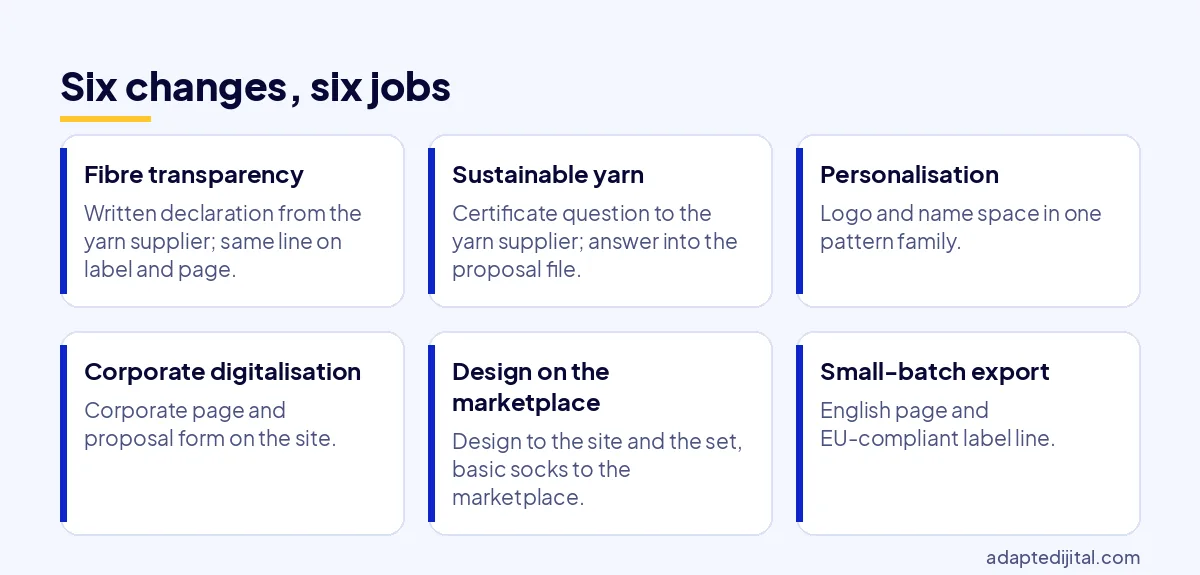
Six changes are waiting for sock brands towards 2027: the fibre declaration becomes an inspected label line, buyers ask for recycled and organic yarn certificates, personalisation becomes the gift standard, corporate gift purchasing moves onto forms and portals, the marketplace leaves design socks invisible in the price list, and European online retail opens to small batches. All six have started; this is preparation, not a forecast.
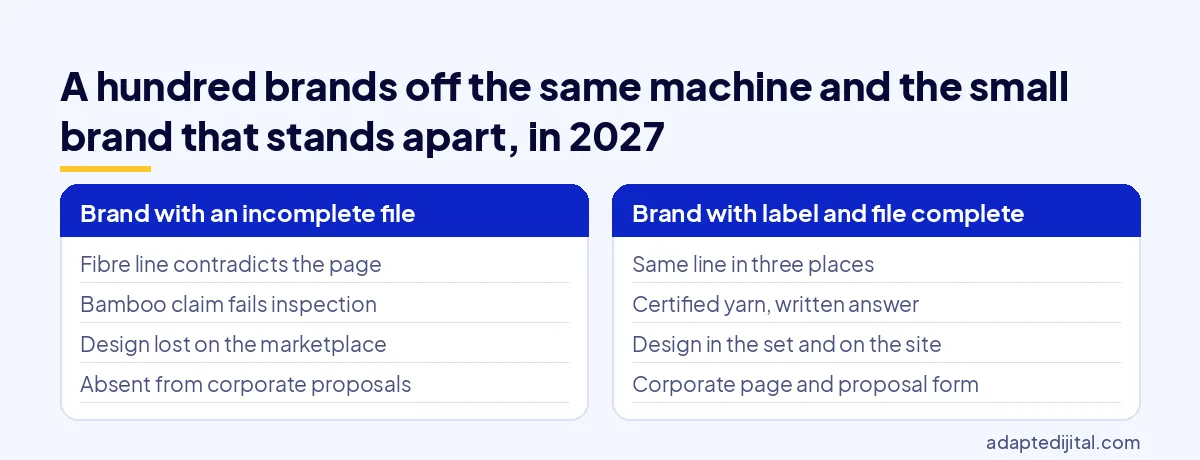
Look, the six share one thing: all favour the small brand that stands apart from the hundred brands off the same machine, and all punish the brand whose label and file are incomplete. Each gets a signal, a consequence and a job for today; all six in one table.
Change 1: fibre transparency becomes an inspected label line
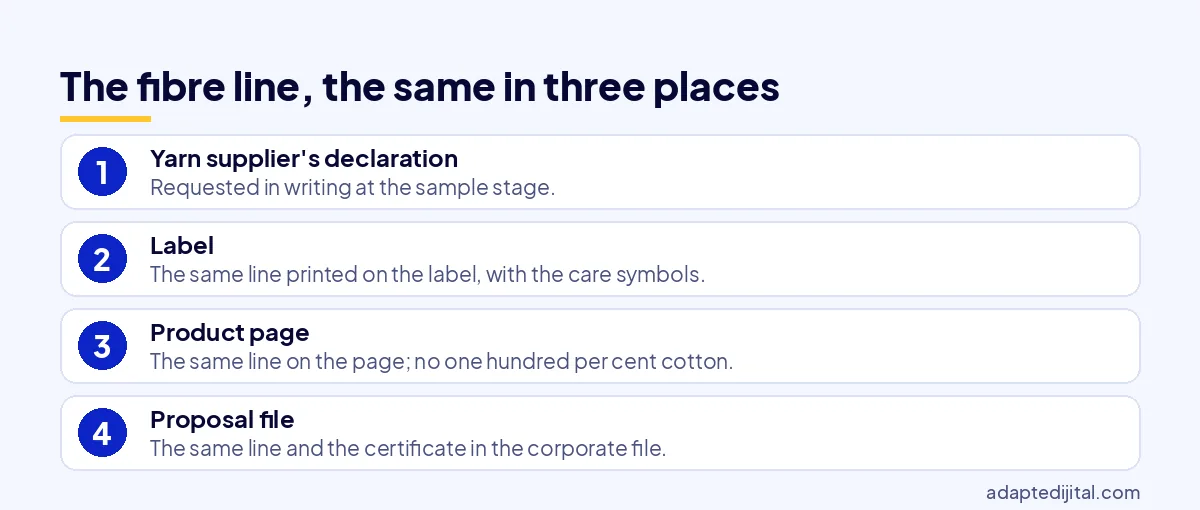
Today’s signal: the Ministry of Trade inspects textiles for missing labels and fibre declarations and announces the results; buyers read the label on their phone and ask about the cotton share. Consequence: in 2027 a product with no fibre line, or one contradicting the yarn supplier’s declaration, is dropped at inspection and in the basket. The one job today: a written declaration from the yarn supplier; the same line on label and page.
The unexpected finding
Say the label is right but the page says one hundred per cent cotton; the buyer reads the page, and the page becomes the return reason. The fibre line must match: declaration, label, page.
Change 2: the sustainable yarn certificate is being asked for
Today’s signal: European retailers and corporate buyers ask for a certificate for recycled or organic yarn; OEKO-TEX and GOTS come through the yarn and the manufacturer. Consequence: in 2027 the certificate question leaves export and becomes a standard line in the corporate proposal file. The one job today: ask the yarn supplier which certificate it carries; write the answer into the file.
Drop the bamboo claim
A bamboo sock is bamboo viscose on the label, not natural bamboo fibre; a sustainability sentence built on bamboo backfires at inspection and with the buyer. The six mistakes are in 6 things people get wrong about sock brands.
The price question
Certified yarn raises unit cost; that share dissolves in a design sock, not in a basic sock. Decide by product group; line items: the cost of starting a sock brand.
Change 3: personalisation becomes the gift standard
Today’s signal: the corporate buyer wants logo-embroidered socks, the individual buyer looks for a named or custom-message set, and the marketplace’s personalised filter is filling up. Consequence: in 2027 a design sock brand with no logo or name space in one pattern family is dropped from corporate proposals. The one job today: that space in one pattern family, and embroidery minimums agreed with the manufacturer.
The question to ask the manufacturer
Personalisation is done on the machine in a jacquard pattern, and after the batch in embroidery; minimum quantity and lead time differ. It is one of the twelve manufacturer questions in how to choose a sock manufacturer.
Building the set
A personalised sock is not sold alone; it sits in the box beside a standard pattern. Set architecture and the three-word rule are in the gift-led method.
Change 4: corporate gift purchasing goes digital
Today’s signal: purchasing departments collect proposals by form rather than email, want the catalogue on a page rather than a PDF, and open sample requests through a portal. Consequence: in 2027 a sock brand with no corporate page and proposal form misses the September–October window. The one job today: a corporate page with set options, box visual and quantity tiers, plus a proposal form.
The link to the calendar
Corporate purchasing decides in September and October; the proposal form must be working before then. The overlap of the three calendars is in when should a sock brand launch.
The unexpected finding
Say the purchaser likes the page; the approver still wants to hold the box. A digital proposal does not remove the sample; it collects the sample’s address.
Change 5: design stays invisible on the marketplace
Today’s signal: marketplace ranking runs on price, sales velocity and review count; a patterned sock sits in the same small tile as a basic sock and is priced against it. Consequence: in 2027 the marketplace grows as a volume channel for basic socks and design socks grow less visible. The one job today: design socks into sets and the own site, basic socks onto the marketplace.
The decision rule
Design socks on the own site and in the concept store; basic socks on the marketplace; corporate through B2B. The three-channel, six-criteria table: own site, marketplace or store for a sock brand.
Change 6: small-batch export becomes possible
Today’s signal: by TİM (Turkish Exporters Assembly) data, Turkey is among the world’s leading sock exporters, and European online retail is opening to consignment and small batches with small design brands. Consequence: in 2027 export is a door for the small brand with an EU-compliant label and an English page, not only the big contract knitter. The one job today: an English page and an EU-compliant label line for one pattern family.
Six changes in one table
| Change | Today’s signal | The one job today |
|---|---|---|
| Fibre transparency | Inspections; buyers reading labels | Written declaration; same line on label and page |
| Sustainable yarn | Certificates asked for | Certificate question; answer in the file |
| Personalisation | Buyers wanting a logo and a name | Space in one pattern family; minimums agreed |
| Corporate digitalisation | Proposals collected by form | Corporate page and proposal form |
| Invisible design on marketplace | Ranking by price and velocity | Design to site and set, basic to marketplace |
| Small-batch export | Europe opening to small brands | English page, EU-compliant label |
The common denominator is the label and the file. Sequence in the pillar article, your stage in the hub article, industry picture in the guide to starting a sock brand, scope on the brand consultancy page.
Frequently Asked Questions
Quick Summary
- Six changes: fibre transparency, sustainable yarn, personalisation, corporate digitalisation, marketplace visibility, small-batch export.
- All have started; all favour the small brand with a complete label and file.
- One job each: declaration, certificate question, logo space, proposal form, channel separation, English page.
- The fibre line matches in three places: declaration, label, page.
- Bamboo socks are bamboo viscose; do not build sustainability on it.
- A digital proposal collects the sample’s address; it does not remove the sample.
Short Glossary
- Fibre declaration: the yarn supplier’s written statement of the yarn’s fibre blend
- Personalisation space: the area left blank in a pattern family for a name or logo
- Small-batch export: a European retailer trying one pattern family in small quantities and repeating if it sells
- Discovery channel: a channel where one entry set is listed for recognition, drawing buyers to the own site
Next Step
To prepare for the six changes, write via the consult your expert form; scope is on the brand consultancy page. Next: from graphic designer to sock brand, a founder’s story.
Updated: October 2026
Sık Sorulan Sorular
The Ministry’s first-half statement is in the Ministry of Trade announcement; grounds for textile findings and the five measures are in textile labelling rules. For a brand selling into Europe the same rule is in the EU textile labelling regulation.
The big brand must re-verify hundreds of models; the small brand gets two pattern families’ declarations in an afternoon. Reading a label in thirty seconds: yarn count, knit density and fibre content explained.
The certificate is not issued to the brand; yarn and manufacturer are certified and the brand shows this through its supply chain. Scope and verification are on the OEKO-TEX site; the brand chooses certified yarn, it does not obtain a document.
Set options, box, logo space, delivery time and quantity tiers; the price goes on the form, not the page. The corporate page falls under website consulting.
One of the four reasons a brand with many likes and few sales stalls is invisibility on the marketplace; the likes-to-sales gap is in why a design sock brand stalls in year one.
For design socks the marketplace is a discovery channel, not a sales channel: one entry set is listed, the rest draws buyers to the site. Rules and commissions are on the Trendyol seller page.
Industry data and the country ranking are on the TİM and İHKİB sites; which table answers which question is in Turkey’s sock industry in numbers. Read the figures there.
A European online retailer tries one pattern family in small quantities and repeats if it sells; it resembles consignment, and Istanbul concept store experience carries across. Export preparation: foreign trade consultancy.
Fibre transparency becoming an inspected label line; declaration, label and page carry the same line.
No; one entry set is listed for discovery, and sales stay on the own site and in the concept store. Basic socks grow there.
By keeping label and file complete: declaration, certified yarn, logo space, corporate page, channel separation, English page.