
How Adapte Dijital Positions a Bag Brand: The Photography-First Method

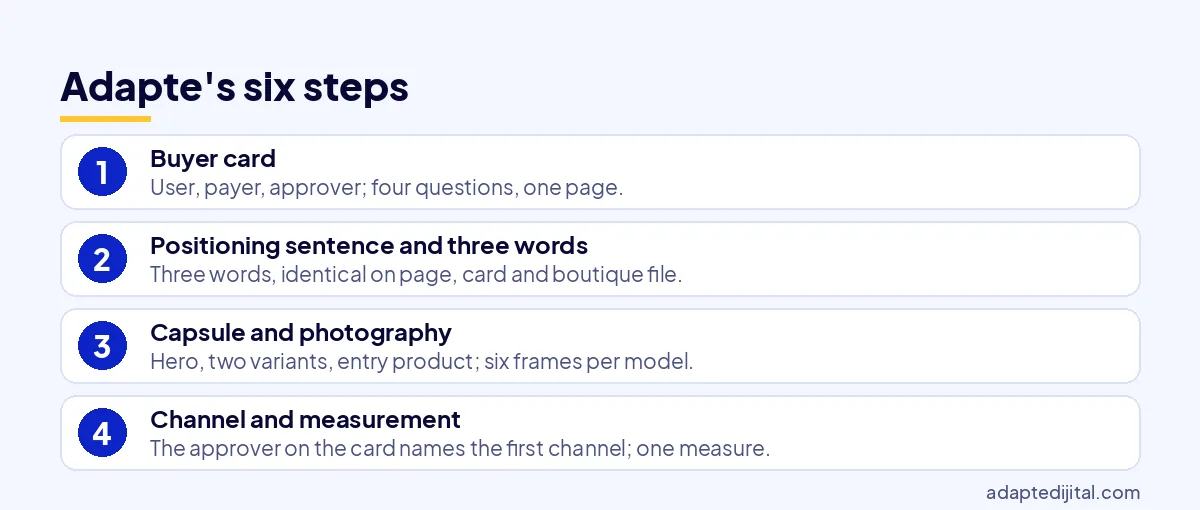
Adapte Dijital positions a bag brand in six photography-first steps: buyer card, positioning sentence, three words, capsule architecture, photography standard, channel order tied to measurement. We do not decide who sews the bag, but to whom, in which frame and in which channel it is sold. The position is how the bag appears on screen.
Six steps, the output of each and what differs in bags. Socks, babywear and underwear took the same method; in bags the photograph is half the product. No sales pitch: this is how we do it.
Why start with the buyer, not the product?
BU BÖLÜMÜN ÖZETİ
- Three people
- The bag difference
- Output
In bags the product difference is large in the hand and small on screen: good leather, clean stitching and a solid clasp are obvious when held, but on screen the same bag fits the same tile as faux leather. So the first work is a buyer card, not a design brief.
Three people
The user carries the bag; the payer is usually the same person, except a gift buyer at year end; the approver is a boutique owner, a marketplace algorithm or a trusted review.
The bag difference
In socks the payer did not wear the product; in bags user and payer are one person deciding on a screen where leather cannot be touched. We position the frame that gives touch.
Output
A one-page card: three people, the moment of purchase, the approver’s question, three words. It fills the first blank in the pillar article on starting a bag brand.
How is the buyer card filled in?
BU BÖLÜMÜN ÖZETİ
- The template
- The filling rule
- The card’s test
Four rows, three columns; each column a person, each row a question: who, at what moment, seeing what do they decide, which sentence do they want to hear. The brand owner fills it in with us in a week; a blank cell returns as a gap later.
The template
| Question | User | Payer | Approver |
|---|---|---|---|
| Who? | Carries it; age, job, style | Same person; gift buyer at year end | Boutique owner, algorithm, review |
| When? | Morning, packing the laptop | Season start, special days | Shelf setup, list ranking |
| What decides? | Silhouette, grain, interior | Scale shot, returns, box | Photo set, margin, documents |
| Which sentence? | Fits everything, nobody else has it | Repaired if it breaks | Sells, photos ready |
The filling rule
One sentence per cell; two sentences means two buyers, and the card splits. A leather shoulder bag and a promotional cotton bag have separate cards.
The card’s test
Read the card to one boutique owner and two buyers; rewrite any cell they do not understand. Its empty cells explain the first-collection case.
How are the positioning sentence and three words chosen?
BU BÖLÜMÜN ÖZETİ
- A failed sentence
- A successful sentence
- The three-word rule
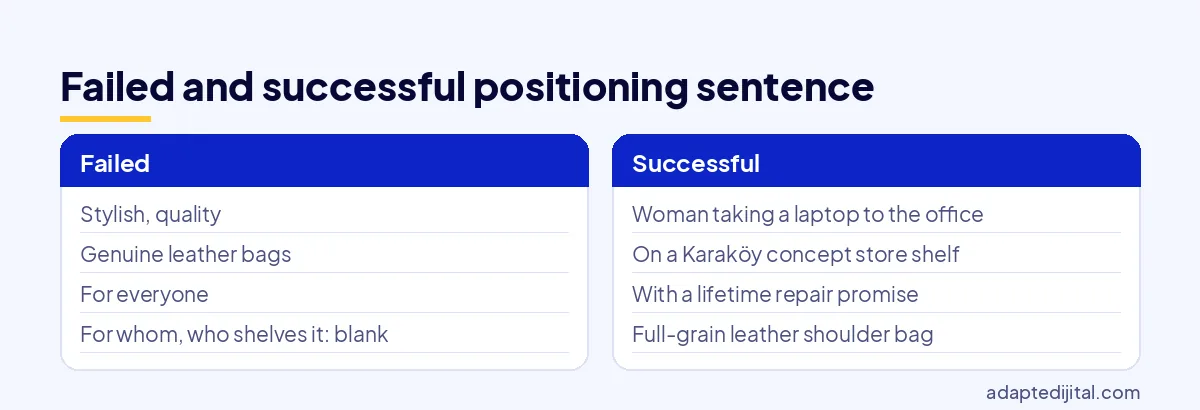
The positioning sentence has a fixed pattern: this brand makes, for [the user], [the product] that [the approver] will happily shelve and [the payer] pays for with peace of mind. Three words drawn from it repeat in the same order on the product page, the box card and the boutique file.
A failed sentence
Stylish, quality, genuine leather bags. For whom, who shelves it, why this price: all blank. The same sentence sits on the faux leather bag’s marketplace page.
A successful sentence
For the woman who takes her laptop to the office and wants a silhouette nobody else has, a full-grain leather shoulder bag the Karaköy concept store will shelve, paid for with a lifetime repair promise.
The three-word rule
The words come from the card: full-grain leather, fits a laptop, lifetime repair. Next to the price they move the comparison from faux leather to craft; see why people pay for small bag brands.
How is the capsule architecture built?
The capsule has four pieces: one hero model, two variants and one entry product. The hero carries photography and story, the variants are size or colour versions of the same silhouette, the entry product introduces the brand through a card holder or wallet. Without a capsule: twelve models, no hero.
Four pieces
The hero is the window product for website and boutique; the variants are options on the same page; the entry product is the marketplace introduction. Four models, two colours.
Dust bag and box
Dust bag, care card and box are the segment’s language and carry the returns promise, so packaging’s share is set aside in unit cost. A founder producing on pre-order: from an architect’s studio to a bag brand.
Photography standard: six frames per model
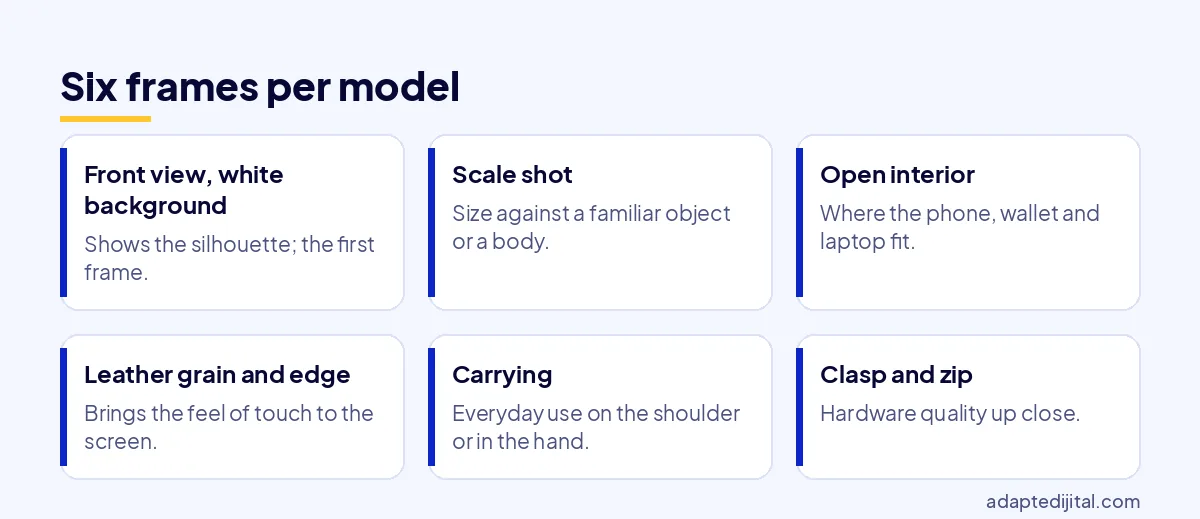
A bag sells on screen through photographs, and the photograph is half the product; so the photo list is a separate step. Six frames per model: front on white, scale shot, open interior, grain and edge paint close-up, on the shoulder or in the hand, clasp and zip close-up.
The six-frame list
The photo list per model:
- Front on white; the silhouette
- Scale shot; size against a familiar object or a body
- Open interior; where phone, wallet and laptop go
- Grain and edge paint close-up; the feel of touch
- On the shoulder or in the hand; everyday use
- Clasp and zip close-up; hardware quality
No sixth frame, no live page; the list comes from the buyer’s questions, not the founder’s.
How are channel order and measurement tied?
BU BÖLÜMÜN ÖZETİ
- The matching table
- The channel side
- The season link
The approver names the first channel: boutique owner means a consignment store and your own website; algorithm means a marketplace and the entry product; corporate buyer means a cotton bag proposal file. Each channel has one measure; the second opens only once it is seen.
The matching table
| Approver on the card | First channel | Second channel | Measure |
|---|---|---|---|
| Boutique owner | Consignment store, own website | European online boutique | Shelf turnover, hero share |
| Marketplace algorithm | Marketplace: card holder, textile tote | Own website | Crossover to website, returns rate |
| Corporate buyer | Cotton bag proposal file | Gift set | Proposal response, repeat orders |
The channel side
Channels are compared in own site, marketplace or boutique; the order comes from the approver, not preference. A leather bag does not enter a marketplace first; that shelf is faux leather.
The season link
Boutique buying periods and the year-end gift calendar tie the order to a week: when should a bag brand launch.
Where does the method’s data come from?
From our consulting form and industry sets. Most bag enquiries ask about workshops and leather prices, not the buyer or the photography; that gap gave rise to the first and fifth steps. Socks, babywear and underwear used the same structure; in bags the photography step and capsule change.
The industry side
Turkey’s leather goods exports are the method’s ground; with workshops easy to find, the position is built on the card and in the frame. Data: İDMİB; route: the industry guide to starting a bag brand.
An honest limit
The method builds the position; it does not draw patterns, choose workshops or buy leather. We build order, frame and language.
Six steps on one page
BU BÖLÜMÜN ÖZETİ
- Six weeks
- What comes next
- To begin
Buyer card, positioning sentence, three words, capsule, photo list, channel and measurement: six outputs, six weeks. The six pages feed the pre-launch checklist and the first-batch decision. The first step is the buyer card; we fill it in together, and the rest follows.
Six weeks
Week one the card, two the sentence and words, three the capsule, four the photo list and shoot, five channel matching, six the measurement table. Each week ends with a signed page.
What comes next
With the six pages ready, the 12-point pre-launch checklist comes into play; stages: which consulting a bag brand needs.
To begin
To fill in the buyer card together, the consult your expert form; scope on the brand consultancy page.
Frequently Asked Questions
Quick Summary
- Six steps: buyer card, positioning sentence, three words, capsule, photo list, channel and measurement.
- The decision is made on a screen; the position is built on the frame that gives touch.
- The three words repeat in the same order on the page, the box card and the boutique file.
- The capsule: hero, two variants, entry product; dust bag and box are part of the product.
- Six frames per model; the approver on the card names the first channel.
Short Glossary
- Buyer card: one page gathering user, payer and approver with purchase moment and expected sentence
- Positioning sentence: the fixed pattern joining user, approver, payer and product; source of the three words
- Capsule architecture: hero, variants and entry product built with channel and price logic
- Scale shot: the photo list’s second frame: real size against a familiar object
Next Step
To fill in the buyer card together, the consult your expert form; scope on the brand consultancy page. Next: genuine, faux and vegan leather explained.
Updated: October 2026
Sık Sorulan Sorular
The order is the buyer’s question order: what is this, how big, what fits inside, how does it sit, is the clasp solid. The same six go into the boutique file.
The founder can shoot them; the standard lives in the list, not the camera. Page: e-commerce consulting; seventh step of the nine-step guide.
Fills in the buyer card, builds the positioning sentence and three words, sets capsule and photo list, ties channel order to measurement; no patterns, workshops or leather.
Six fixed frames per model: front on white, scale shot, open interior, grain close-up, carrying, clasp and zip close-up. No sixth frame, no live page.
One hero, two variants, one entry product; four pieces, two colours. The hero carries photography and story, the entry product introduces the brand.